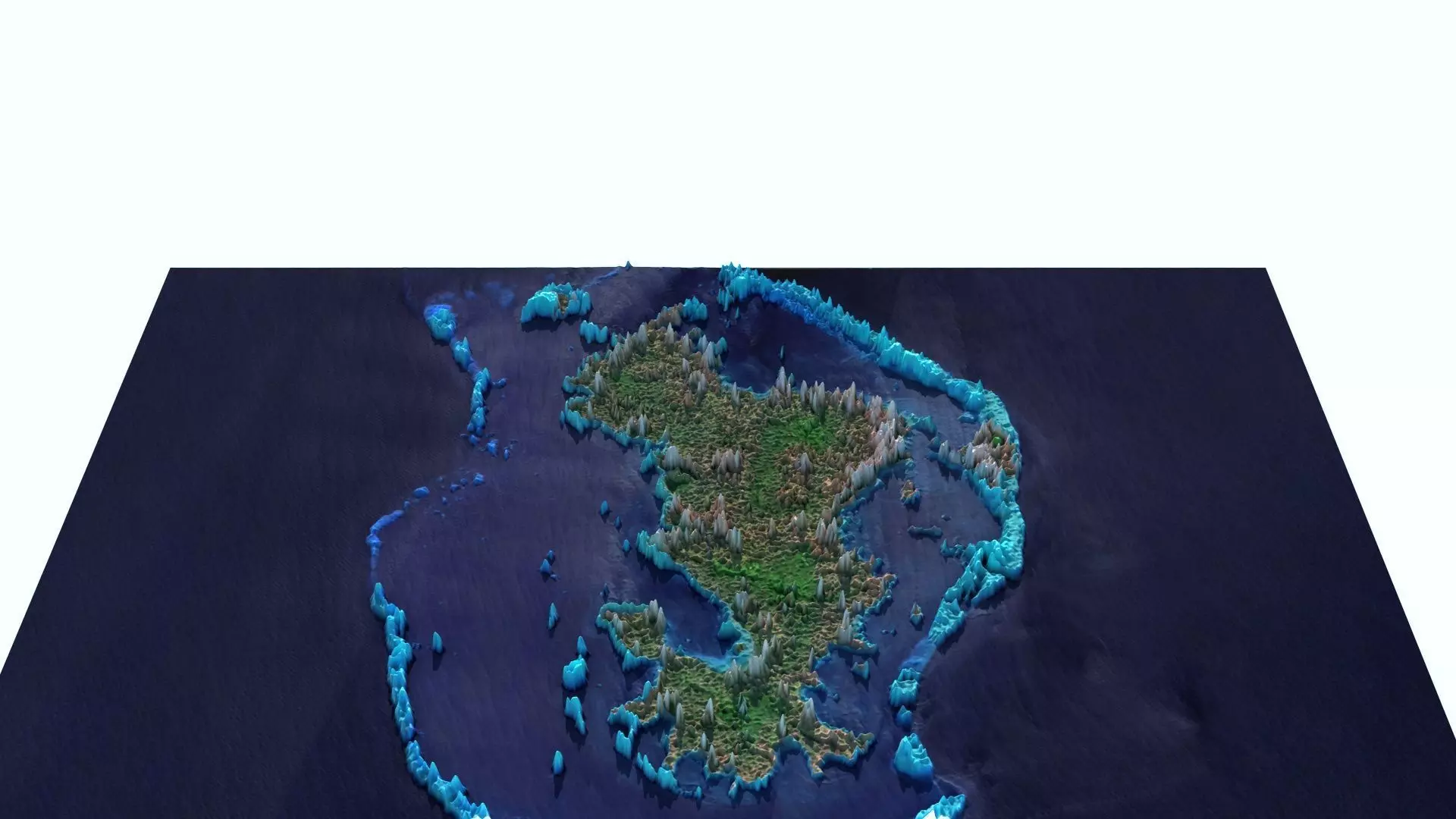
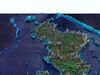
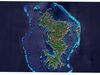
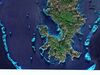
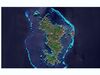
DescriptionMayotte, officially the Department of Mayotte (French: Département de Mayotte) is an overseas department and region and single territorial collectivity of France. It is one of the overseas departments of France as well as one of the 18 regions of France, with the same status as the departments of Metropolitan France. It is an outermost region of the European Union and, as an overseas department of France, part of the eurozone. Mayotte is located in the northern part of the Mozambique Channel in the western Indian Ocean off the coast of Southeastern Africa, between the northwestern part of the island of Madagascar and northeastern Mozambique on the continent. Mayotte consists of a main island, Grande-Terre (or Maore), a smaller island, Petite-Terre (or Pamanzi), as well as several islets around these two. Mayotte's land area is 374 square kilometres (144 sq mi) and, with its 320,901 people according to January 2024 official estimates is very densely populated at 858 inhabitants per km2 (2,228 per sq mi). The biggest city and prefecture is Mamoudzou on the larger Grande-Terre. The Dzaoudzi–Pamandzi International Airport is located on the neighbouring smaller island of Petite-Terre. The territory is also known as Maore, the native name of its main island. French is the official language and is spoken as a second language by an increasing part of the population, with 63% of the population 14 years and older reporting in the 2007 census that they could speak it. There are two native languages of Mayotte. The most commonly spoken is Shimaore, and the lesser spoken is a Malagasy language called Kibushi, of which there are two dialects; Kibushi sakalava, most closely related to the Sakalava dialect of Malagasy, and Kibushi antalaotsi, most closely related to the dialect spoken by the Antalaotra of Madagascar. Both dialects have been influenced by Shimaore. The islands were populated from neighbouring East Africa, with a later arrival of Arabs, who brought the religious faith of Islam. A sultanate was established in 1500. The vast majority of the population today is Muslim. In the 19th century, Mayotte was conquered by Andriantsoly, former king of Iboina on Madagascar. He sold the islands in 1841 to France (Kingdom of France and its later July Monarchy of 1830–1848) and its overseas French Empire, and Mayotte integrated to the Crown of France of King Louis Philippe I (1773–1850, reigned 1830–1848, of the royal dynasty of the House of Bourbon-Orleans), then seven years later with the subsequent Second French Republic (1848–1870) after the French Revolution of 1848. In the immediate aftermath of French sovereignty over the islands, slavery was abolished and laborers were imported to the area to work in fields and plantations. Mayotte chose to remain with France after the nearby Comoros declared its independence following their 1974 independence referendum. Mayotte however became the 101st department of France (Fifth French Republic) on 31 March 2011 and became an outermost associated region of the European Union on 1 January 2014, following a March 2009 referendum with an overwhelming result in favour of remaining in the status of a French department. The issue of illegal immigration became very important in local political life in the 2010s and 2020s which led France to organize Operation Wuambushu. In 2019, with an annual population growth of 3.8%, half the current population was less than 17 years old. In addition, 48% of the population were foreign nationals. Most of the immigrants come from neighboring island state of Comoros, many illegally. Despite being France's poorest department, Mayotte is much richer than other neighboring East African countries and has developed French infrastructure and welfare system, making it a tempting destination for Comorans and other East Africans living in poverty in the region. The department faces enormous challenges. According to an Institut national de la statistique et des études économiques (National Institute of Economic Statistics Studies of France – INSEE) report published in 2018, over 83% of the population live under the poverty line according to French standards, compared to 16% in metropolitan France, 40% of dwellings are corrugated sheet metal shacks, 29% of households have no running water, and 34% of the inhabitants between the age of 15 and 64 do not have a job. These difficult living conditions mainly concern the large population of illegal migrants who crowd into shanty towns.
Texture Resolution: 900 x 540