High-quality 3D assets at affordable prices — trusted by designers, engineers, and creators worldwide. Made with care to be versatile, accessible, and ready for your pipeline.
Included File Formats
This model is provided in 14 widely supported formats, ensuring maximum compatibility:
• - FBX (.fbx) – Standard format for most 3D software and pipelines
• - OBJ + MTL (.obj, .mtl) – Wavefront format, widely used and compatible
• - STL (.stl) – Exported mesh geometry; may be suitable for 3D printing with adjustments
• - STEP (.step, .stp) – CAD format using NURBS surfaces
• - IGES (.iges, .igs) – Common format for CAD/CAM and engineering workflows (NURBS)
• - SAT (.sat) – ACIS solid model format (NURBS)
• - DAE (.dae) – Collada format for 3D applications and animations
• - glTF (.glb) – Modern, lightweight format for web, AR, and real-time engines
• - 3DS (.3ds) – Legacy format with broad software support
• - 3ds Max (.max) – Provided for 3ds Max users
• - Blender (.blend) – Provided for Blender users
• - SketchUp (.skp) – Compatible with all SketchUp versions
• - AutoCAD (.dwg) – Suitable for technical and architectural workflows
• - Rhino (.3dm) – Provided for Rhino users
Model Info
• - All files are checked and tested for integrity and correct content
• - Geometry uses real-world scale; model resolution varies depending on the product (high or low poly)
• • - Scene setup and mesh structure may vary depending on model complexity
• - Rendered using Luxion KeyShot
• - Affordable price with professional detailing
Buy with confidence. Quality and compatibility guaranteed.
If you have any questions about the file formats, feel free to send us a message — we're happy to assist you!
Sincerely,
SURF3D
Trusted source for professional and affordable 3D models.
More Information About 3D Model :
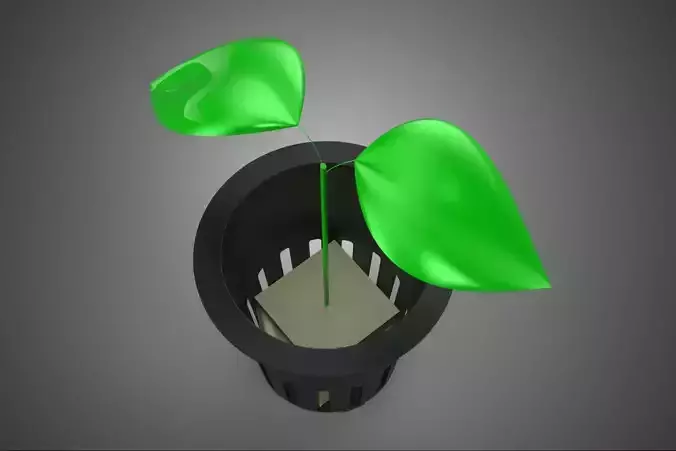
This compilation of materials—ROCKWOOL, FOAM SPONGE, and NET POT CUP MESH—constitutes the foundational components of the substrate and containment infrastructure utilized in controlled environment agriculture (CEA), primarily within hydroponic and aeroponic systems. These integrated elements are designed to replace traditional soil substrates, providing inert physical support, optimal root zone aeration, and regulated moisture delivery for plant propagation and sustained growth.
Growing Media Substrates
The designated media are highly specialized, non-soil materials categorized by their high porosity, chemical inertness, and stable structure, critical features for maintaining a balanced root environment in solution-based cultivation.
Rockwool (Stonewool)
Rockwool, often referred to as stonewool, is an amorphous, fibrous material derived from heating basalt rock or diabase to temperatures exceeding 1,600°C, then spinning the molten liquid into fine fibers, which are subsequently compressed into cubes, blocks, or plugs. This medium is sterile upon manufacturing and exhibits a unique characteristic of holding vast quantities of water (typically up to 80% saturation by volume) while simultaneously retaining a substantial percentage of air space (15–25% total volume), thereby mitigating the risk of root anoxia. Rockwool is predominantly utilized in commercial hydroponics for starting seeds and cuttings due to its consistent structure and ability to maintain a stable environment once saturated. While chemically inert, new Rockwool substrates possess a high pH and typically require an initial conditioning soak in a low-pH solution before use.
Polyurethane (PU) Foam Sponges
Polyurethane (PU) foam sponges represent an alternative synthetic propagation medium. These open-cell polymer matrices are characterized by their uniformity, lightweight nature, and defined pore size. PU sponges are cut into small cubes or plugs specifically designed for seedling establishment. They offer consistent moisture retention and rapid root penetration, often utilized interchangeably with Rockwool, particularly in systems prioritizing ease of handling, cleanliness, and resistance to degradation. The structure of the foam provides excellent resilience against mechanical compression and vibration.
Containment System: Net Pots, Cups, and Mesh
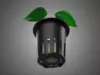
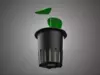
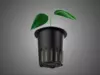
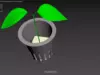
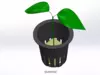
The Net Pot Cup Mesh system serves as the structural container that physically anchors the growing medium (Rockwool or Foam Sponge) and the plant crown, positioning the root zone optimally within the hydroponic reservoir or channel.
Structure and Function
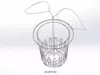
Net pots are typically fabricated from durable, non-reactive plastics, such as High-Density Polyethylene (HDPE) or Polypropylene (PP). Their defining characteristic is the presence of numerous openings, or mesh slits, covering the sides and bottom of the cup. This design facilitates maximum interaction between the root mass and the circulating nutrient solution.
The primary functions of the net pot include:
- Physical Support: Holding the fragile propagation medium (plug) and the young plant upright.
- Root Excursion: Allowing roots to rapidly grow through the mesh openings and into the free volume of the nutrient solution, transitioning from the solid medium to the liquid environment.
- Hydroponic Interface: Acting as the crucial interface between the plant and the system, ensuring the crown remains above the moisture line while the developing roots are fully submerged or exposed to mist/film, depending on the cultivation technique (e.g., Deep Water Culture, Nutrient Film Technique, or Ebb and Flow).
### Integration and Application
The full system assembly involves placing a pre-rooted propagation cube (Rockwool or PU sponge) inside a suitable net pot. This assembly is then inserted into corresponding holes on the lids of reservoirs (as in DWC) or integrated into the delivery channels of NFT or vertical farming units. The combined use of inert media and open-mesh containers ensures sterility, mitigates the risk of soilborne diseases, and provides cultivators precise control over nutrient concentration, temperature, and oxygen saturation within the root environment. This precision is instrumental in maximizing plant growth rate, yield consistency, and resource efficiency.
KEYWORDS: Hydroponics, Rockwool, Stonewool, Growing medium, Soilless culture, Polyurethane foam, PU sponge, Net pot, Mesh cup, Deep water culture, DWC, Nutrient film technique, NFT, Propagation, Seed starting, Aeration, Water retention, Inert substrate, Root anchor, CEA, Controlled environment agriculture, Horticulture, Mineral wool, Open-cell foam, Sterility, Transplant shock, Root zone, Basalt fibers, Wicking action, Plug tray, Polypropylene.