Blog post:
http://toddblatt.blogspot.com/2013/11/first-sense-scan.html
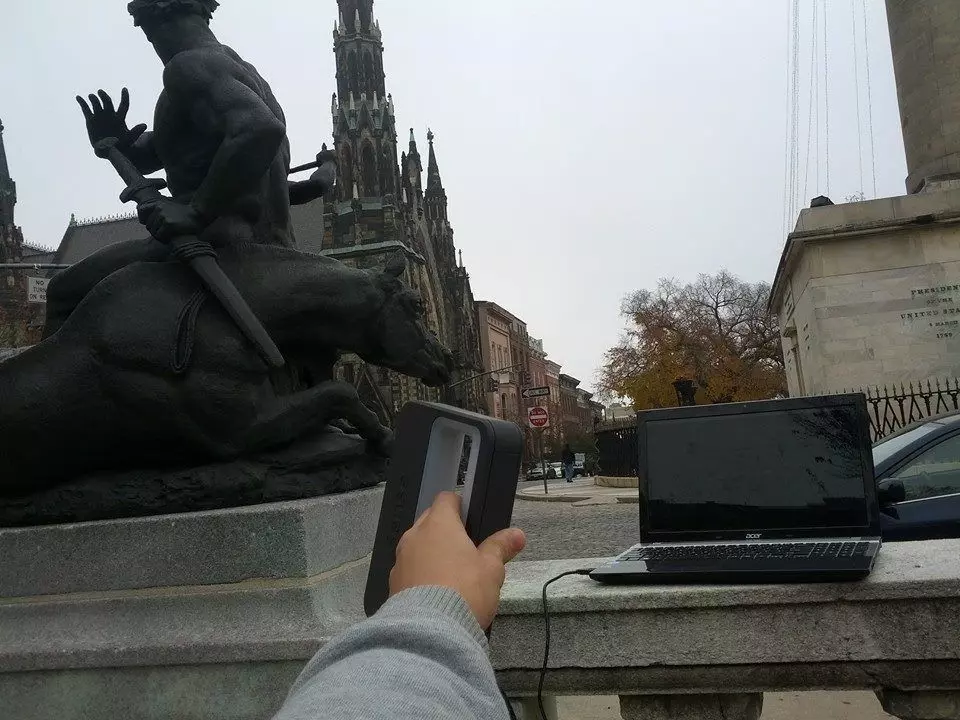
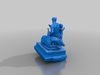
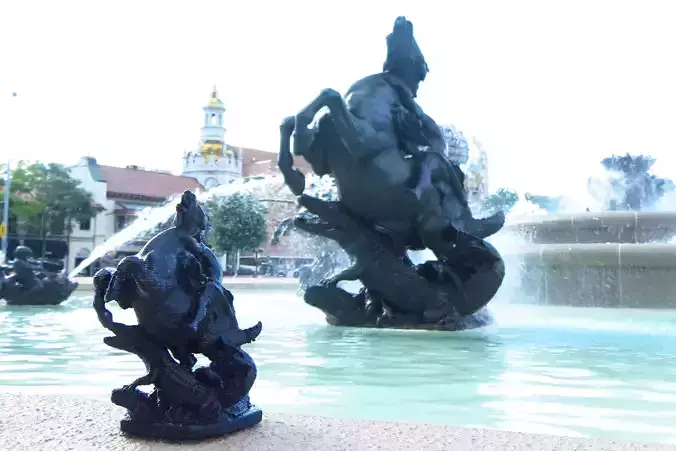
This morning I walked two blocks from my apartment over to the park by the Walter's Art Museum in Baltimore, in the shadow of the Washington Monument. There are many large statues in this area, and for smaller ones, one at each 'corner' of the circle that goes around the monument. Metal letters spelling out the words "War, Peace, Order and Force" are below each. I brought the Sense and my laptop out to scan one of them. Here's the result of my first scan.
In the Sense scanning software, you have options right when you open the software. It asks you if you're scanning a person or an object, and then it asks you how big the object is... small medium or large. I scanned the War sculpture and the next scan using the object and large settings.
I think I made a mistake and didn't have color on when I exported the file, and I loaded a new scan so all I've got are the exported .ply and .stl scans. When I opened the .ply in Meshlab, there was no color data, so I'm assuming I had a setting wrong when I exported. While scanning I know that color was on.
Overall using the scanner feels a lot like the other PrimeSense scanners, but the software is really what sets it apart. It's simple and straightforward, no need to jump between software packages to go from scan data to printable object. When I scan with my Asus Xtion Pro, I needed to originally struggle with the ReconstructMe settings to get it to initialize, save using the command prompt, load the file into Meshmixer and clean up the scan there manually. I like doing it manually with meshmixer, and don't mind the command prompt, but the average consumer wouldn't use a device where all those steps are needed. Doing it with the Sense software was a breeze. Of course, that's why this costs $399 and not ~$150 like the others. The software is certainly the biggest added value to this scanner over the Kinect or Asus.
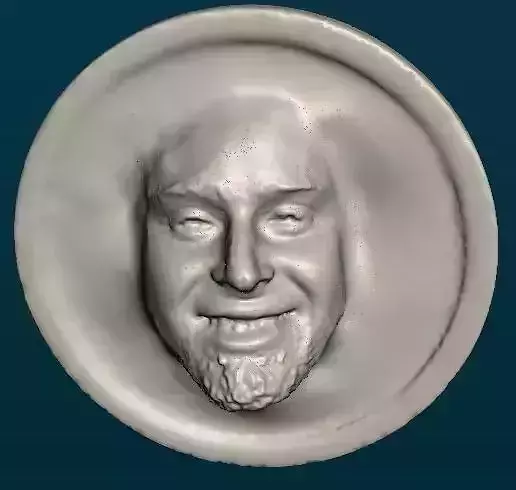
I bumped in to Yair at Dooby's (where I'm currently typing this up) and did a quick 15 second scan. I got it right this time and was able to export the color data. I didn't go back and tell it that I was scanning a smaller thing, nor did I switch the setting to 'person.' Sorry Yair, now 3d systems thinks you're an object and not a person.
I liked the feedback it gave me while I was scanning, though it was frustrating at times. It helps guide you to make sure the scanner is the right distance away from the object. It suggests 15". While I was scanning the War sculpture, It would sometimes switch from "Too Close" to "Too Far" as I passed by parts of the sculpture which protruded more, like the horse's head. I did find that it would keep scanning even if it was telling you that you were too close or two far. Being too close made the scan go very slowly, and being too far would sometimes make you lose tracking. It does a nice overlay to help guide you to line up the scan with the sculpture if you lose tracking, and usually can find itself and resume.
Overall this is a great device and excellent software execution by 3D Systems