High-quality 3D assets at affordable prices — trusted by designers, engineers, and creators worldwide. Made with care to be versatile, accessible, and ready for your pipeline.
Included File Formats
This model is provided in 14 widely supported formats, ensuring maximum compatibility:
• - FBX (.fbx) – Standard format for most 3D software and pipelines
• - OBJ + MTL (.obj, .mtl) – Wavefront format, widely used and compatible
• - STL (.stl) – Exported mesh geometry; may be suitable for 3D printing with adjustments
• - STEP (.step, .stp) – CAD format using NURBS surfaces
• - IGES (.iges, .igs) – Common format for CAD/CAM and engineering workflows (NURBS)
• - SAT (.sat) – ACIS solid model format (NURBS)
• - DAE (.dae) – Collada format for 3D applications and animations
• - glTF (.glb) – Modern, lightweight format for web, AR, and real-time engines
• - 3DS (.3ds) – Legacy format with broad software support
• - 3ds Max (.max) – Provided for 3ds Max users
• - Blender (.blend) – Provided for Blender users
• - SketchUp (.skp) – Compatible with all SketchUp versions
• - AutoCAD (.dwg) – Suitable for technical and architectural workflows
• - Rhino (.3dm) – Provided for Rhino users
Model Info
• - All files are checked and tested for integrity and correct content
• - Geometry uses real-world scale; model resolution varies depending on the product (high or low poly)
• • - Scene setup and mesh structure may vary depending on model complexity
• - Rendered using Luxion KeyShot
• - Affordable price with professional detailing
Buy with confidence. Quality and compatibility guaranteed.
If you have any questions about the file formats, feel free to send us a message — we're happy to assist you!
Sincerely,
SURF3D
Trusted source for professional and affordable 3D models.
More Information About 3D Model :
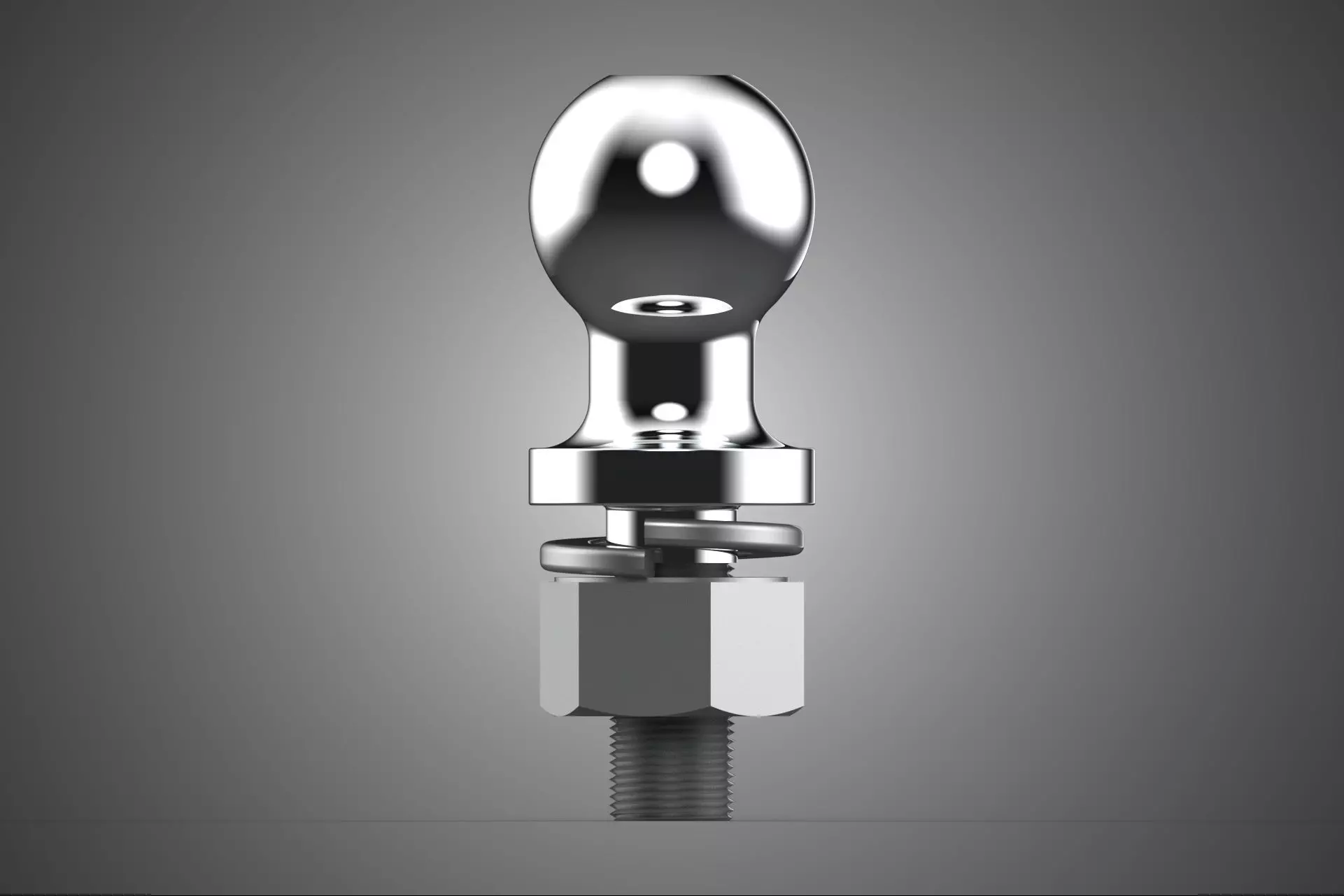
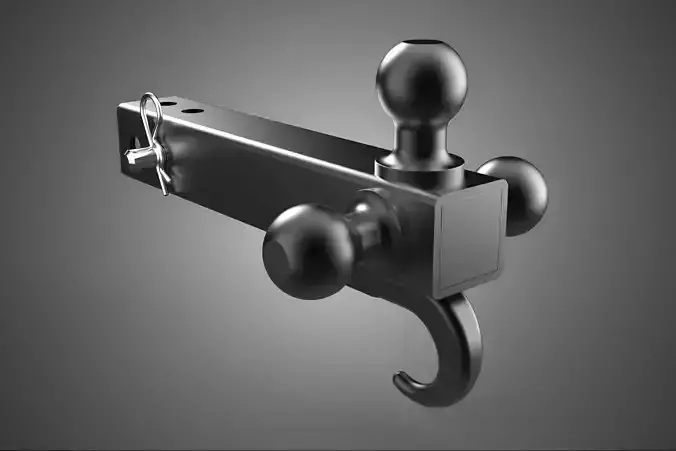
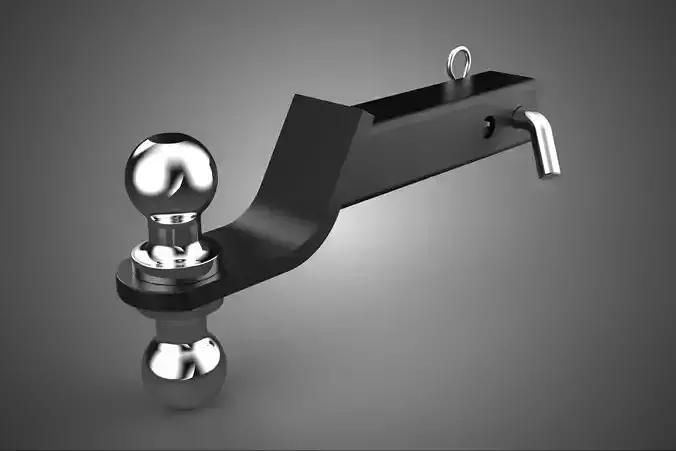
The standard hitch ball joint is a formalized mechanical coupling system universally employed for non-permanent, articulated towing linkages between a prime mover (e.g., truck, tractor, utility vehicle) and a drawn implement (e.g., trailer, cart, caravan). This standardized mounting system is characterized by its simplicity, reliability, and capability to facilitate movement across three axes: pitch, yaw, and limited roll, enabling safe negotiation of uneven terrain and angular maneuvering.
Functional Components and Mechanism
The coupling system is bifurcated into two essential, interlocking components: the Hitch Ball and the Coupler Head (or Socket).
1. The Hitch Ball (Male Component):
The hitch ball is typically manufactured from high-strength forged steel and defined by a polished spherical head connected via a shank to a mounting platform, commonly known as a drawbar, ball mount, or drop hitch. The dimensions of the sphere are standardized to ensure interchangeability and adherence to specific load capacities. Common diameters include 1-7/8 inches (47.6 mm), 2 inches (50.8 mm), and 2-5/16 inches (58.7 mm), with larger diameters corresponding to higher Gross Trailer Weight (GTW) ratings. The ball mount itself is often secured into a vehicle's Receiver Tube, a square-profile female component integrated into the vehicle’s chassis or bumper assembly.
2. The Coupler Head (Female Component):
The coupler is rigidly fixed to the tongue or A-frame structure of the trailer. It features a concave socket designed to precisely encapsulate the lower hemisphere and neck of the hitch ball. The crucial element of the coupler is the integrated latch assembly or locking mechanism. When the socket is seated over the ball, this mechanism is manually actuated, applying downward pressure and circumferential clamping force to secure the ball firmly within the socket. This locking action prevents the trailer from detaching vertically (lift-off) or horizontally while simultaneously allowing free rotation around the ball's center point.
Standardization and Classification
To ensure compatibility and safety across diverse applications, the standard hitch ball joint system adheres to strict industry specifications, most notably SAE J684 in North America, which governs coupling classifications based on load rating.
| Class | Gross Trailer Weight (GTW) | Application Range | Standard Ball Diameter (Typical) |
| :---: | :---: | :---: | :---: |
| I | Up to 2,000 lbs (907 kg) | Light Utility, Bicycle Racks | 1-7/8|
| II | Up to 3,500 lbs (1,588 kg) | Small Boats, Snowmobiles | 2 |
| III | Up to 5,000 lbs (2,268 kg) | Mid-Size Trailers, Caravans | 2|
| IV | Up to 10,000 lbs (4,536 kg) | Heavy Duty, Large Travel Trailers | 2 or 2-5/16|
| V | 10,000 lbs and Above | Extreme Heavy Duty, Commercial | 2-5/16 or Pintle Hook |
Beyond weight ratings, these standards dictate critical geometric parameters, materials specifications, and testing protocols, ensuring the components can withstand dynamic stresses, including accelerating, braking forces, and the calculated Tongue Weight (TW)—the downward vertical force exerted by the trailer tongue on the coupling point.
Applications
The standard hitch ball joint assembly is foundational to light and medium-duty transportation and material handling.
- Automotive: Used extensively for recreational towing, including travel trailers (caravans), boat trailers, and utility trailers.
- Agricultural and Industrial: Employed for linking small implements, portable generators, compressed air carts, and specialized material handling trolleys to utility vehicles or small tractors.
- Recreational: Essential for connecting small cargo carts and recreational vehicle accessories.
### Safety and Operational Considerations
Proper operation mandates that the ball diameter precisely matches the coupler socket diameter. Safety chains or cables, independent of the coupling system, are legally required backups designed to prevent complete separation should the primary coupling fail. Regular maintenance includes lubrication of the ball surface and inspection of the latch assembly for wear, corrosion, and proper locking function, all of which are critical to maintaining towing integrity and safety.
KEYWORDS: TOWING, HITCH BALL, COUPLER, TRAILER, TOW MOUNT, DRAWBAR, RECEIVER TUBE, ARTICULATION, SAE J684, GROSS TRAILER WEIGHT, TONGUE WEIGHT, LATCH ASSEMBLY, MECHANICAL COUPLING, PITCH, YAW, ROLL, FORGED STEEL, HITCH CLASS, CARAVAN, UTILITY TRAILER, AUTOMOTIVE TOWING, TRAILER TONGUE, SHANK, WELD-ON COUPLER, SWIVEL JOINT, BALL MOUNT, SAFETY CHAIN, TRAILER HITCH SYSTEM, TRANSPORTATION.