High-quality 3D assets at affordable prices — trusted by designers, engineers, and creators worldwide. Made with care to be versatile, accessible, and ready for your pipeline.
Included File Formats
This model is provided in 14 widely supported formats, ensuring maximum compatibility:
• - FBX (.fbx) – Standard format for most 3D software and pipelines
• - OBJ + MTL (.obj, .mtl) – Wavefront format, widely used and compatible
• - STL (.stl) – Exported mesh geometry; may be suitable for 3D printing with adjustments
• - STEP (.step, .stp) – CAD format using NURBS surfaces
• - IGES (.iges, .igs) – Common format for CAD/CAM and engineering workflows (NURBS)
• - SAT (.sat) – ACIS solid model format (NURBS)
• - DAE (.dae) – Collada format for 3D applications and animations
• - glTF (.glb) – Modern, lightweight format for web, AR, and real-time engines
• - 3DS (.3ds) – Legacy format with broad software support
• - 3ds Max (.max) – Provided for 3ds Max users
• - Blender (.blend) – Provided for Blender users
• - SketchUp (.skp) – Compatible with all SketchUp versions
• - AutoCAD (.dwg) – Suitable for technical and architectural workflows
• - Rhino (.3dm) – Provided for Rhino users
Model Info
• - All files are checked and tested for integrity and correct content
• - Geometry uses real-world scale; model resolution varies depending on the product (high or low poly)
• • - Scene setup and mesh structure may vary depending on model complexity
• - Rendered using Luxion KeyShot
• - Affordable price with professional detailing
Buy with confidence. Quality and compatibility guaranteed.
If you have any questions about the file formats, feel free to send us a message — we're happy to assist you!
Sincerely,
SURF3D
Trusted source for professional and affordable 3D models.
More Information About 3D Model :
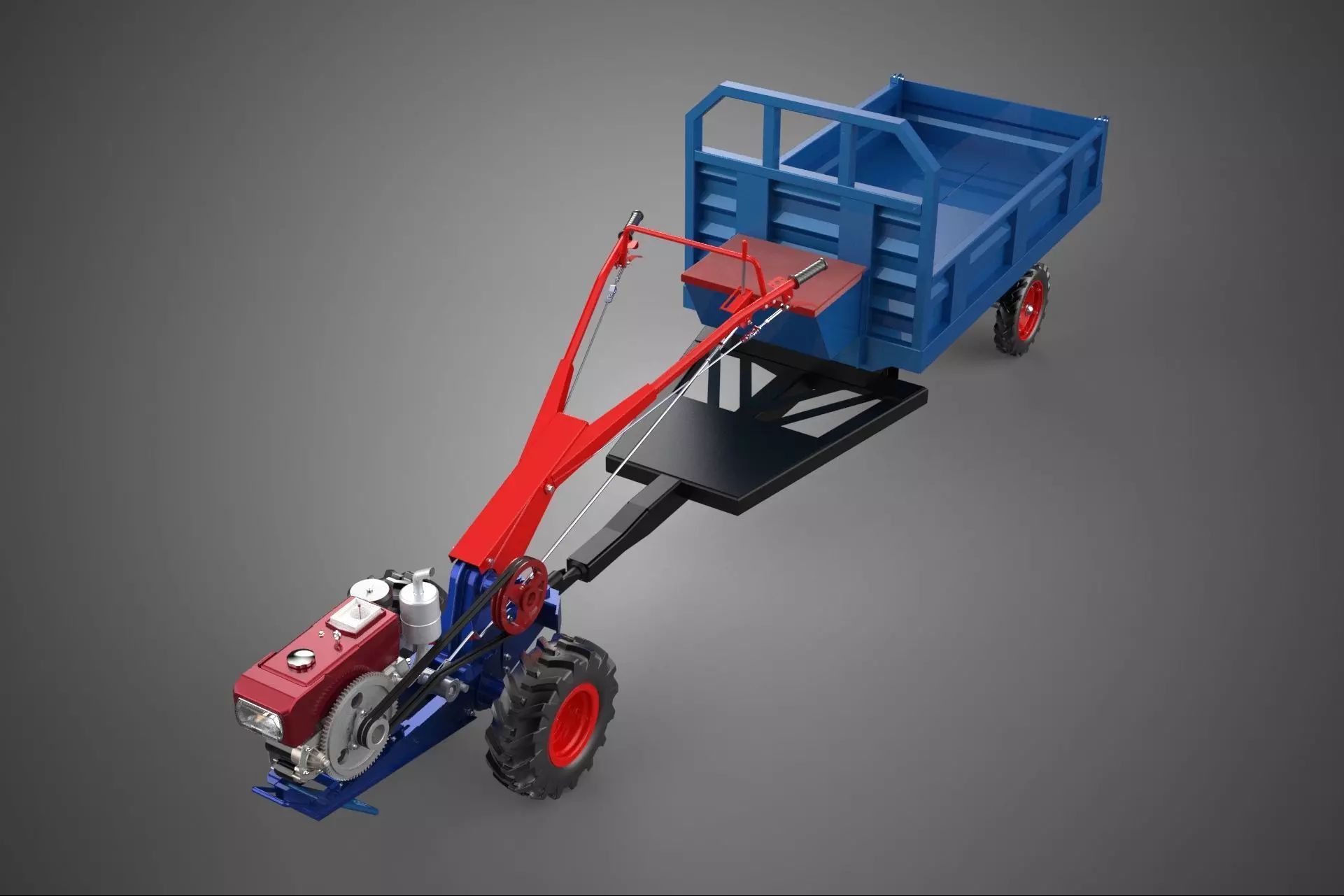
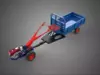
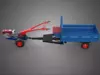
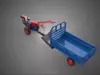
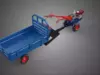
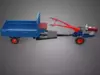
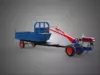
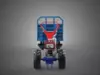
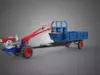
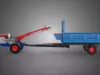
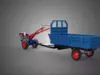
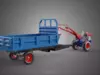
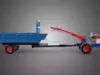
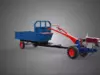
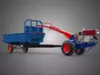
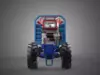
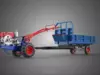
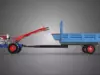
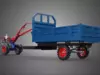
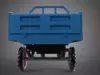
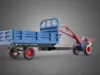
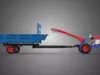
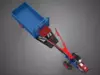
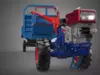
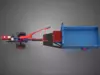
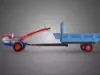
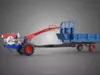
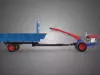
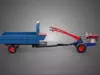
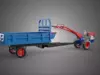
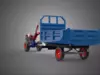
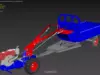
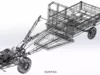
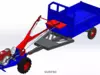
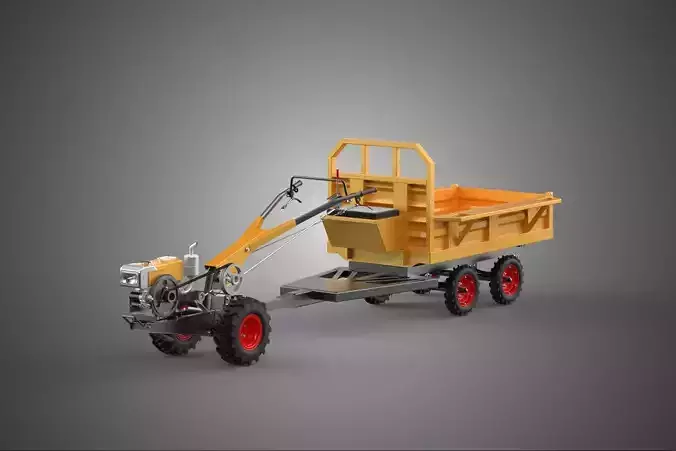
A Two-Wheel Tractor Transport System, often referred to colloquially by its commercial designation—such as the Diesel Walk-Behind Tractor Trailer Cart Cargo Wagon—is a specialized, modular motorized vehicle assemblage designed for localized hauling and material logistics. This system integrates a dedicated, pedestrian-controlled power unit (the two-wheel tractor or power tiller) with a passive, detachable cargo trailer or wagon. Primarily utilized in small-scale agriculture, market gardening, difficult terrain environments, and infrastructure maintenance, this unit serves as an economical and highly maneuverable alternative to conventional four-wheel utility tractors and trucks.
Nomenclature and Core Components
The system is fundamentally bipartite, comprising the prime mover and the towed implement:
1. The Prime Mover (Two-Wheel Tractor/Power Tiller):
This component is the independent traction unit, operated by an accompanying pedestrian who maneuvers the machine via adjustable handlebars.
- Engine Type: The defining feature of this specific model is the use of a compression-ignition (diesel) engine. Diesel engines are favored in this application for their superior low-end torque characteristics, fuel efficiency, and longevity under sustained load, particularly when operating at the low speeds required for hauling heavy trailers. Engines typically range from 5 to 15 horsepower (3.7 to 11 kW), featuring water-cooling or forced air-cooling systems.
- Transmission and Drive: Power is transmitted through a multi-speed gearbox, often featuring several forward gears, one or two reverse gears, and a differential lock for enhanced traction on challenging surfaces. The driving wheels are typically pneumatic tires with deep lugs to maximize grip.
- Hitching Mechanism: The tractor unit includes a robust rear hitch or drawbar coupling, facilitating the secure attachment and detachment of the trailer.
- Control Interface: Operator controls are mounted on the handlebars, including the throttle, clutch lever, gear selector, and often engine decompression levers for starting.
2. The Towed Implement (Trailer/Wagon/Cart):
This component is designed solely for carrying freight and is entirely dependent on the prime mover for propulsion and steering.
- Structure: The trailer typically consists of a steel chassis, a flatbed or cargo box (often featuring removable side gates), and either a single or tandem axle system.
- Connection: The trailer is connected to the tractor via a pivoting universal hitch (articulated joint), which allows the system to articulate during turning and maintain stability over uneven terrain.
- Load Capacity: Depending on the tractor power and trailer construction, load capacities generally range from 500 kg to 2,000 kg.
- Braking System: For safety, particularly when hauling heavy loads or operating on inclines, the trailer is frequently equipped with an independent braking system (mechanical drum or hydraulic disc), controlled by a lever accessible to the operator while walking or utilizing a specialized seat attachment.
### Operational Characteristics and Utility
The Walk-Behind Tractor Transport System excels in environments where scale, infrastructure limitations, or cost prohibit the use of full-sized vehicles.
- Maneuverability: Due to its short wheelbase and pedestrian control, the system offers exceptional maneuverability, allowing it to navigate narrow paths, densely planted fields, crowded market areas, and steep, winding tracks unsuitable for conventional vehicles.
- Flexibility: While functioning as a transport unit, the prime mover remains a versatile two-wheel tractor. The rapid detachment of the trailer allows the tractor to be immediately repurposed for tilling, plowing, pumping, or powering stationary implements via its Power Take-Off (PTO) shaft.
- Economic Advantage: The initial capital investment and operational costs (maintenance, fuel consumption) are substantially lower than those associated with four-wheel agricultural tractors, making it a staple technology in developing economies and subsistence farming operations globally.
### Safety and Regulations
Operation requires careful consideration of load distribution to prevent instability (jackknifing or overturning). Due to the absence of a protected operator cab and its pedestrian-based control mechanism, operation on public thoroughfares is often restricted or prohibited, or requires specialized licensing and safety features (lights, reflectors, designated seating).
KEYWORDS: Two-Wheel Tractor, Power Tiller, Walk-Behind Tractor, Diesel Engine, Cargo Wagon, Material Haulage, Agricultural Logistics, Small-Scale Farming, Low-Speed Transport, Trailer Cart, Utility Vehicle, Compression Ignition, Towed Implement, Farm Machinery, Pedestrian Controlled, Drawbar Hitch, Torque, Fuel Efficiency, Rural Transport, Power Take-Off, Maneuverability, Market Gardening, Agricultural Equipment, Hauling System, Gearbox, Axle System, Pneumatic Tires, Mechanical Braking, Multi-Purpose, Traction Unit.