Catalog Reference
Type: Lattice Boltzmann Method (LBM) — MRT Transformation VisualizationListing ID: MRT-001Editions: Wireframe (structural connectivity) & Solid (volumetric representation)
Model Specifications
Vertices: 22,801Triangles: 45,000Indexing: [Start: 0, Count: 135,000]Geometry Size: 47.845 × 21.600 × 3.866 unitsGlobal Size: Scaled, high-resolution meshormats Included: GLTF
Background & Mathematical Significance
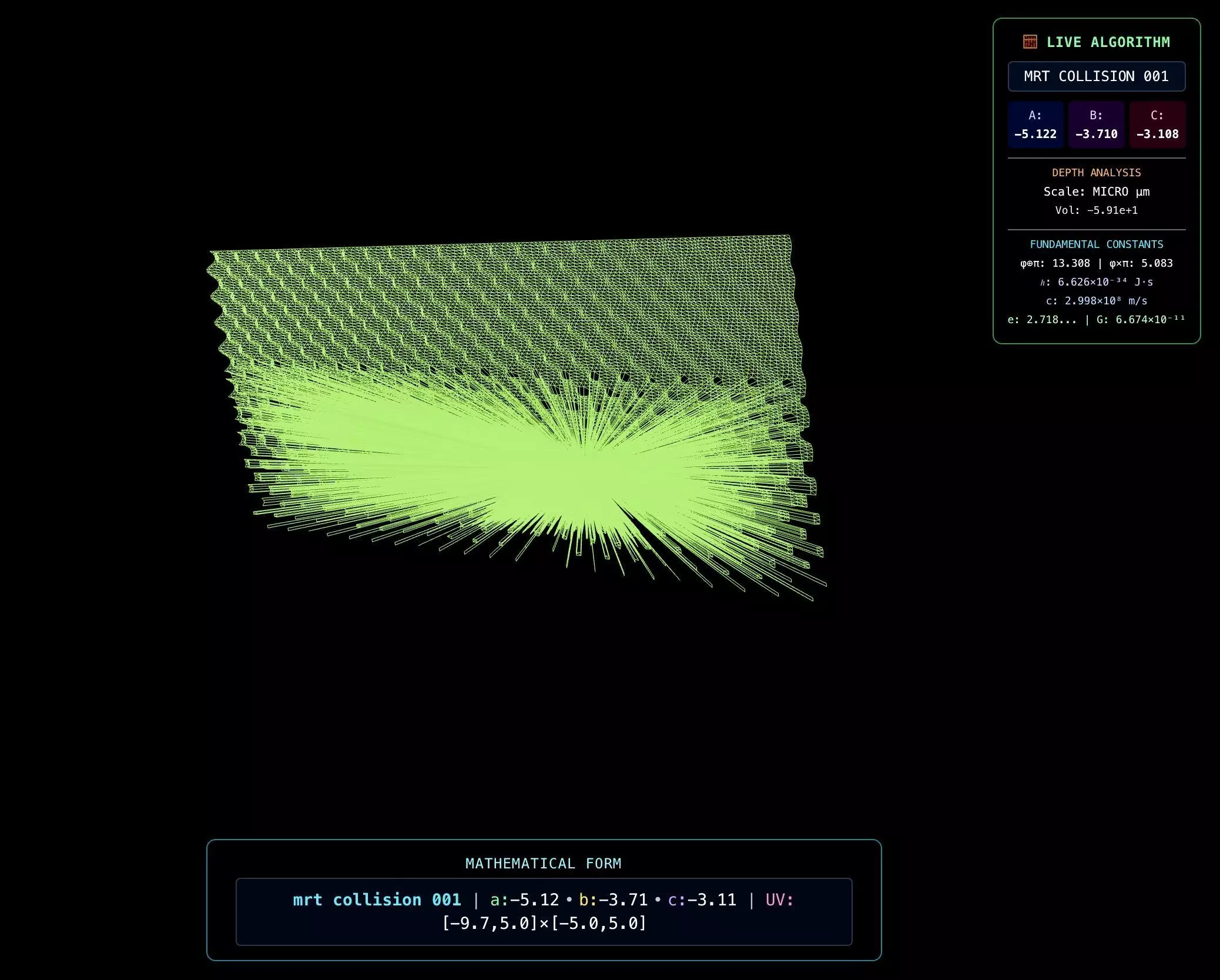
This model visualizes the MRT (Multiple-Relaxation-Time) collision operator in the Lattice Boltzmann Method (LBM), one of the most powerful algorithms for simulating fluid dynamics.
Center Point: Represents the origin in moment space.
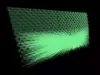
Radiating Lines (Wireframe Edition): Show the sparsity/connectivity structure of the transformation matrix, highlighting which velocity components interact.
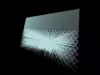
Solid Edition: Embodies the same relationships but as a dense volumetric geometry, emphasizing overall stability and structure.
Coupling: Each ray illustrates how velocity distributions are transformed into moments (density, momentum, stress, etc.), relaxed via different rates, and then mapped back.
This starburst geometry makes visible the hidden algebraic structure that gives MRT its stability advantages over simpler operators.
Why Two Versions?
Wireframe Edition: Ideal for technical study, emphasizes sparsity, connectivity, and structure.
Solid Edition: Suited for visual presentation, highlights the form and density of MRT’s full coupling pattern.
Both editions reflect the same underlying mathematics, presented for different applications.
Included Assets
Wireframe 3D mesh (OBJ, USDZ, glTF)
Solid 3D mesh (OBJ, USDZ, glTF)
Procedural fractal normal maps (MRT-001 variants)
Verification “stamp file” for catalog authentication
Licensing & Ownership
Sold without bundled license.
Commercial, reproduction, or exclusive rights available by license agreement.
Contact: UUON Foundation — phi1@uuonfoundation.com)
Note: Preview renders are demonstration-only. Screenshots cannot reproduce fractal normal mapping; only the original procedural files contain the algorithmic surface data.
Applications
Scientific Visualization: Lattice Boltzmann Method (LBM) research, teaching, and publicationsMathematical Art: Geometric rendering of hidden algebraic structuresSimulation Support: Understanding collision stability in MRT schemes