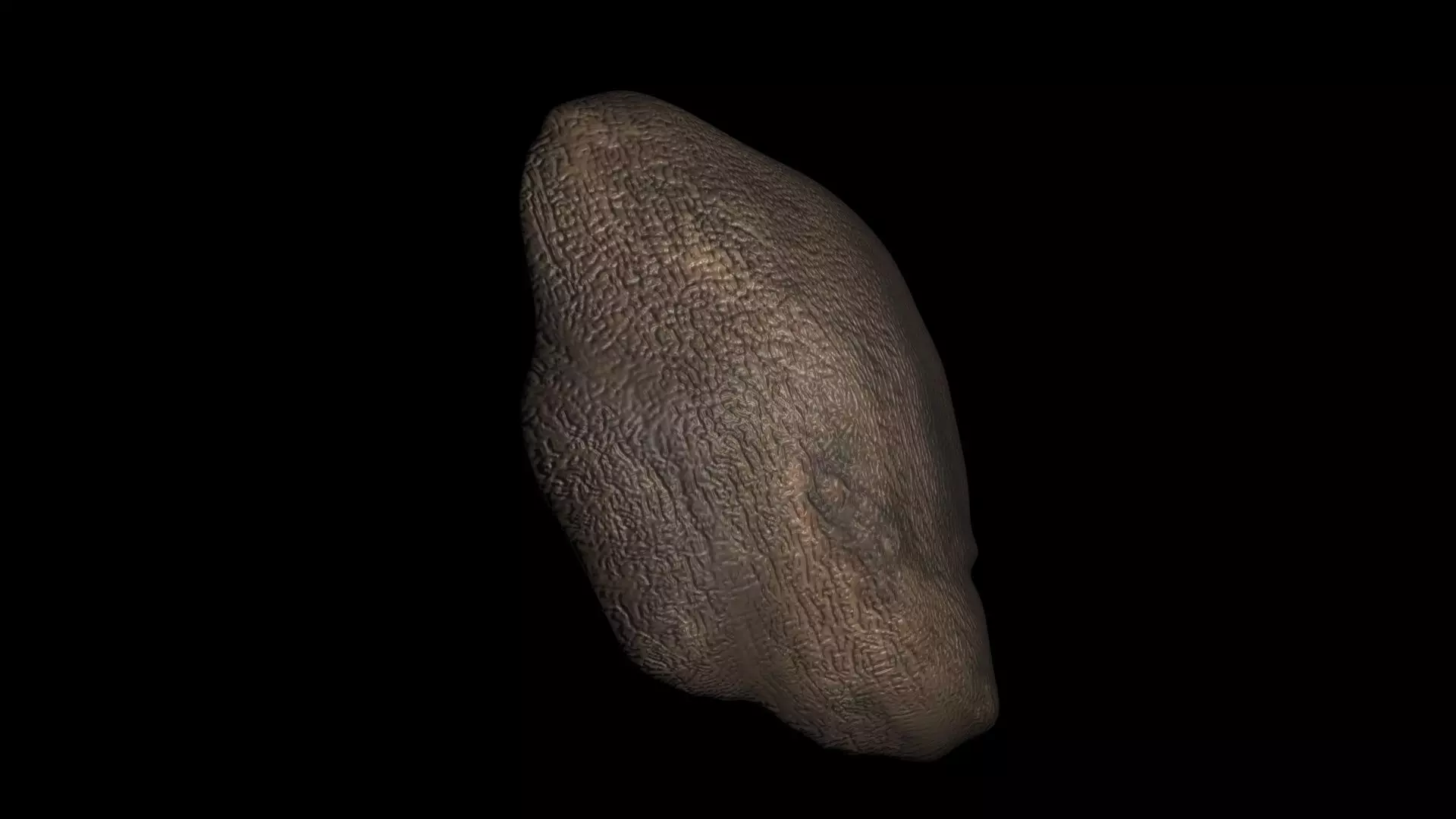
DescriptionWeywot (formal designation (50000) Quaoar I) is a natural satellite or moon of the trans-Neptunian dwarf planet Quaoar. It was discovered by Michael Brown and Terry-Ann Suer using images taken by the Hubble Space Telescope on 14 February 2006. It is named after the Tongva sky god and son of Quaoar. Weywot is about 200 km (120 mi) in diameter and orbits Quaoar every 12.4 days at an average distance of 13,300 km (8,300 mi). Weywot is thought to play a role in maintaining Quaoar's outer ring by gravitationally influencing it in an orbital resonance. Weywot was first imaged by the Hubble Space Telescope on 14 February 2006, during Michael Brown's survey for satellites around large trans-Neptunian objects (TNOs) using Hubble's high-resolution Advanced Camera for Surveys. Consecutive images from that date showed that Weywot appeared stationary relative to Quaoar and was visibly separated at an angular distance of 0.35 arcseconds. 1547 After Brown's Hubble survey concluded in late 2006, he and his colleague Terry-Ann Suer reported their newly discovered TNO satellites to the Central Bureau for Astronomical Telegrams, which published their discovery of Weywot alongside the three TNO satellites Vanth, Tinia, and the nameless moon of 208996 Achlys on 22 February 2007. To determine Weywot's orbit, Brown reobserved Weywot with Hubble in March 2007 and March 2008. Together with his colleague Wesley Fraser, Brown published the first preliminary orbit of Weywot in May 2010. Fraser and Brown were unable to precover Weywot in earlier ultraviolet Hubble images of Quaoar from 2002, either because the satellite was obscured by Quaoar or it was too faint in ultraviolet light. Weywot was not assigned a provisional designation when its discovery was announced. Brown left the choice of a name up to the Tongva, whose creator-god Quaoar had been named after. The Tongva chose the sky god Weywot, son of Quaoar. The name of Weywot was officially announced by the Minor Planet Center in a notice published on 4 October 2009.
Texture Resolution: 1920 x 1080