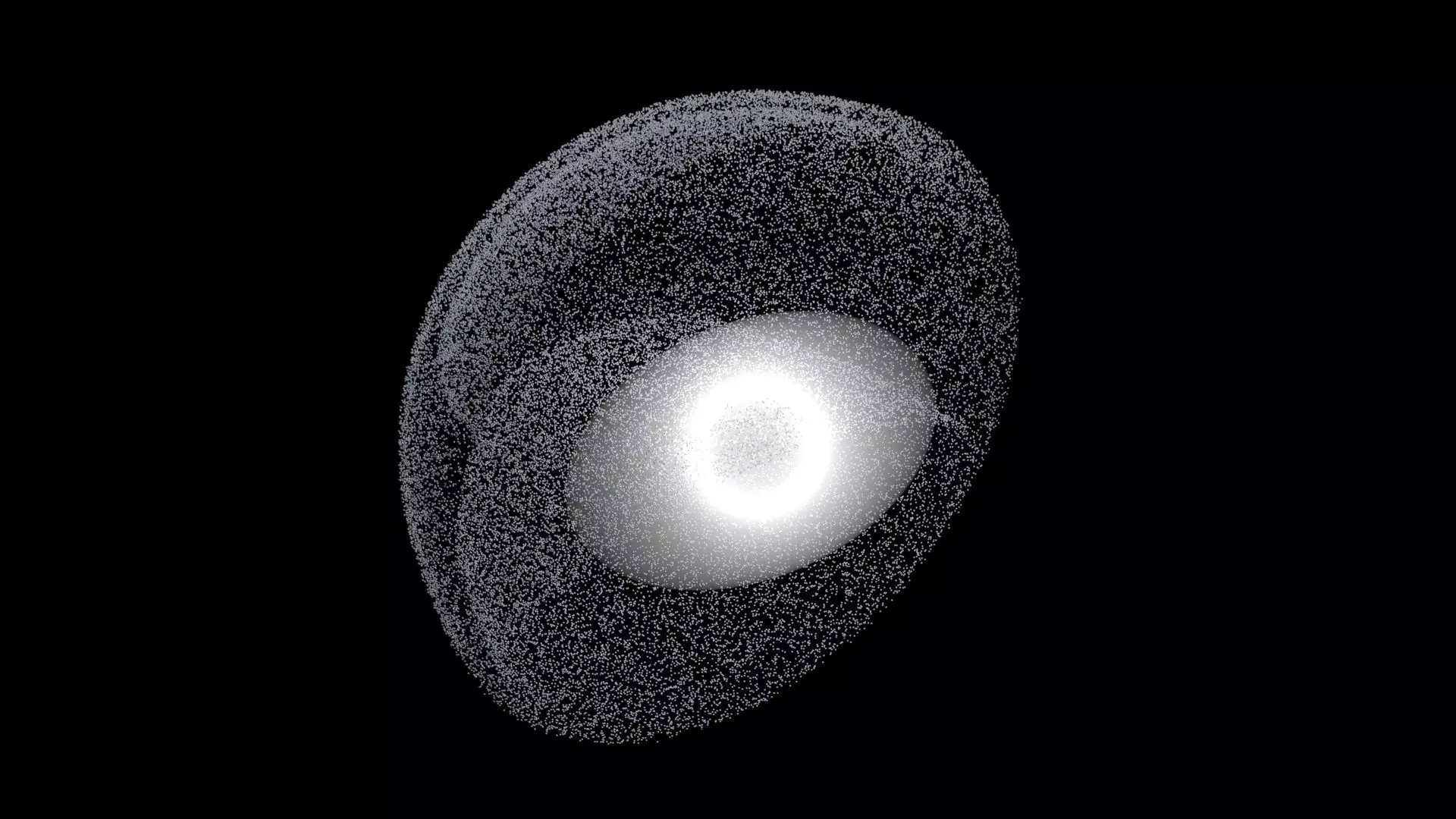
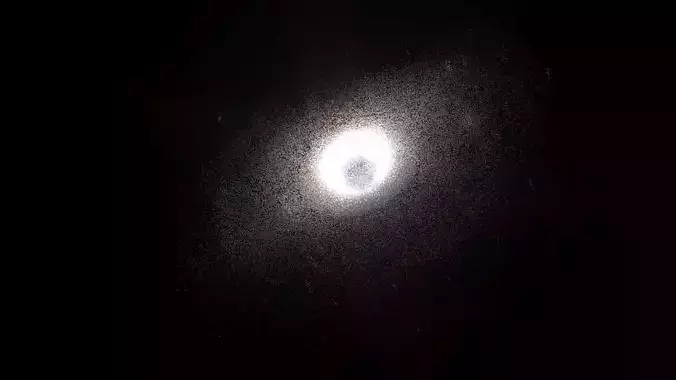
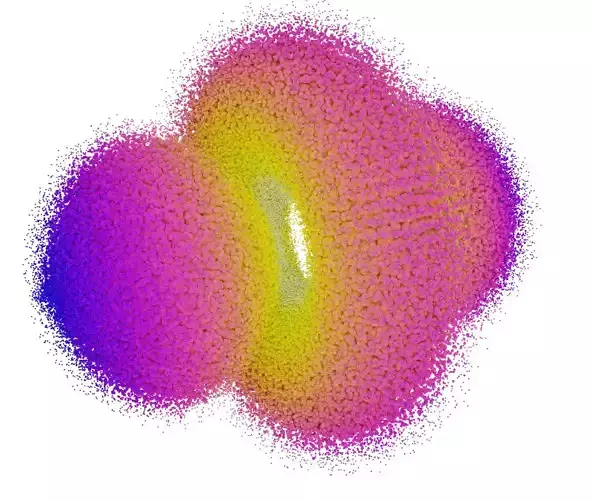
DescriptionThe Oort cloud (sometimes called the Öpik–Oort cloud) is theorized to be a cloud of billions of icy planetesimals surrounding the Sun at distances ranging from 2,000 to 200,000 AU (0.03 to 3.2 light-years). The cloud was proposed in 1950 by the Dutch astronomer Jan Oort, in whose honor the idea was named. Oort proposed that the bodies in this cloud replenish and keep constant the number of long-period comets entering the inner Solar System—where they are eventually consumed and destroyed during close approaches to the Sun. The cloud is thought to encompass two regions: a disc-shaped inner Oort cloud aligned with the solar ecliptic (also called its Hills cloud) and a spherical outer Oort cloud enclosing the entire Solar System. Both regions lie well beyond the heliosphere and are in interstellar space. The innermost portion of the Oort cloud is more than a thousand times farther from the Sun than the Kuiper belt, the scattered disc and the detached objects—three nearer reservoirs of trans-Neptunian objects. The outer limit of the Oort cloud defines the cosmographic boundary of the Solar System. This area is defined by the Sun's Hill sphere, and hence lies at the interface between solar and galactic gravitational dominion. The outer Oort cloud is only loosely bound to the Solar System and its constituents are easily affected by the gravitational pulls of passing stars, the Milky Way itself and the cloud's own microgravity. These forces served to moderate and render more circular the highly eccentric orbits of material ejected from the inner Solar System during its early phases of development. The circular orbits of material in the Oort disc are largely thanks to this galactic gravitational torquing. By the same token, galactic interference in the motion of Oort bodies occasionally dislodges comets from their orbits within the cloud, sending them into the inner Solar System. Based on their orbits, most but not all of the short-period comets appear to have come from the Oort disc. Other short-period comets may have originated from the far larger spherical cloud. Astronomers hypothesize that the material presently in the Oort cloud formed much closer to the Sun, in the protoplanetary disc, and was then scattered far into space through the gravitational influence of the giant planets. No direct observation of the Oort cloud is possible with present imaging technology. Nevertheless, the cloud is thought to be the source that replenishes most long-period and Halley-type comets, which are eventually consumed by their close approaches to the Sun after entering the inner Solar System. The cloud may also serve the same function for many of the centaurs and Jupiter-family comets.
Texture Resolution: 1059 x 748