DESCRIPTION

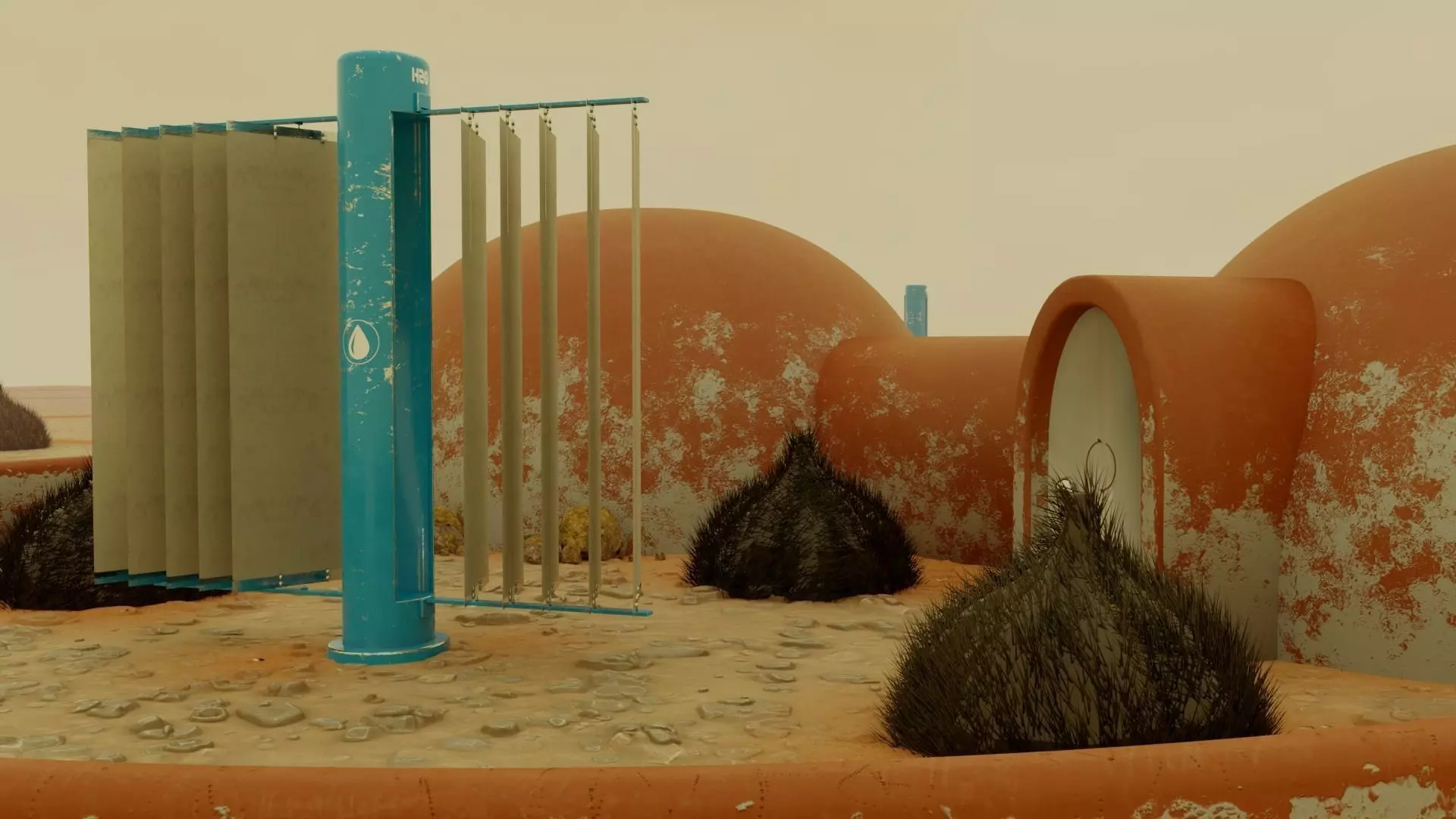
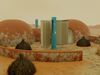
A Mars frontier concept scene I had made for a challenge competition. Most are light on the polycount.Items include:

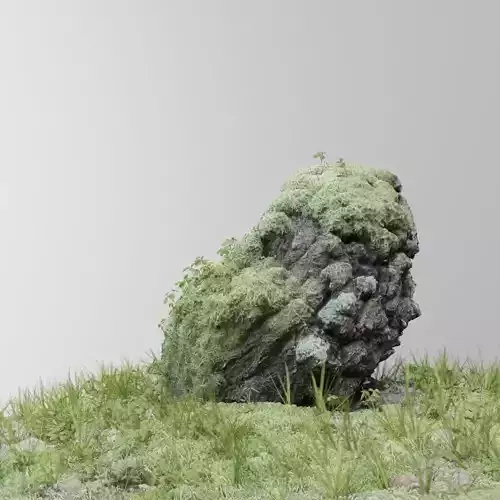
  • Rock with lichen collection (588 poly)
  • Domicile
  • A ‘Furry Cactus’ (35,000 verts with hair, 937 without)
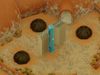
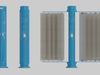
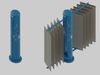
  • A ‘Water Catcher’ (12,416 verts)
  • Textures, most of which 4k-2k Substance PBR in metal-roughness workflow

The 'Water Catcher' is animated to open (for closing, simply reverse). Please note that the animation is available only in the FBX format. Tested in Unreal Engine.

Here is the challenge application:The Water Catcher, the focus of this scene and the official entry for the Mechanical Award, is a mechanical solution to the problem of water scarcity on Mars. It can be placed around urban settlements as well as frontier domiciles. When night comes and the humidity shoots up, the Water Catcher deploys sails whose membrane is extra rough and cooler than the environment. Air hits the sails and the humidity it contains undergoes rapid freezing and accumulates on the sail (sails that catch the humidity itself may also be used, though given Mars’s thin atmosphere, the amounts they’d catch would be so miniscule it’d hardly be worth the effort). Before dawn the catcher retracts the sails and seals them in its hermetically sealed body. An air condenser then increases the pressure inside the water catcher and a heater heats up the micro environment to levels where the humidity caught in the sails can transform into water. The water then trickles down and into a pressurized reservoir, from which they are later collected.The Furry Cactus is a genetically modified plant that combines the water retention capacity of cacti with a durability to cold climates. The main purpose of the Furry Cactus is to siphon humidity directly from the air through its hair-like leafs, which are ideal to the task as they have plenty of surface area and durability in harsh climates. To make efficient use of the weak Martian radiation, Furry Cacti have low albedo — and therefore a high solar absorption rate. When the cactus matures it is harvested for its water and bio matter (which can be fermented into a more than decent Tequila).The Seeder Lichen (the yellow mossy patches on the rocks) is a genetically modified Arctic Lichen designed to serve several purposes — first, to produce methane, one of the most efficient greenhouse gasses, which will increase Mars’s atmosphere’s energy buffer and help dense it up, making it more warm and hospitable to higher life forms, and turn back its continuing degradation, and second, to enrich the soil. Similarly to the role cyanobacteria played on Earth billions of years ago, the Seeder will set the stage for more advanced forms of life.The domes in the background serve as an airlock to an underground house and as a pantry that takes advantage of Mars’s low temperature to keep consumables cold. As their base color suggests, it is constructed using local material.Credits:Game Textures from Substance Share for the Martian soil texture

REVIEWS & COMMENTS

See what other buyers think about this model - real feedback on quality,
accuracy, and usability.
There are no reviews or comments yet. Please be the first one to write it.
BEST PRICE GUARANTEED
Found this model cheaper on another marketplace? Let our support team know - we’ll match it.

Mars Frontier Scene Low-poly 3D model

Royalty Free License
Hire
Like this model to show appreciation to the designer.
See how many times this model was viewed.
Share this model to support the designer and boost their visibility.
File formats
OBJ
OBJ | 18 files<br />File Size: 5.78 MB
BLEND
Blender<br />Version: 2.79<br />File Size: 94.7 MB
TEXTURES
Textures<br />File Size: 232 MB
3DS
3D Studio | 9 files<br />File Size: 1.78 MB
DAE
Collada | 9 files<br />File Size: 7.89 MB
FBX
Autodesk FBX | 10 files<br />File Size: 7.95 MB
Verified by CGTrader
Verified models are of higher quality as they have
passed CGT Standard technical and visual checks,
making them more professional-grade 3D assets.
Learn more.
FBX
This FBX file has successfully passed the CGT Standard technical and visual checks. The verification results are detailed in the section below.
File & scene
Binary FBX
Binary FBX file is more compact and faster to load and process.
Learn more
No unsupported objects
Unsupported objects:
- Lights
- Cameras
Learn more
Geometry
No N-gons
N-gons are polygons with five or more sides which might cause issues in certain processes like rendering or animation. Learn more
No faceted geometry
Faceted geometry uses flat surfaces without smoothing, which can look unrealistic on curves.
Learn more
Manifold geometry
Manifold geometry ensures all surfaces are properly connected, avoiding issues like edges shared by more than two faces.
Learn more
Textures & material
PBR textures
PBR textures simulate how light interacts with materials, making the model look realistic under different lighting.
Required PBR textures:
- Base Color
- Roughness
- Metalness
- Normal
Learn more
No embed textures
Embedded textures are stored inside the model file, increasing its size and sometimes causing compatibility issues.
Learn more
Square textures
Texture aspect ratio is the width-to-height ratio of a texture. Expected texture aspect ratio: 1:1
Learn more
Power of 2 texture sizes
Textures with dimensions in power of two (e.g. 512x512px, 1024x1024px) are used to optimize performance and memory usage.
Learn more
Assigned materials
Materials are applied to the 3D model to allow visualize a model's surface properties and appearance.
Learn more
UVs & naming
No UV overlaps
UVs overlap when multiple points on the 3D model's surface are mapped to the same point on the UV island causing texture stretching.
Learn more
UV unwrapped model
A UV unwrapped model means its 3D surface is flattened into 2D space, allowing textures to be applied accurately.
Learn more
Allowed characters
Allowed ASCII characters: a-zA-Z0-9-_
Learn more
Provided by designer
Information and details shared directly by the model's designer.
3D Features
The model includes animations (movement or actions) that can be played in supported software or engines.
The model has a skeleton or bone structure, making it ready for posing or animation.
PBR
Uses Physically Based Rendering materials, which give the model realistic lighting and surface properties.
Textures
The model includes image files (textures) that add color, patterns, or detail to its surfaces.
Materials
The model has material settings that define how surfaces look (color, shine, transparency, etc.).
UV Mapping
The model's surfaces are mapped to a 2D image, allowing textures to display correctly.
Plugins Used
Some external plugins were used to create the model. These may be required for full functionality.
3D printing
Indicates whether the designer marked this model as suitable for 3D printing.
Model is not 3D printable
The designer indicates this model is intended for digital use only (rendering, animation, or AR/VR) and not for 3D printing.
Unwrapped UVs
Publish date
Model ID
Chat