High-quality 3D assets at affordable prices — trusted by designers, engineers, and creators worldwide. Made with care to be versatile, accessible, and ready for your pipeline.
Included File Formats
This model is provided in 14 widely supported formats, ensuring maximum compatibility:
• - FBX (.fbx) – Standard format for most 3D software and pipelines
• - OBJ + MTL (.obj, .mtl) – Wavefront format, widely used and compatible
• - STL (.stl) – Exported mesh geometry; may be suitable for 3D printing with adjustments
• - STEP (.step, .stp) – CAD format using NURBS surfaces
• - IGES (.iges, .igs) – Common format for CAD/CAM and engineering workflows (NURBS)
• - SAT (.sat) – ACIS solid model format (NURBS)
• - DAE (.dae) – Collada format for 3D applications and animations
• - glTF (.glb) – Modern, lightweight format for web, AR, and real-time engines
• - 3DS (.3ds) – Legacy format with broad software support
• - 3ds Max (.max) – Provided for 3ds Max users
• - Blender (.blend) – Provided for Blender users
• - SketchUp (.skp) – Compatible with all SketchUp versions
• - AutoCAD (.dwg) – Suitable for technical and architectural workflows
• - Rhino (.3dm) – Provided for Rhino users
Model Info
• - All files are checked and tested for integrity and correct content
• - Geometry uses real-world scale; model resolution varies depending on the product (high or low poly)
• • - Scene setup and mesh structure may vary depending on model complexity
• - Rendered using Luxion KeyShot
• - Affordable price with professional detailing
Buy with confidence. Quality and compatibility guaranteed.
If you have any questions about the file formats, feel free to send us a message — we're happy to assist you!
Sincerely,
SURF3D
Trusted source for professional and affordable 3D models.
More Information About 3D Model :
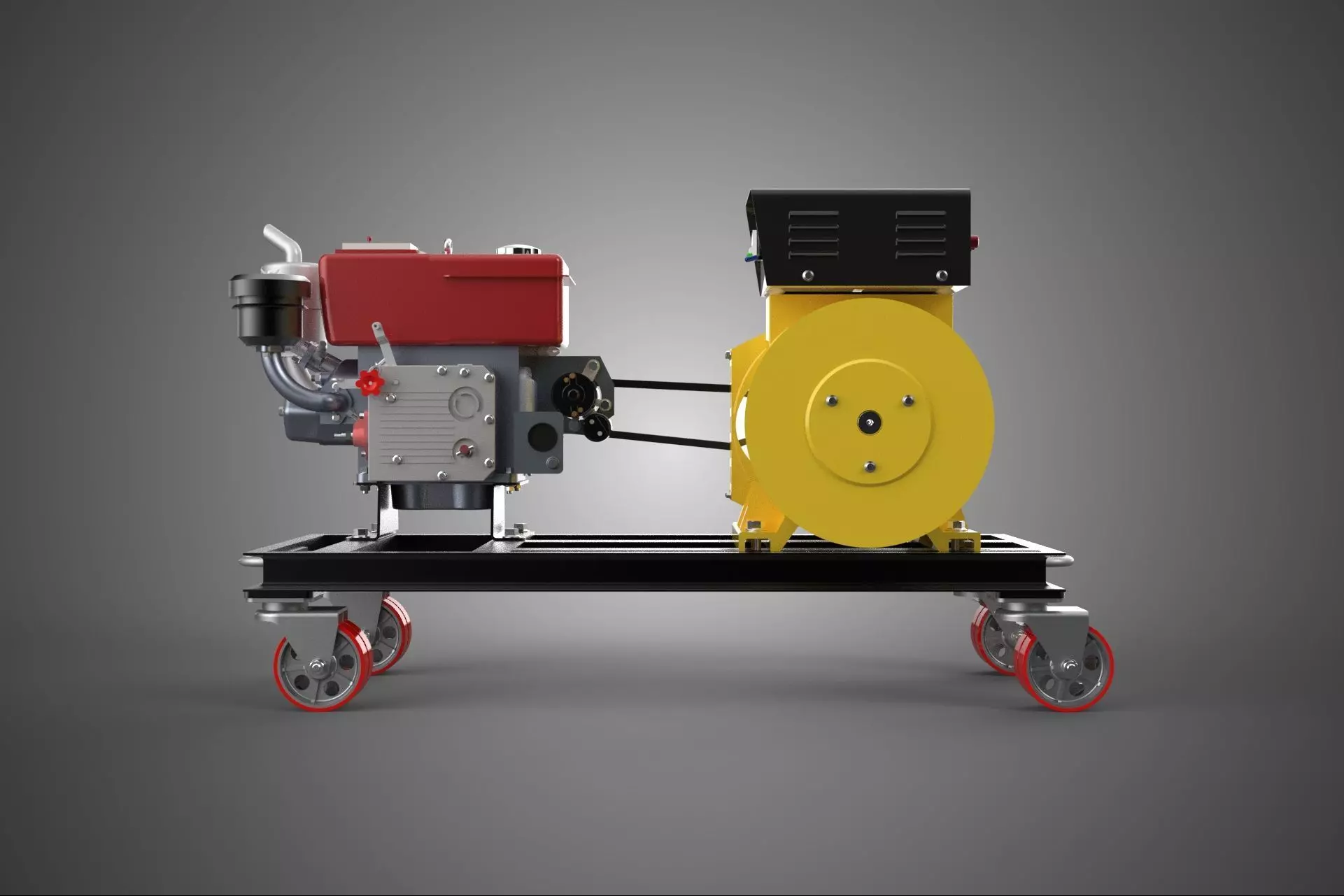
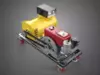
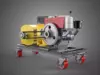
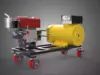
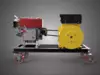
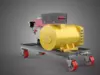
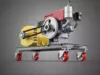
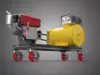
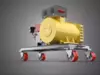
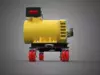
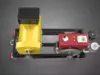
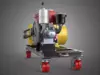
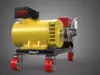
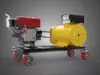
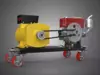
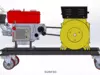
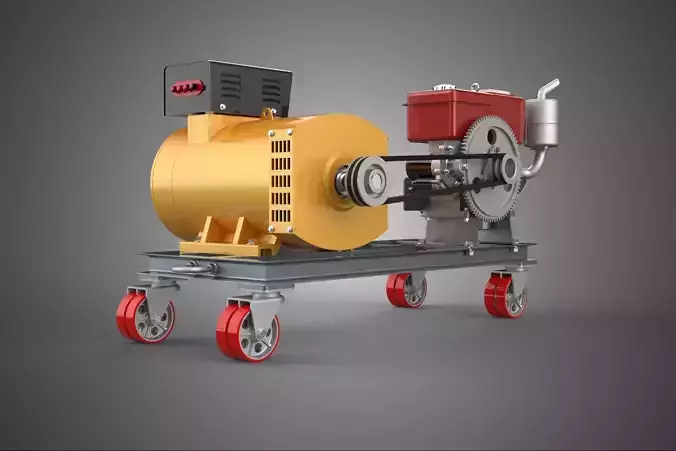
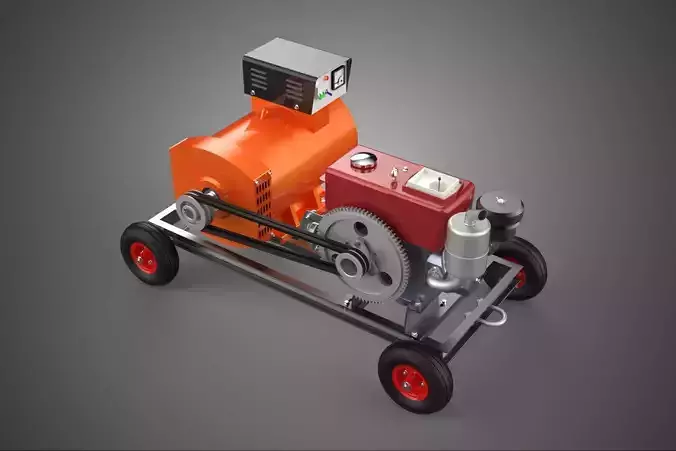
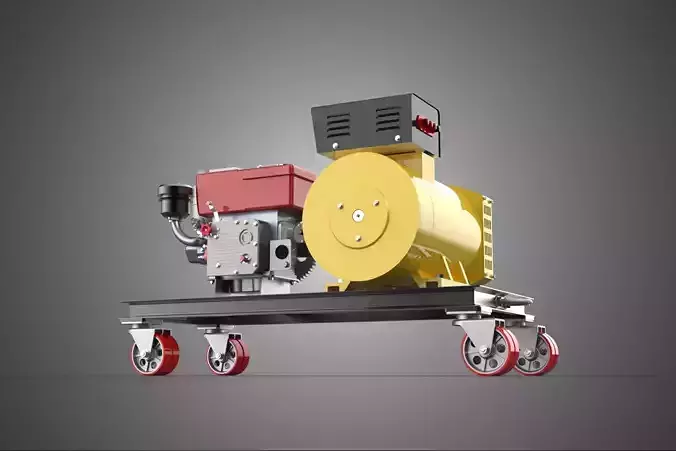
The industrial genset power generator system, driven by a combustion engine, is a robust, integrated electrical power production unit engineered for demanding commercial, institutional, and utility-scale applications. These systems are specifically designed to provide reliable, high-capacity electrical energy, functioning either as a primary source (prime power), a continuous source (base load), or as critical emergency backup (standby power).
I. Definition and Operational Modalities
A Generator Set (Genset) is the mechanical and electrical coupling of an internal combustion engine (the prime mover) and an electrical generator (the alternator). The industrial designation denotes high structural integrity, optimized thermal management, sophisticated digital controls, and the capability for sustained operation under high load factors.
Industrial gensets operate primarily in three modes:
- Standby Power: Providing electricity automatically upon failure of the primary utility grid. This is standard for hospitals, data centers, financial institutions, and emergency services.
- Prime Power: Supplying electrical current as the sole source for a facility, typically in remote locations (e.g., mining operations, construction sites) where connection to the public grid is infeasible.
- Peak Shaving (Load Management): Operating in parallel with the utility grid during periods of high demand to reduce energy consumption costs or stabilize grid load.
### II. Core Components and Prime Mover Characteristics
A. Internal Combustion Engine (Prime Mover):
The driving force is typically a heavy-duty, multi-cylinder, reciprocating engine. The selection of the engine is critical, determining the system’s fuel efficiency, transient response, maintenance schedule, and environmental compliance. Common fuel sources include:
- Diesel: Favored for its rapid startup, high torque density, and relative storage stability, making it the dominant choice for standby applications.
- Natural Gas (NG/CNG/LNG): Preferred for prime power or continuous operation due to lower fuel costs, reduced particulate emissions, and easier integration with natural gas utility lines.
- Biogas/Propane: Used in specialized applications, often in waste-to-energy or remote installations.
B. Alternator (Generator Head):
The alternator is a synchronous AC machine that converts the rotational mechanical energy from the engine into electrical energy. Industrial units typically feature brushless exciters to minimize maintenance and are rated for low total harmonic distortion (THD). Output is generally configured for three-phase power at common industrial voltages (e.g., 480V, 4160V) and frequencies (50 Hz or 60 Hz), regulated by an Automatic Voltage Regulator (AVR) for precise voltage control under varying loads.
### III. System Integration and Auxiliary Subsystems
Industrial genset power generator systems are complex assemblies requiring several integrated subsystems for reliable operation:
- Control and Monitoring System: Microprocessor-based controllers manage engine parameters (temperature, pressure, speed), monitor electrical output (voltage, frequency, amperage), and interface with safety shutdowns. Advanced controllers facilitate synchronization (paralleling multiple units) and load sharing.
- Automatic Transfer Switch (ATS): Essential for standby systems, the ATS automatically senses a utility outage and transfers the electrical load from the grid to the generator, reversing the process when utility power is restored.
- Cooling System: Utilizes either radiator-based cooling (air-to-liquid exchange) or remote heat exchangers, often necessary in large installations or continuous operations to manage the substantial thermal load produced by the high-displacement engine.
- Fuel Delivery and Storage: Includes primary fuel tanks, specialized day tanks (for immediate engine supply), and transfer pump systems, often requiring strict adherence to environmental and fire codes.
- Exhaust Management: Involves highly specialized silencing equipment (mufflers) to meet acoustic regulations and emissions control technology (e.g., Selective Catalytic Reduction – SCR) to meet stringent governmental air quality standards (Tier levels).
### IV. Deployment and Performance Standards
Industrial gensets are standardized according to established performance metrics, such as ISO 8528 and various National Fire Protection Association (NFPA) codes (e.g., NFPA 110 for emergency and standby power). Reliability, measured in terms of uptime and rapid transient response to sudden load changes, is the paramount concern in these installations. Genset sizing is determined by the facility’s total load and the necessity of managing motor starting currents (inrush current), ensuring that the system can maintain acceptable voltage and frequency stability during peak demand surges.
KEYWORDS: Standby Power, Prime Mover, Alternator, Internal Combustion Engine, Diesel Genset, Natural Gas, Automatic Transfer Switch, Load Management, Peak Shaving, Synchronous Generator, Automatic Voltage Regulator, Paralleling Switchgear, Cogeneration, Data Center, Industrial Power, Reciprocating Engine, SCR Technology, ISO 8528, NFPA 110, Emissions Control, Emergency Power, Base Load, Control Panel, Transient Response, Fuel Delivery System, Cooling System, High-Capacity, Three-Phase Power, Prime Power, Microprocessor Control.