High-quality 3D assets at affordable prices — trusted by designers, engineers, and creators worldwide. Made with care to be versatile, accessible, and ready for your pipeline.
Included File Formats
This model is provided in 14 widely supported formats, ensuring maximum compatibility:
• - FBX (.fbx) – Standard format for most 3D software and pipelines
• - OBJ + MTL (.obj, .mtl) – Wavefront format, widely used and compatible
• - STL (.stl) – Exported mesh geometry; may be suitable for 3D printing with adjustments
• - STEP (.step, .stp) – CAD format using NURBS surfaces
• - IGES (.iges, .igs) – Common format for CAD/CAM and engineering workflows (NURBS)
• - SAT (.sat) – ACIS solid model format (NURBS)
• - DAE (.dae) – Collada format for 3D applications and animations
• - glTF (.glb) – Modern, lightweight format for web, AR, and real-time engines
• - 3DS (.3ds) – Legacy format with broad software support
• - 3ds Max (.max) – Provided for 3ds Max users
• - Blender (.blend) – Provided for Blender users
• - SketchUp (.skp) – Compatible with all SketchUp versions
• - AutoCAD (.dwg) – Suitable for technical and architectural workflows
• - Rhino (.3dm) – Provided for Rhino users
Model Info
• - All files are checked and tested for integrity and correct content
• - Geometry uses real-world scale; model resolution varies depending on the product (high or low poly)
• • - Scene setup and mesh structure may vary depending on model complexity
• - Rendered using Luxion KeyShot
• - Affordable price with professional detailing
Buy with confidence. Quality and compatibility guaranteed.
If you have any questions about the file formats, feel free to send us a message — we're happy to assist you!
Sincerely,
SURF3D
Trusted source for professional and affordable 3D models.
More Information About 3D Model :
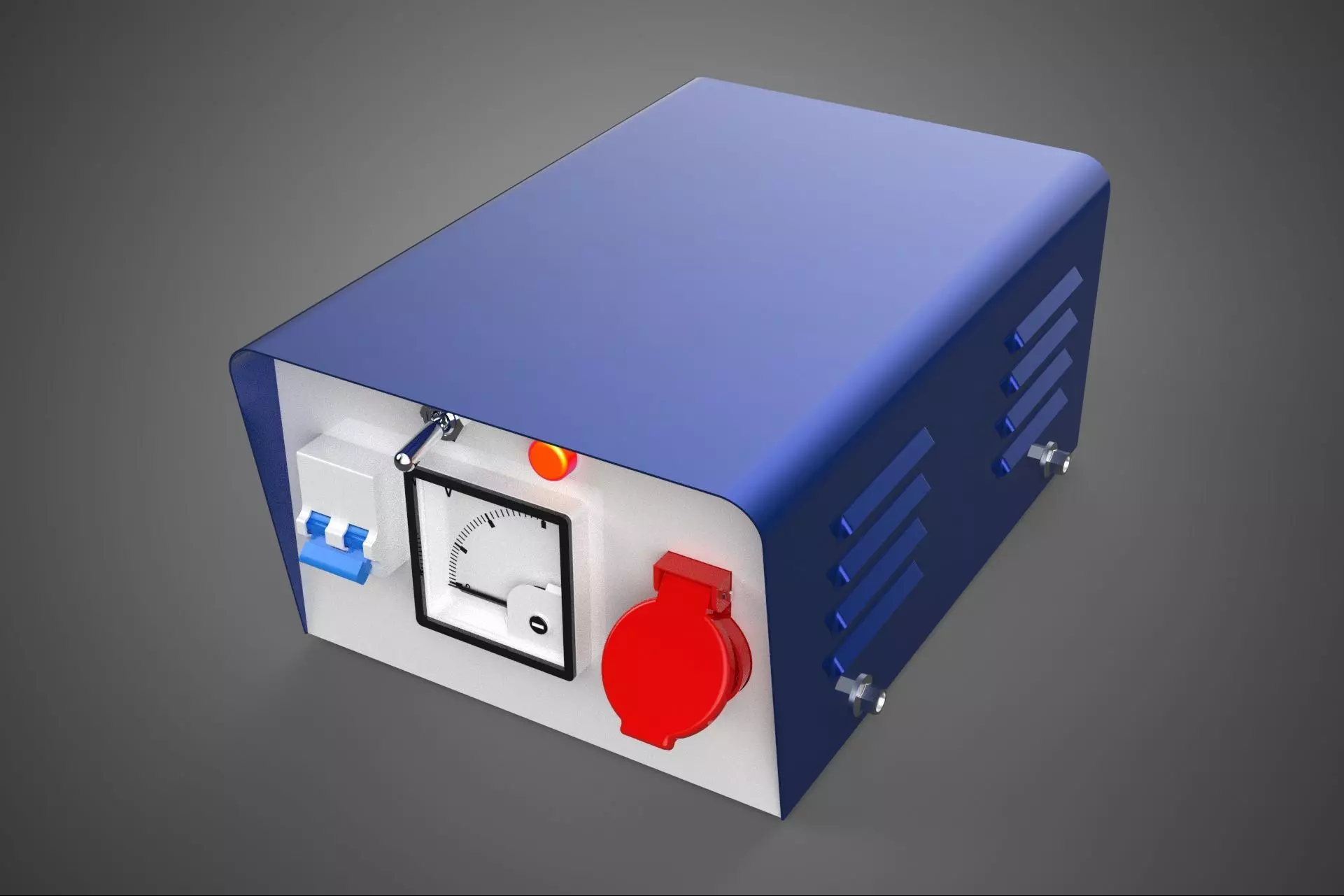
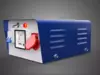
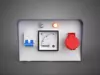
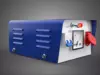
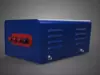
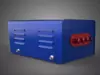
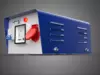
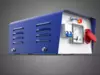
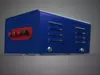
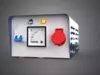
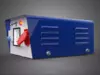
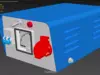
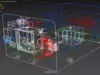
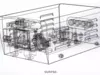
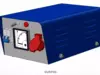
Transformer Control Panel Voltage Regulator Box AC DC Power PSU
An integrated electromechanical apparatus, generically termed a Transformer Control Panel Voltage Regulator Box AC DC Power PSU, represents a specialized subsystem designed for the management, stabilization, monitoring, and protection of electrical power systems centered around a core power transformer. This consolidated unit serves critical functions in maintaining power quality and ensuring operational resilience across diverse applications, ranging from utility substations to high-demand industrial processes.
System Definition and Architecture
The system consolidates four primary functional domains:
- Transformer Interface: Connection points and sensing circuitry interfacing directly with the primary windings (input) and secondary windings (output) of the associated power transformer.
- Voltage Regulator Box (VRB): The hardware responsible for active voltage management. This typically incorporates an Automatic Voltage Regulator (AVR) that utilizes mechanisms such as On-Load Tap Changers (OLTC) or servo-controlled auto-transformers to maintain a specified output voltage tolerance irrespective of variations in input grid voltage or dynamic load fluctuations.
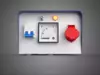
- Control Panel/HMI: The human-machine interface (HMI) and logic center. This panel houses metering instrumentation (voltmeters, ammeters, power factor indicators), protective relays (overcurrent, earth fault, thermal protection), annunciation circuits, and communication modules (e.g., Modbus, IEC 61850) for integration into Supervisory Control and Data Acquisition (SCADA) networks.
- AC DC Power PSU (Power Supply Unit): This designation denotes a critical auxiliary function. While the system manages high-voltage AC transformation, the internal circuitry requires highly stable, low-voltage direct current (DC) power (commonly 12V, 24V, or 48V). The integrated PSU converts station AC power to DC to energize sensitive electronic components, control logic, protective relays, switchgear tripping coils, and often maintains a charge on backup batteries essential for maintaining panel operation and critical tripping functions during primary power failure.
### Operational Principles of Voltage Regulation
The core function of the VRB is to compensate for voltage sag or swell. In high-power applications, this regulation is primarily achieved through tap changing. The AVR continuously monitors the output voltage and, if deviation exceeds preset limits, sends commands to the tap changer motor drive. By mechanically altering the ratio of the transformer’s windings, the output voltage is corrected quickly and efficiently. Modern systems employ microprocessor-based controllers offering enhanced stability algorithms, speed of response, and non-linear load compensation features.
### Control and Protection Integration
The Control Panel operates as the central nervous system for the transformer. Key protection functions incorporated include:
- Overcurrent Protection: Utilizes time-delayed and instantaneous relays to disconnect the transformer upon detection of short circuits or excessive load currents.
- Thermal Monitoring: Employs resistance temperature detectors (RTDs) or thermistors to monitor winding and oil temperatures, initiating alarms or forced cooling when thresholds are exceeded.
- Differential Protection: Compares the current entering the primary winding with the current leaving the secondary winding; a discrepancy indicates an internal fault (e.g., winding short).
- Operational Status Display: Provides real-time feedback, enabling operators to confirm regulation status, monitor power flow, and acknowledge alarms.
### Applications
This integrated unit is foundational to reliable electrical infrastructure where power quality is paramount. Typical installations include:
- Utility Substation Automation: Stabilizing grid voltage for distribution networks.
- Industrial Plants: Providing stable power for sensitive manufacturing equipment, such as induction furnaces or large motor drives.
- Renewable Energy Grid Tie-In: Regulating voltage fluctuation inherent in systems connecting renewable sources (wind, solar) to the main grid.
- Data Centers: Ensuring precise voltage delivery to uninterruptible power supplies (UPS) and critical loads.
The integration of AC and DC power management within the control panel ensures that the critical protection and monitoring functions remain operational even during severe transient events, solidifying the system’s role as a reliable safeguard for high-value electrical assets.
KEYWORDS: Voltage Regulation, Transformer Control, AC DC Power Supply Unit, Automatic Voltage Regulator, OLTC, Substation, SCADA, Power Quality, Protective Relays, HMI, Tap Changer, Auxiliary Power, Electrical Engineering, Distribution Network, Microprocessor Control, Industrial Automation, Current Monitoring, Fault Protection, Electromechanical System, Power Conversion, AVR, Winding Protection, Switchgear, DC Bus, UPS Integration, Power Electronics, Annunciation Circuit, Load Fluctuation, Grid Stability, Power System Management.