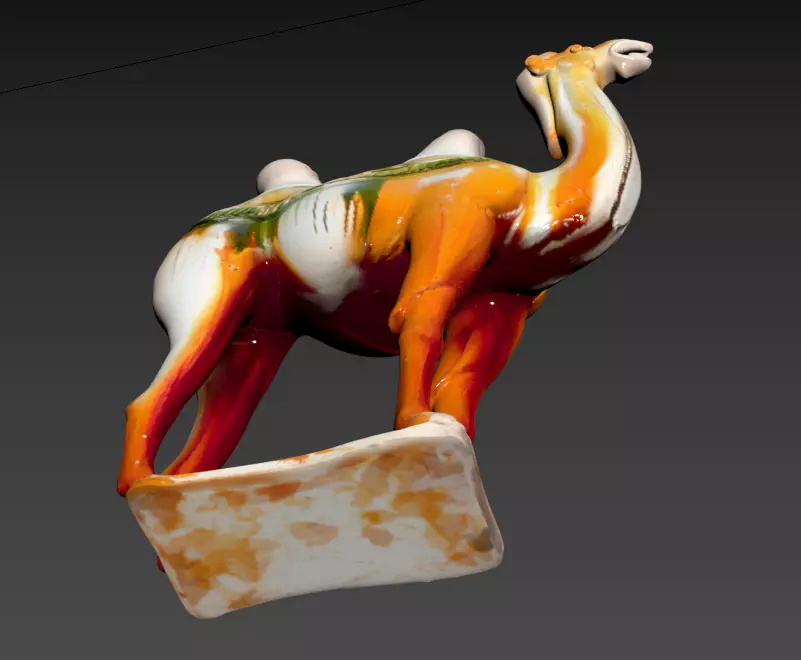
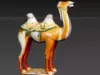
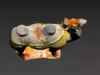
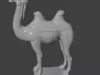
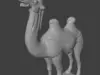
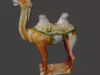
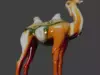
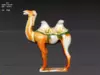
The Tang Dynasty tri colored camel is not porcelain, but pottery. It is one of the most representative animal figurines in Tang tri colored pottery (low-temperature lead glazed pottery), vividly reflecting the level of craftsmanship and cultural exchange along the Silk Road in the Tang Dynasty. Its main characteristics can be summarized as follows:
-Vivid in design, with a balance between realism and art: Camels are often depicted in the form of Bactrian camels, primarily standing or walking, with their heads held high and their mouths open. Their posture is lifelike, and their limbs are steady and powerful, accurately portraying the camel's load-bearing and resilient image as a ship in the desert. Some works use techniques such as molding, engraving, and stacking to strengthen details such as muscles and bristles, enhancing dynamism and texture.
-The glaze color is colorful and the kiln effect is unique: yellow, white, and green are the basic glaze colors, and brown, blue, purple, and other colors are also common. The glaze is based on lead and contains metal oxides such as iron, copper, and cobalt for coloring. During the secondary firing process at approximately 900 ℃, the glaze melts and flows naturally, blending together to form a colorful and mottled kiln effect, which is the most prominent artistic feature of Tang Sancai.
-Exquisite craftsmanship and reasonable structure: The body is made of white kaolin, which is then fired with glaze and fired again. To reduce weight, camels often have a hollow structure. Some works use the hair pulling technique on the neck, thighs, and other areas, using tools to create a granular texture on the glaze, simulating the effect of hair. The technique is mature.
-The cultural significance is profound, reflecting the prosperity of the Silk Road: Camels were the most important means of transportation on the Silk Road, and tricolor camels often carried silk, water bottles, cargo bags, and other items, or carried people, directly reproducing the prosperity of Sino foreign trade in the Tang Dynasty. Its image not only symbolizes wealth and communication, but is also endowed with cultural connotations of openness, inclusiveness, confidence, and progress.
-Diverse types and widely distributed: According to the back load, it can be divided into three types: empty camel, cargo camel, and manned camel. The excavated areas were mainly concentrated in the two capitals of the Tang Dynasty (Chang'an and Luoyang) and surrounding areas, such as Henan and Shaanxi, reflecting the political and economic center status at that time.