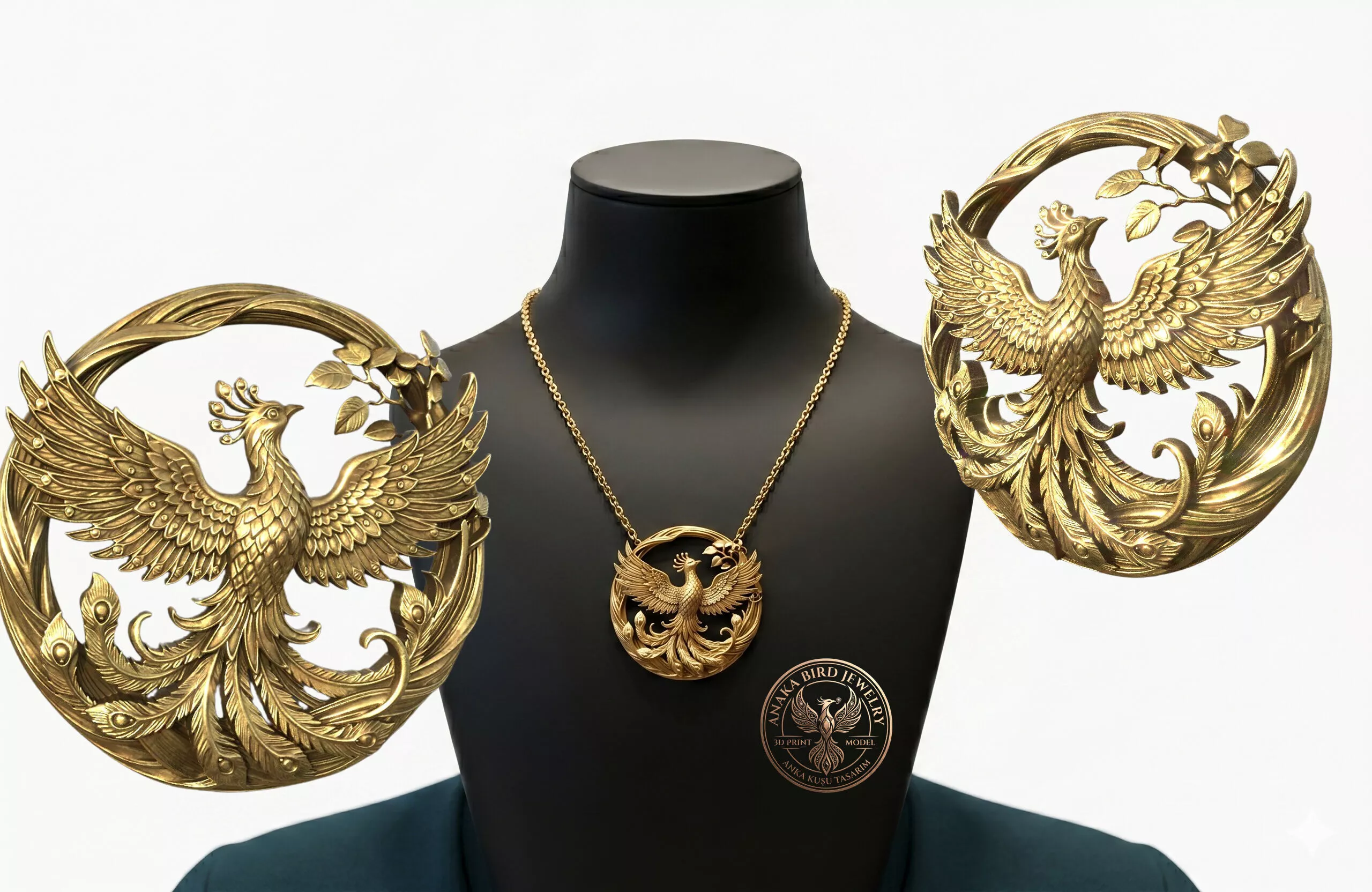
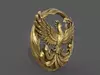
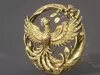
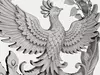
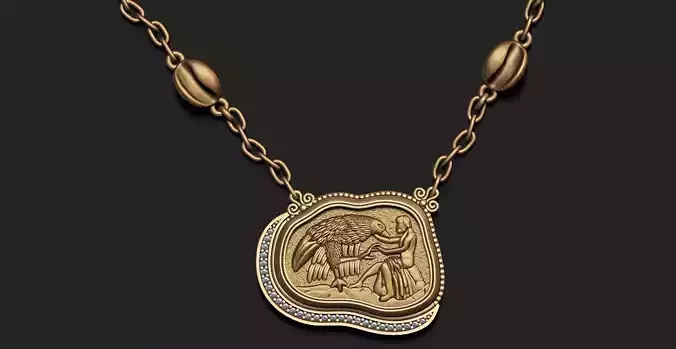
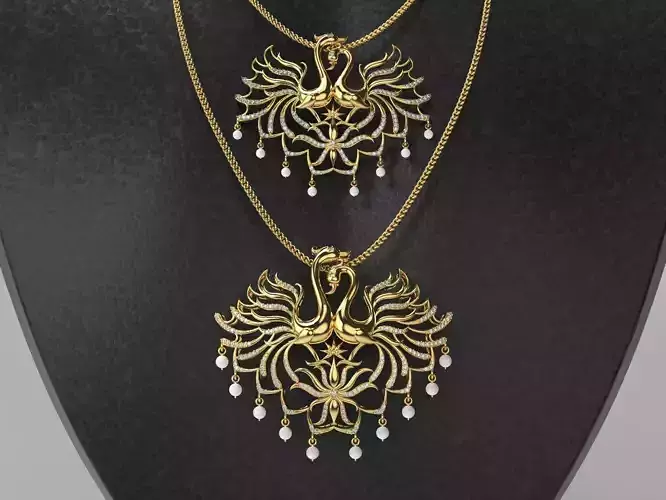
Anaka bird jewelry set 3D print modelFor other uses, see Simorgh (disambiguation).Simurgh
Simurgh as the royal emblem of the Sassanian Empire[1][better source needed]Creature informationGrouping Mythical creatureFolklore Persian mythologyOriginCountry Ancient Iran
Sassanian silver plate of a simurgh (Sēnmurw), 7th or 8th century CEThe simurgh (/sɪˈmɜːrɡ/; Persian: سیمرغ; also spelled senmurv, simorgh, simorg, simurg, simoorg, simorq or simourv) is a benevolent bird in Persian mythology and literature. It bears some similarities with mythological birds from different origins, such as the phoenix (Persian: ققنوس quqnūs) and the humā (Persian: هما).[2] The figure can be found in all periods of Iranian art and literature and is also evident in the iconography of Georgia,[3] medieval Armenia,[4] the Eastern Roman Empire,[5] and other regions that were within the realm of Persian cultural influence.
EtymologyThe Persian word sīmurğ (سیمرغ) derives from Middle Persian sēnmurw[6][7] and earlier sēnmuruγ, also attested in Pazend texts as sīna-mrū. The Middle Persian word comes from Avestan mərəγō Saēnō the bird Saēna, originally a raptor, likely an eagle, falcon, or sparrowhawk, as can be deduced from the etymological cognate Sanskrit śyenaḥ (श्येनः) raptor, eagle and bird of prey, which also appears as a divine figure.[8] Saēna is also a personal name. The word was lent to Armenian as siramarg (սիրամարգ) 'peacock'.[9]
On the other hand, the phrase sī murğ (سی مرغ) means thirty birds in Persian; this has been used by Attar of Nishapur in his symbolic story of The Conference of the Birds, the frame story of which employs a play on the name.[10] The Conference of the Birds directly references Simurghs as being the birds involved in the tale.
Mythology
Samanian Simurgh platter" (9th-10th century). Simurgh as a word in Persian is a double entendre (or Īhām), and can be interpreted as 30 birds. This plate depicts that interpretation. Attar of Nishapur also mentions this interpretation in his poetic book of Conference of the Birds.
Ambassador with Simurgh design on his dress in the Afrasiab murals, 648–651 CE.[11]Form and functionThe Simurgh is depicted in Iranian art as a winged creature in the shape of a bird, gigantic enough to carry off an elephant or a whale. It appears as a peacock with the head of a dog and the claws of a lion – sometimes, however, also with a human face. The Simurgh is inherently benevolent.[12] Being part mammal, they suckle their young.[12][13] The Simurgh has an enmity towards snakes, and its natural habitat is a place with plenty of water.[12][13] Its feathers are said to be the colour of copper in some versions, and though it was originally described as being a dog-bird, later it was shown with either the head of a man or a dog (Bearded vultures are variably orange or rust of plumage on their head, breast, and leg feathers, but this is thought to be cosmetic. This colouration comes from dust-bathing or rubbing iron-rich mud on its body).[12][13]
Si-, the first element in the name, has been connected in folk etymology to Modern Persian si ‘thirty’. Although this prefix is not historically related to the origin of the name simurgh, thirty has nonetheless been the basis for legends incorporating that number – for instance, that the simurgh was as large as thirty birds or had thirty colours (siræng). Other suggested etymologies include Pahlavi sin murgh ‘eagle bird’ and Avestan saeno merego ‘eagle’.[12]
Iranian legends consider the bird so old that it had seen the destruction of the world three times over. The simurgh learned so much by living so long that it is thought to possess the knowledge of all the ages. In one legend, the simurgh was said to live 1,700 years before plunging itself into flames (much like the phoenix).[12]
The simurgh was considered to purify the land and waters and hence bestow fertility. The creature represented the union between the Earth and the sky, serving as mediator and messenger between the two. The simurgh roosted in Gaokerena, the Hōm (Avestan: Haoma) Tree of Life, which stands in the middle of the world sea (Vourukasha). The plant is potent medicine and is called all-healing, and the seeds of all plants are deposited on it. When the simurgh took flight, the leaves of the tree of life shook, making all the seeds of every plant fall out. These seeds floated around the world on the winds of Vayu-Vata and the rains of Tishtrya, in cosmology taking root to become every type of plant that ever lived and curing all the illnesses of mankind.
The relationship between the simurgh and Hōm is extremely close. Like the simurgh, Hōm is represented as a bird, a messenger, and the essence of purity that can heal any illness or wound. Hōm – appointed as the first priest – is the essence of divinity, a property it shares with the simurgh. The Hōm is in addition the vehicle of farr(ah) (MPers: khwarrah, Avestan xᵛarənah, kavaēm kharēno) ‘divine glory; fortune’. Farrah in turn represents the divine mandate that was the foundation of a king's authority.
It appears as a bird resting on the head or shoulder of would-be kings and clerics, indicating Ormuzd's acceptance of that individual as his divine representative on Earth. For the commoner, Bahrām wraps fortune/glory around the house of the worshipper, for wealth in cattle, like the great bird Saena, and as the watery clouds cover the great mountains (Yasht 14.41, cf. the rains of Tishtrya above). Like the simurgh, farrah is also associated with the waters of Vourukasha (Yasht 19.51, 56–57). In Yašt 12.17 Simorgh's (Saēna's) tree stands in the middle of the sea Vourukaša, it has good and potent medicine and is called all-healing, and the seeds of all plants are deposited on it.
The Simugh is comparable to the Griffin, often viewed by historians and scholars as the Western Iranic version of this creature, whereas the Griffin is the Eastern Iranic version, as it originated in Scythia. The Simugh, in a similar parallel, represents power and protection in Iranian folkloric symbolism and myth.[14]
The Sasanians heavily used the Simurgh, both as their tribal emblem, but also in their art and propaganda.[15]