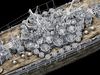
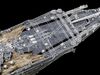
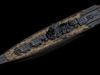
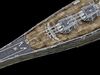
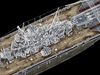
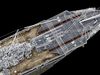
Yamato (大和) was the lead ship of her class of battleships built for the Imperial Japanese Navy (IJN) shortly before World War II. She and her sister ship, Musashi, were the heaviest and most powerfully armed battleships ever constructed, displacing 72,800 tonnes at full load and armed with nine 46 cm (18.1 in) Type 94 main guns, which were the largest guns ever mounted on a warship.
Named after the ancient Japanese Yamato Province, Yamato was designed to counter the numerically superior battleship fleet of the United States, Japan's main rival in the Pacific. She was laid down in 1937 and formally commissioned a week after the Pearl Harbor attack in late 1941. Throughout 1942, she served as the flagship of the Combined Fleet, and in June 1942 Admiral Isoroku Yamamoto directed the fleet from her bridge during the Battle of Midway, a disastrous defeat for Japan. Musashi took over as the Combined Fleet flagship in early 1943, and Yamato spent the rest of the year, and much of 1944, moving between the major Japanese naval bases of Truk and Kure in response to American threats. Although present at the Battle of the Philippine Sea in June 1944, she played no part in the battle.
The only time Yamato fired her main guns at enemy surface targets was in October 1944, when she was sent to engage American forces invading the Philippines during the Battle of Leyte Gulf. While threatening to sink American troop transports, they encountered a light escort carrier group of the U.S. Navy's Task Force 77, Taffy 3, in the Battle off Samar. The Japanese turned back after American air attacks convinced them they were engaging a powerful US carrier fleet.
During 1944, the balance of naval power in the Pacific decisively turned against Japan, and by early 1945, its fleet was much depleted and badly hobbled by critical fuel shortages in the home islands. In a desperate attempt to slow the Allied advance, Yamato was dispatched on a one-way mission to Okinawa in April 1945, with orders to beach herself and fight until destroyed, thus protecting the island. The task force was spotted south of Kyushu by US submarines and aircraft, and on 7 April 1945 she was sunk by American carrier-based bombers and torpedo bombers with the loss of most of her crew
Ямато» (яп. 大和) — линкор японского императорского флота времён Второй мировой войны типа «Ямато». Один из самых больших военных кораблей в истории человечества из когда-либо потопленных в ходе боевых действий. «Ямато» — древнее название самой Японии, однако в виду известной традиции Императорского Флота называть линейные корабли именами исторических провинций, в данном случае имелась в виду провинция Ямато, примерно соответствующая современной префектуре Нара.
Musashi (武蔵), named after the former Japanese province, was one of three Yamato-class battleships[N 1] built for the Imperial Japanese Navy (IJN), beginning in the late 1930s. The Yamato-class ships were the heaviest and most powerfully armed battleships ever constructed, displacing almost 72,000 long tons (73,000 t) fully loaded and armed with nine 46-centimetre (18.1 in) main guns. Their secondary armament consisted of four 15.5-centimetre (6.1 in) triple-gun turrets formerly used by the Mogami-class cruisers. They were equipped with six or seven floatplanes to conduct reconnaissance.
Commissioned in mid-1942, Musashi was modified to serve as the flagship of the Combined Fleet, and spent the rest of the year working up. The ship was transferred to Truk in early 1943 and sortied several times that year with the fleet in unsuccessful searches for American forces. She was used to transfer forces and equipment between Japan and various occupied islands several times in 1944. Torpedoed in early 1944 by an American submarine, Musashi was forced to return to Japan for repairs, during which the navy greatly augmented her anti-aircraft armament. She was present during the Battle of the Philippine Sea in June, but did not come in contact with American surface forces. Musashi was sunk by an estimated 19 torpedo and 17 bomb hits from American carrier-based aircraft on 24 October 1944 during the Battle of Leyte Gulf. Over half of her crew was rescued. Her wreck was located in March 2015 by a team of researchers employed by Microsoft co-founder Paul Allen.
Мусаси (яп. 武蔵) — второй линкор в серии типа «Ямато» японского императорского флота времён Второй мировой войны. Флагман Объединённого флота Японии. Получил название в честь древней японской провинции Мусаси. «Мусаси» и однотипный ему «Ямато» были самыми крупными и самыми мощными линейными кораблями в мире, имели водоизмещение 74 000 тонн, главный калибр орудий — 460 мм. «Мусаси» был заложен 29 марта 1938 года, спущен на воду 1 ноября 1940 года, и вступил в строй в августе 1942 года. До конца 1942 года линкор проходил испытания, дооборудование и боевую подготовку в японских водах. 22 января 1943 года он прибыл на Трук и стал новым флагманом Объединённого флота. В мае 1943 года был включен в состав соединения, предназначенного для срыва Алеутской десантной операции флота США, но японцы промедлили с развёртыванием своих сил, и операцию пришлось отменить.
29 марта 1943 года «Мусаси» вышел из бухты Трука, уклоняясь от атаки американской палубной авиации, но в море был атакован подлодкой США «Танни» (англ. Tunny) и получил попадание торпеды в носовую часть. Было принято 3000 тонн воды, потери составили 18 человек. Ремонт проводился в Куре до конца апреля. 19—23 июня «Мусаси» вместе с «Ямато» участвовал в сражении в Филиппинском море, но не добился никаких результатов.