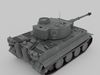
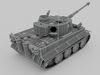
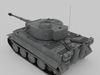
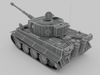
DESCRIPTION

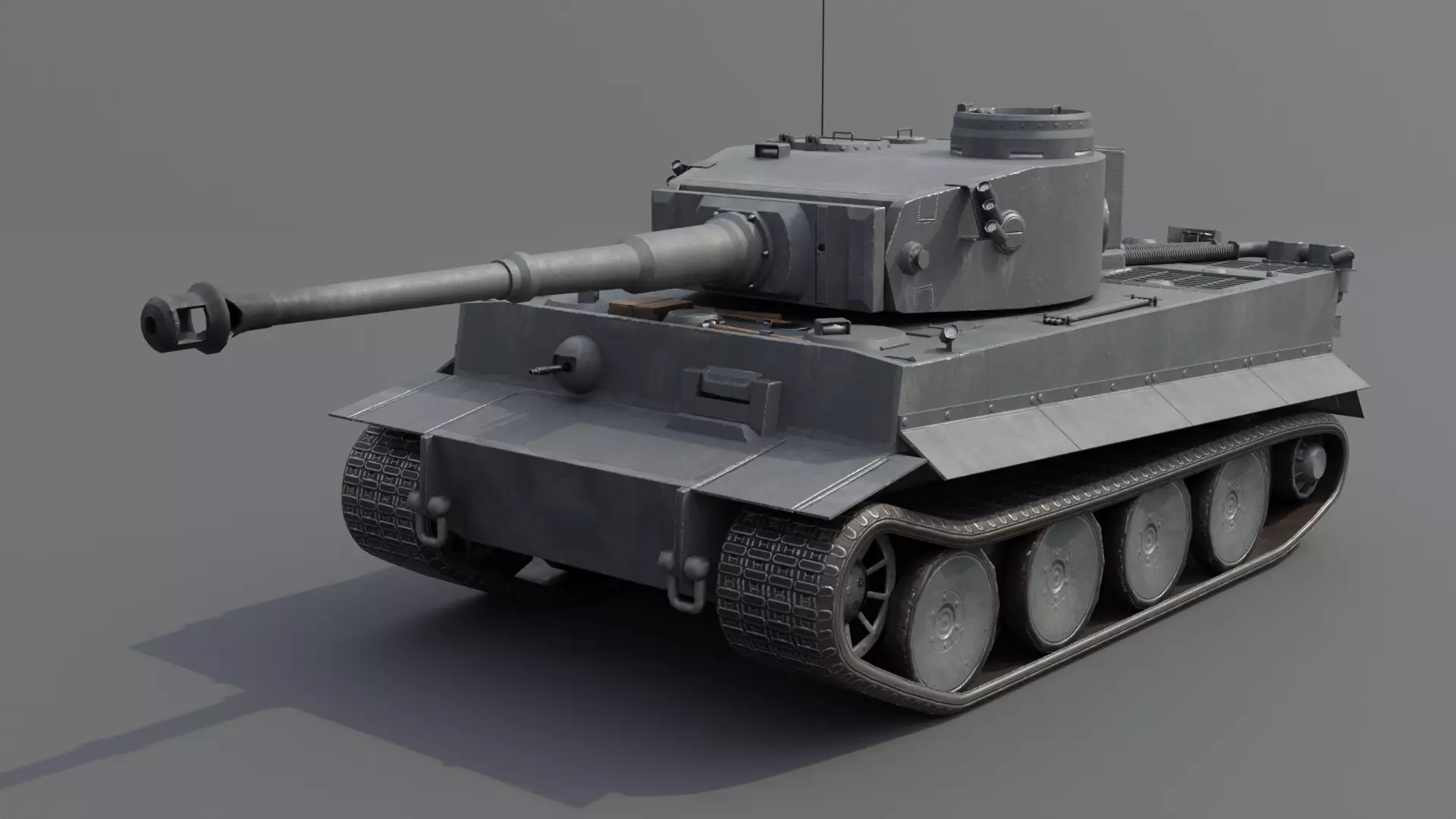
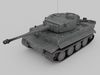
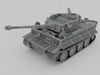
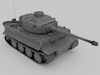
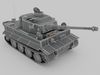
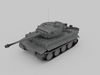
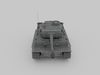
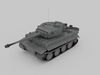
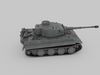
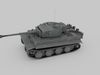
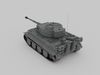
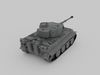
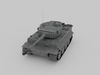
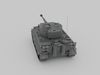
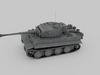
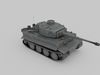
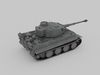
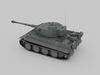
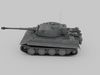
Tiger Ausf. H1 Heavy Tank Lowpoly 3D model

Rar file contain Blendfile, Texture folder , FBX , Obj mtl

Centered (in right place) and Seperated parts

Blender 2.91.0

Textured with substance painter

1 Set of material and Texture

2k textures

Pictures rendered in cycle engine

Vertices:16587

Faces:14692

Tris:28501

Description:The Tiger I was a German heavy tank of World War II that operated beginning in 1942 in Africa and in the Soviet Union, usually in independent heavy tank battalions. It was designated Panzerkampfwagen VI Ausf H during development but was changed to Panzerkampfwagen VI Ausf E during production. The Tiger I gave the German Army its first armoured fighting vehicle that mounted the 8.8 cm KwK 36 gun (derived from the 8.8 cm Flak 36). 1,347 were built between August 1942 and August 1944. After August 1944, production of the Tiger I was phased out in favour of the Tiger II.

While the Tiger I has been called an outstanding design for its time, it has also been called over-engineered,using expensive materials and labour-intensive production methods. The Tiger was prone to certain types of track failures and breakdowns and was limited in range by its high fuel consumption. It was expensive to maintain, but generally mechanically reliable. It was difficult to transport and vulnerable to immobilisation when mud, ice, and snow froze between its overlapping and interleaved Schachtellaufwerk-pattern road wheels, often jamming them solid. This was a problem on the Eastern Front in the muddy rasputitsa season and during periods of extreme cold.

The tank was given its nickname Tiger by Ferdinand Porsche, and the Roman numeral was added after the later Tiger II entered production. The initial designation was Panzerkampfwagen VI Ausführung H (literally armoured combat vehicle VI version H), abbreviated PzKpfw VI Ausf. H) where 'H' denoted Henschel as the designer/manufacturer. It was classified with ordnance inventory designation Sd.Kfz. 182. The tank was later re-designated as PzKpfw VI Ausf. E in March 1943, with ordnance inventory designation Sd.Kfz. 181.

REVIEWS & COMMENTS

See what other buyers think about this model - real feedback on quality,
accuracy, and usability.
ha
harryservienReturning buyer from this seller
This user has purchased multiple models from this seller
Amazing tank and I love that it hasn't too many details. Thank you!
BEST PRICE GUARANTEED
Found this model cheaper on another marketplace? Let our support team know - we’ll match it.

Tiger Ausf H1 Heavy Tank Low-poly 3D model

Royalty Free License
Hire
Like this model to show appreciation to the designer.
See how many times this model was viewed.
Share this model to support the designer and boost their visibility.
Native file format
BLEND
Size: 26.8 MB
Renderer: Cycles | 2.91.0
Exchange formats
OBJ
OBJ<br />File Size: 26.8 MB
FBX
Autodesk FBX<br />File Size: 26.8 MB
PNG
PNG<br />File Size: 26.8 MB
Verified by CGTrader
Verified models are of higher quality as they have
passed CGT Standard technical and visual checks,
making them more professional-grade 3D assets.
Learn more.
FBX
This FBX file has successfully passed the CGT Standard technical and visual checks. The verification results are detailed in the section below.
File & scene
Binary FBX
Binary FBX file is more compact and faster to load and process.
Learn more
No unsupported objects
Unsupported objects:
- Lights
- Cameras
Learn more
Geometry
No N-gons
N-gons are polygons with five or more sides which might cause issues in certain processes like rendering or animation. Learn more
No faceted geometry
Faceted geometry uses flat surfaces without smoothing, which can look unrealistic on curves.
Learn more
Manifold geometry
Manifold geometry ensures all surfaces are properly connected, avoiding issues like edges shared by more than two faces.
Learn more
Textures & material
PBR textures
PBR textures simulate how light interacts with materials, making the model look realistic under different lighting.
Required PBR textures:
- Base Color
- Roughness
- Metalness
- Normal
Learn more
No embed textures
Embedded textures are stored inside the model file, increasing its size and sometimes causing compatibility issues.
Learn more
Square textures
Texture aspect ratio is the width-to-height ratio of a texture. Expected texture aspect ratio: 1:1
Learn more
Power of 2 texture sizes
Textures with dimensions in power of two (e.g. 512x512px, 1024x1024px) are used to optimize performance and memory usage.
Learn more
Assigned materials
Materials are applied to the 3D model to allow visualize a model's surface properties and appearance.
Learn more
UVs & naming
No UV overlaps
UVs overlap when multiple points on the 3D model's surface are mapped to the same point on the UV island causing texture stretching.
Learn more
UV unwrapped model
A UV unwrapped model means its 3D surface is flattened into 2D space, allowing textures to be applied accurately.
Learn more
Allowed characters
Allowed ASCII characters: a-zA-Z0-9-_
Learn more
Provided by designer
Information and details shared directly by the model's designer.
3D Features
The model includes animations (movement or actions) that can be played in supported software or engines.
The model has a skeleton or bone structure, making it ready for posing or animation.
PBR
Uses Physically Based Rendering materials, which give the model realistic lighting and surface properties.
Textures
The model includes image files (textures) that add color, patterns, or detail to its surfaces.
Materials
The model has material settings that define how surfaces look (color, shine, transparency, etc.).
UV Mapping
The model's surfaces are mapped to a 2D image, allowing textures to display correctly.
Plugins Used
Some external plugins were used to create the model. These may be required for full functionality.
3D printing
Indicates whether the designer marked this model as suitable for 3D printing.
Model is not 3D printable
The designer indicates this model is intended for digital use only (rendering, animation, or AR/VR) and not for 3D printing.
Geometry
14692 polygons
The total number of polygons (flat shapes) that make up the 3D model.
/ 16587 vertices
The number of points (corners) that define the shape of the model's polygons.
Unwrapped UVs
Publish date
Model ID
Chat