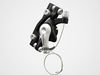
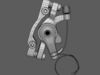
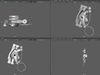



DESCRIPTION

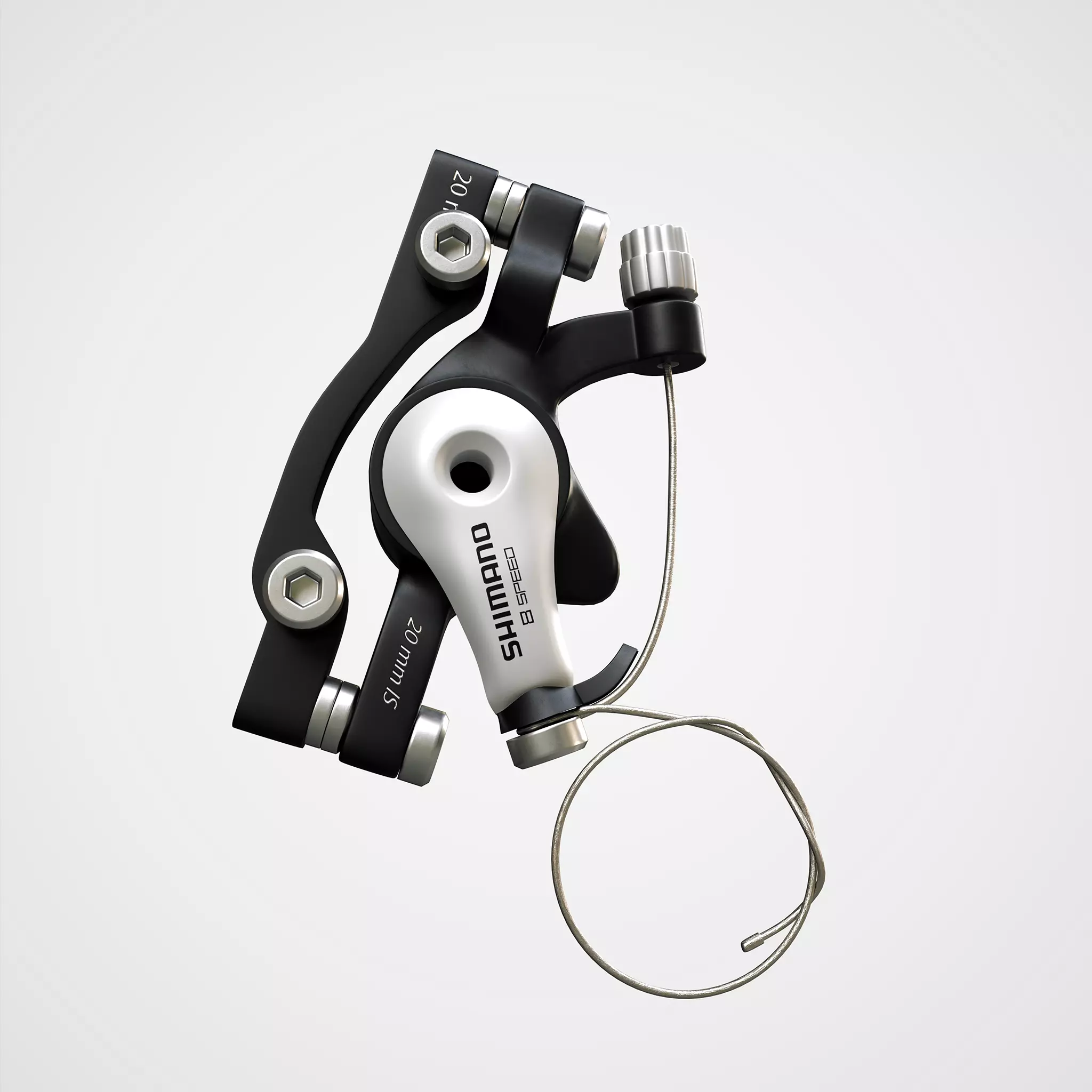
Here's an overview of the key components and features of hydraulic disc brakes on bicycles:

Brake Caliper:

The brake caliper houses the brake pads and is responsible for squeezing them against the brake rotor to create friction and slow down the bike.There are usually two pistons within the caliper that move when the brake lever is squeezed.Brake Rotor:

The brake rotor is a metal disc attached to the wheel hub. When the brake caliper squeezes the brake pads against the rotor, it creates friction, resulting in the bike coming to a stop.Rotors come in various sizes, and larger rotors generally provide more stopping power.Brake Lever:

The brake lever is the component on the handlebars that the rider squeezes to activate the brake system.In hydraulic disc brakes, the lever is connected to the brake caliper by a hydraulic line filled with brake fluid.Hydraulic Fluid:

Hydraulic disc brakes use brake fluid (usually mineral oil or DOT fluid) to transmit force from the brake lever to the caliper.The fluid is housed in a sealed system, and when the brake lever is squeezed, it compresses the fluid, causing the pistons in the caliper to move and press the brake pads against the rotor.Master Cylinder:

The master cylinder is part of the brake lever assembly and contains a reservoir for brake fluid.When the brake lever is activated, the master cylinder regulates the flow of hydraulic fluid to apply the appropriate amount of pressure on the brake caliper.Hoses:

Hydraulic hoses connect the master cylinder to the brake caliper, allowing the transmission of hydraulic fluid between the two.These hoses are typically made of reinforced materials to withstand high pressures.Advantages of Hydraulic Disc Brakes:

Increased Stopping Power: Hydraulic disc brakes provide excellent stopping power, especially in wet or muddy conditions.

Modulation: Riders can easily control the amount of braking force applied, allowing for precise modulation.

Less Effort: Hydraulic brakes require less finger effort at the brake lever compared to mechanical disc brakes.

Consistent Performance: They are less affected by cable stretch, providing more consistent performance over time.

Self-Adjusting: As the brake pads wear, hydraulic disc brakes are often self-adjusting, maintaining consistent performance.

It's important to note that hydraulic disc brakes may require specialized tools and knowledge for maintenance and repair. If you're unfamiliar with bicycle brake systems, it's advisable to seek assistance from a professional bike mechanic when dealing with hydraulic brakes.

REVIEWS & COMMENTS

See what other buyers think about this model - real feedback on quality,
accuracy, and usability.
There are no reviews or comments yet. Please be the first one to write it.
QUALITY VERIFIED
This model passed automated CGTrader quality checks and meets professional, PBR-ready standards.

Bicycle Hydraulic Disc Brake 3D model

Royalty Free License
Hire
Like this model to show appreciation to the designer.
See how many times this model was viewed.
Share this model to support the designer and boost their visibility.
File formats
STL
Stereolithography<br />Version: 2020<br />File Size: 1.21 MB
OBJ
OBJ<br />Version: 2020<br />File Size: 1.81 MB
SKP
Sketchup<br />Version: 2020 - Renderer: V-Ray 2020<br />File Size: 12.4 MB
FBX
Autodesk FBX | 2 files<br />Version: 2020<br />File Size: 4.17 MB
3DS
3D Studio<br />Version: 2020<br />File Size: 581 KB
MAX
Autodesk 3ds Max<br />Version: 2023 - Renderer: V-Ray 6<br />File Size: 3.34 MB
MA
Autodesk Maya<br />Version: 2020 - Renderer: V-Ray 5<br />File Size: 1.25 MB
BLEND
Blender<br />Version: 3.6 - Renderer: Cycles 3.<br />File Size: 5.69 MB
GLTF
glTF<br />Version: 2.2<br />File Size: 3.39 MB
Verified by CGTrader
Verified models are of higher quality as they have
passed CGT Standard technical and visual checks,
making them more professional-grade 3D assets.
Learn more.
FBX
This FBX file has successfully passed the CGT Standard technical and visual checks. The verification results are detailed in the section below.
File & scene
Binary FBX
Binary FBX file is more compact and faster to load and process.
Learn more
No unsupported objects
Unsupported objects:
- Lights
- Cameras
Learn more
Geometry
No N-gons
N-gons are polygons with five or more sides which might cause issues in certain processes like rendering or animation. Learn more
No faceted geometry
Faceted geometry uses flat surfaces without smoothing, which can look unrealistic on curves.
Learn more
Manifold geometry
Manifold geometry ensures all surfaces are properly connected, avoiding issues like edges shared by more than two faces.
Learn more
Textures & material
PBR textures
PBR textures simulate how light interacts with materials, making the model look realistic under different lighting.
Required PBR textures:
- Base Color
- Roughness
- Metalness
- Normal
Learn more
No embed textures
Embedded textures are stored inside the model file, increasing its size and sometimes causing compatibility issues.
Learn more
Square textures
Texture aspect ratio is the width-to-height ratio of a texture. Expected texture aspect ratio: 1:1
Learn more
Power of 2 texture sizes
Textures with dimensions in power of two (e.g. 512x512px, 1024x1024px) are used to optimize performance and memory usage.
Learn more
Assigned materials
Materials are applied to the 3D model to allow visualize a model's surface properties and appearance.
Learn more
UVs & naming
No UV overlaps
UVs overlap when multiple points on the 3D model's surface are mapped to the same point on the UV island causing texture stretching.
Learn more
UV unwrapped model
A UV unwrapped model means its 3D surface is flattened into 2D space, allowing textures to be applied accurately.
Learn more
Allowed characters
Allowed ASCII characters: a-zA-Z0-9-_
Learn more
Provided by designer
Information and details shared directly by the model's designer.
3D Features
PBR
Uses Physically Based Rendering materials, which give the model realistic lighting and surface properties.
Textures
The model includes image files (textures) that add color, patterns, or detail to its surfaces.
Materials
The model has material settings that define how surfaces look (color, shine, transparency, etc.).
UV Mapping
The model's surfaces are mapped to a 2D image, allowing textures to display correctly.
Plugins Used
Some external plugins were used to create the model. These may be required for full functionality.
3D printing
Indicates whether the designer marked this model as suitable for 3D printing.
Model is not 3D printable
The designer indicates this model is intended for digital use only (rendering, animation, or AR/VR) and not for 3D printing.
Geometry
Polygon mesh
A model built from polygons (triangles or quads) connected in a mesh.
25366 polygons
The total number of polygons (flat shapes) that make up the 3D model.
/ 12853 vertices
The number of points (corners) that define the shape of the model's polygons.
Unwrapped UVs
Publish date
Model ID
Chat