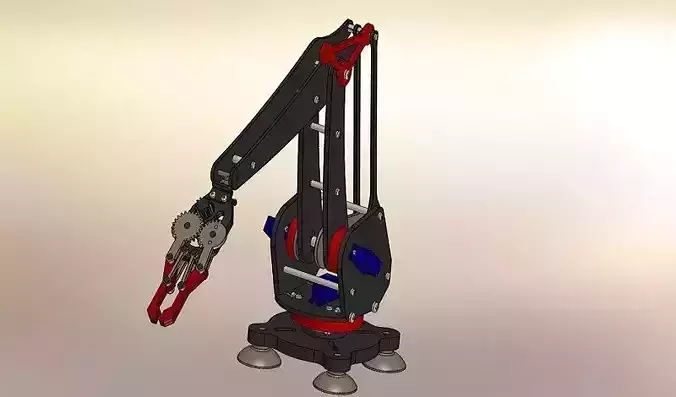
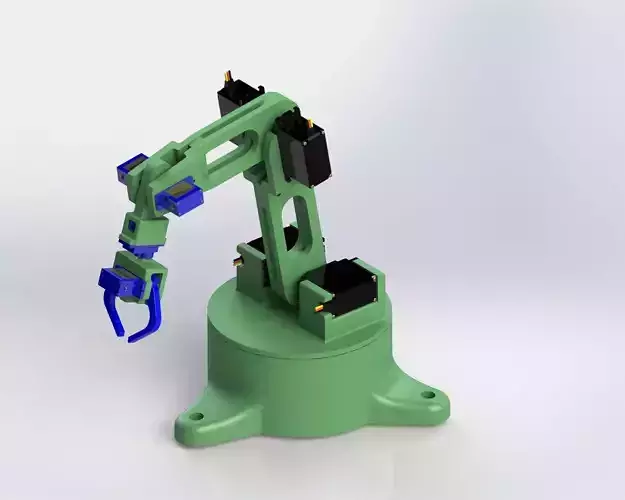
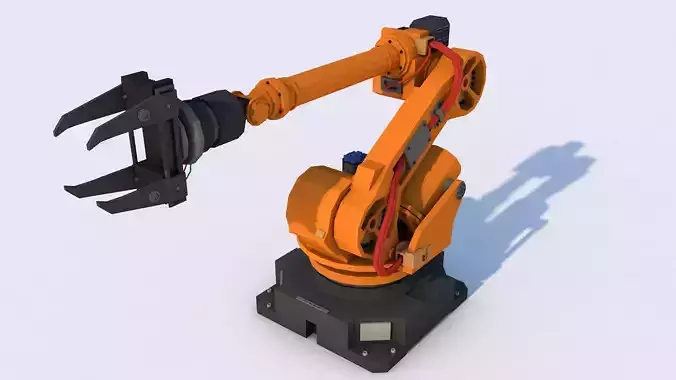
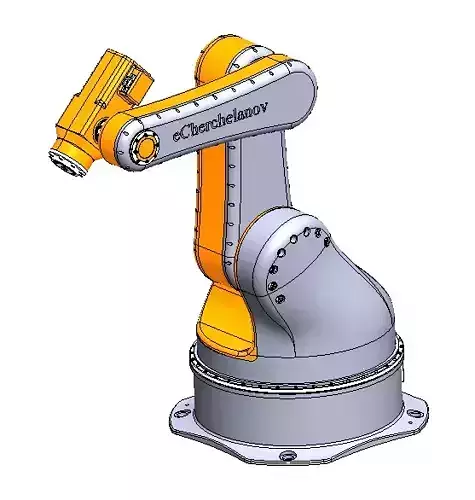
In robotics, an end effector is the device at the end of a robotic arm, designed to interact with the environment. The exact nature of this device depends on the application of the robot.
In the strict definition, which originates from serial robotic manipulators, the end effector means the last link (or end) of the robot. At this endpoint the tools are attached. In a wider sense, an end effector can be seen as the part of a robot that interacts with the work environment. This does not refer to the wheels of a mobile robot or the feet of a humanoid robot which are also not end effectors—they are part of the robot's mobility.
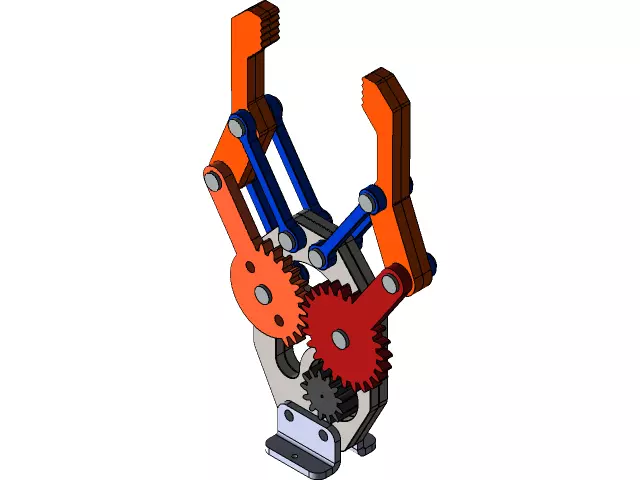
End effectors may consist of a gripper or a tool. When referring to robotic prehension there are four general categories of robot grippers, these are:
Impactive – jaws or claws which physically grasp by direct impact upon the object.
Ingressive – pins, needles or hackles which physically penetrate the surface of the object (used in textile, carbon and glass fibre handling).
Astrictive – suction[vague] forces applied to the objects surface (whether by vacuum, magneto- or electroadhesion).
Contigutive – requiring direct contact for adhesion to take place (such as glue, surface tension or freezing).They are based on different physical effects used to guarantee a stable grasping between a gripper and the object to be grasped.[2] Industrial grippers can be mechanical, the most diffused in industry, but also based on suction or on the magnetic force. Vacuum cups and electromagnets dominate the automotive field and in particular metal sheet handling. Bernoulli grippers exploit the airflow between the gripper and the part that causes a lifting force which brings the gripper and part close each other (i.e. the Bernoulli's principle). Bernoulli grippers are a type of contactless grippers, namely the object remains confined in the force field generated by the gripper without coming into direct contact with it. Bernoulli grippers have been adopted in photovoltaic cell handling, silicon wafer handling, and also in the textile and leather industries. Other principles are less used at the macro scale (part size >5mm), but in the last ten years they demonstrated interesting applications in micro-handling. Some of them are ready of spreading out their original field. The other adopted principles are: Electrostatic grippers and van der Waals grippers based on electrostatic charges (i.e. van der Waals' force), capillary grippers and cryogenic grippers, based on liquid medium, and ultrasonic grippers and laser grippers, two contactless grasping principles. Electrostatic grippers are based on charge difference between the gripper and the part (i.e. electrostatic force) often activated by the gripper itself, while van der Waals grippers are based on the low force (still electrostatic) due to the atomic attraction between the molecules of the gripper and those of the object. Capillary grippers use the surface tension of a liquid meniscus between the gripper and the part to center, align and grasp the part, cryogenic grippers freeze a small amount of liquid and the resulting ice guarantees the necessary force to lift and handle the object (this principle is used also in food handling and in textile grasping). Even more complex are ultrasonic based grippers, where pressure standing waves are used to lift up a part and trap it at a certain level (example of levitation are both at the micro level, in screw and gasket handling, and at the macro scale, in solar cell or silicon wafer handling), and laser source that produces a pressure able to trap and move microparts in a liquid medium (mainly cells). The laser gripper are known also as laser tweezers.
A particular category of friction/jaw gripper are the needle grippers: they are called intrusive grippers and exploits both friction and form closure as standard mechanical grippers.
The most known mechanical gripper can be of two, three or even five fingers.
The end effectors that can be used as tools serve various purposes, such as spot welding in an assembly, spray painting where uniformity of painting is necessary, and for other purposes where the working conditions are dangerous for human beings. Surgical robots have end effectors that are specifically manufactured for the purpose.