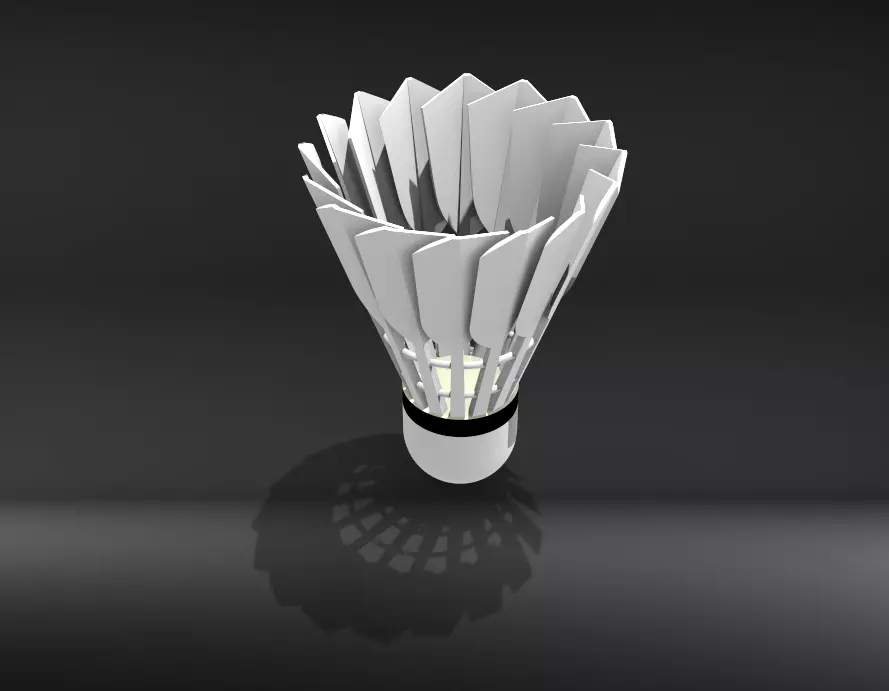
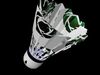
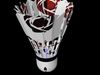
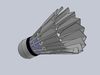
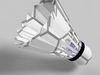
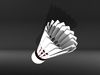
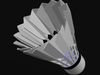
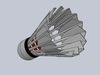
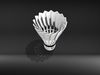
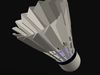
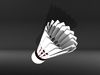
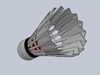
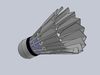
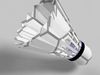
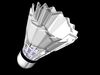
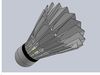
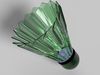
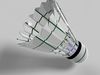
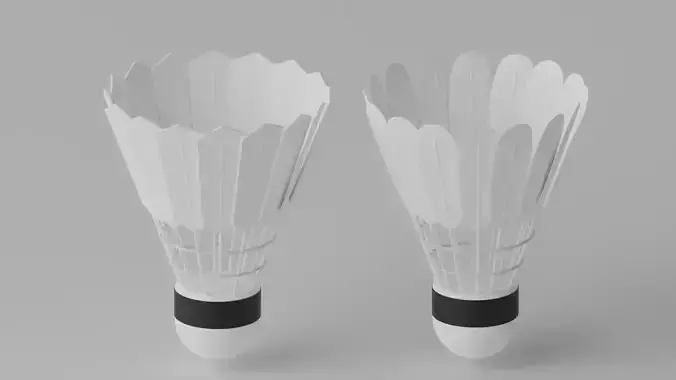
A model of Shuttlecock (Badminton Feather)#A shuttlecock (also called a bird or birdie) is a high-drag projectile used in the sport of badminton. It has an open conical shape formed by feathers (or a synthetic alternative) embedded into a rounded cork (or rubber) base. The shuttlecock's shape makes it extremely aerodynamically stable. Regardless of initial orientation, it will turn to fly cork first, and remain in the cork-first orientation.#The name ' ' originates in 1570s England, when badminton first became popular. It is frequently shortened to shuttle. The shuttle part of the name is derived from its back-and-forth motion during the game, resembling the shuttle of a 14th-century loom, while the " " part of the name is derived from the resemblance of the feathers to those on a chicken.#A shuttlecock weighs around 4.75 to 5.50 g (0.168 to 0.194 oz). It has 16 feathers with each feather 70 mm (2.8 in) in length. The diameter of the cork is 25 to 28 mm (0.98 to 1.10 in) and the diameter of the circle that the feathers make is around 58 to 68 mm (2.3 to 2.7 in).#A shuttlecock is formed from 16 or so overlapping feathers, usually goose or duck, embedded into a rounded cork base. The cork is covered with thin leather. To ensure satisfactory flight properties, it is considered preferable to use feathers from right or left wings only in each shuttlecock, and not mix feathers from different wings, as the feathers from different wings are shaped differently.##The feathers are brittle; shuttlecocks break easily and often need to be replaced several times during a game. For this reason, synthetic shuttlecocks have been developed that replace the feathers with a plastic skirt. Players often refer to synthetic shuttlecocks as plastics and feathered shuttlecocks as feathers.
Feather shuttles need to be properly humidified for at least 4 hours prior to play in order to fly the correct distance at the proper speed and to last longer. Properly humidified feathers flex during play, enhancing the shuttle's speed change and durability. Dry feathers are brittle and break easily, causing the shuttle to wobble. Saturated feathers are 'mushy', making the feather cone narrow too much when strongly hit, which causes the shuttle to fly overly far and fast. Typically a humidification box is used, or a small moist sponge is inserted in the feather end of the closed shuttle tube container, avoiding any water contact with the cork of the shuttle. Shuttles are tested prior to play to make sure they fly true and at the proper speed, and cover the proper distance. Different weights of shuttles are used to compensate for local atmospheric conditions. Both humidity and height above sea level affect shuttle flight. World Badminton Federation Rules say the shuttle should reach the far doubles service line plus or minus half the width of the tram. According to manufacturers proper shuttle will generally travel from the back line of the court to just short of the long doubles service line on the opposite side of the net, with a full underhand hit from an average player.