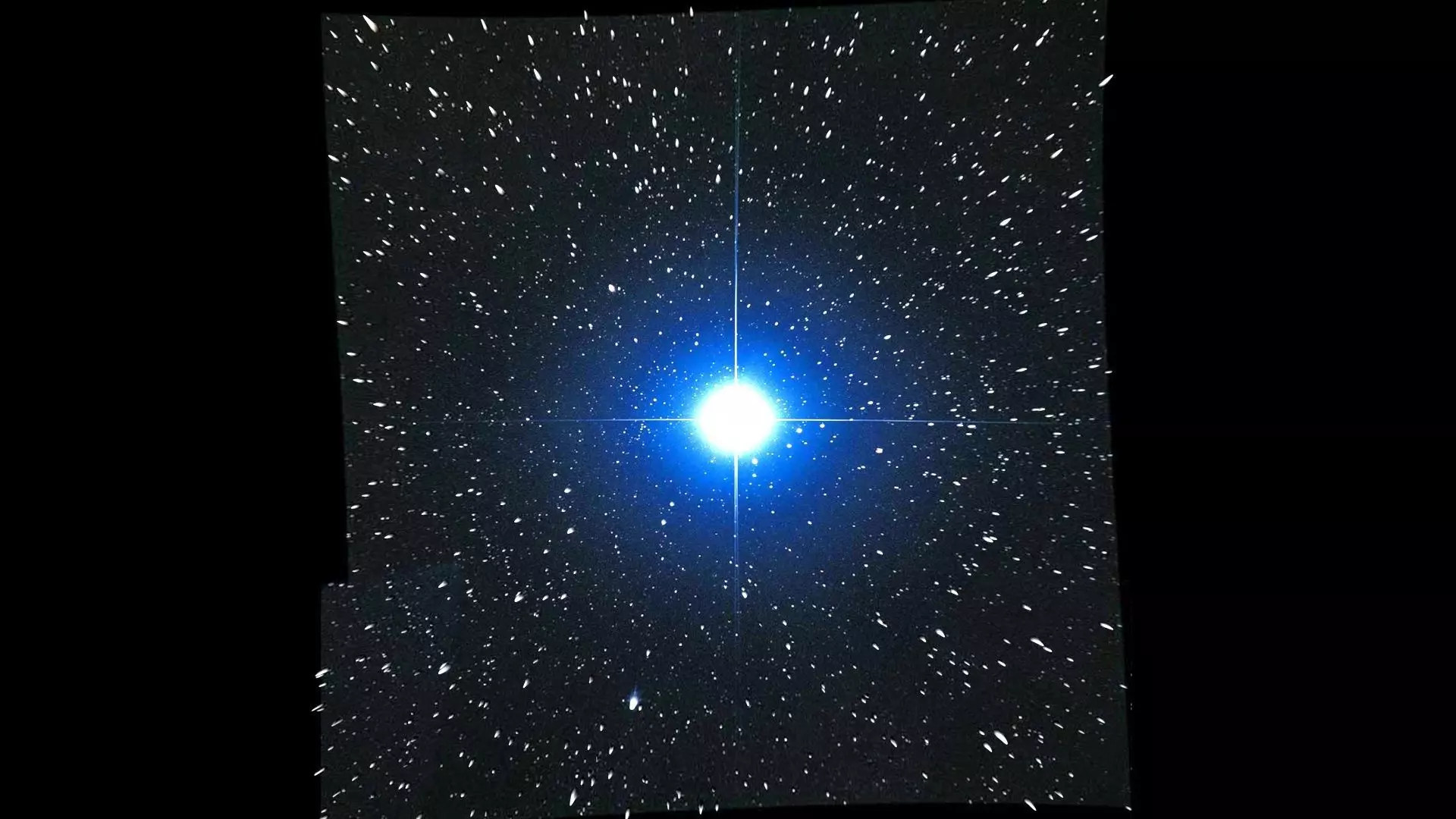
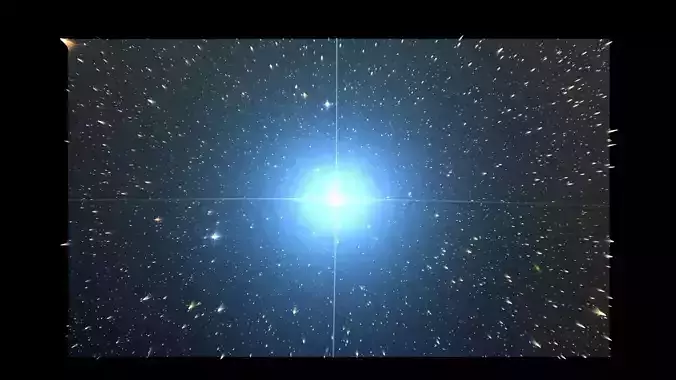
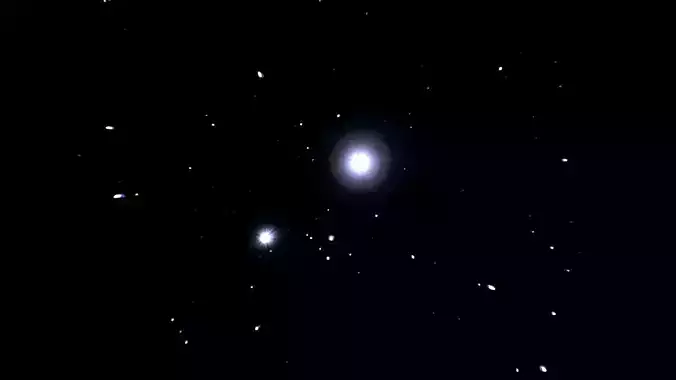
DescriptionSirius Star. Sirius is the brightest star in the night sky. Its name is derived from the Greek word Σείριος (Latin script: Seirios), meaning lit. 'glowing' or 'scorching'. The star is designated α Canis Majoris, Latinized to Alpha Canis Majoris, and abbreviated α CMa or Alpha CMa. With a visual apparent magnitude of −1.46, Sirius is almost twice as bright as Canopus, the next brightest star. Sirius is a binary star consisting of a main-sequence star of spectral type A0 or A1, termed Sirius A, and a faint white dwarf companion of spectral type DA2, termed Sirius B. The distance between the two varies between 8.2 and 31.5 astronomical units as they orbit every 50 years. Sirius appears bright because of its intrinsic luminosity and its proximity to the Solar System. At a distance of 2.64 parsecs (8.6 ly), the Sirius system is one of Earth's nearest neighbours. Sirius is gradually moving closer to the Solar System and it is expected to increase in brightness slightly over the next 60,000 years to reach a peak magnitude of −1.68. Coincidentally, at about the same time, Sirius will take its turn as the southern Pole Star, around the year 66,270 AD. In that year, Sirius will come to within 1.6 degrees of the south celestial pole. This is due to axial precession and proper motion of Sirius itself which moves slowly in the SSW direction, so it will be visible from the southern hemisphere only. After that time, its distance will begin to increase, and it will become fainter, but it will continue to be the brightest star in the Earth's night sky for approximately the next 210,000 years, at which point Vega, another A-type star that is intrinsically more luminous than Sirius, becomes the brightest star. Sirius A is about twice as massive as the Sun (MO) and has an absolute visual magnitude of +1.43. It is 25 times as luminous as the Sun, but has a significantly lower luminosity than other bright stars such as Canopus, Betelgeuse, or Rigel. The system is between 200 and 300 million years old. It was originally composed of two bright bluish stars. The initially more massive of these, Sirius B, consumed its hydrogen fuel and became a red giant before shedding its outer layers and collapsing into its current state as a white dwarf around 120 million years ago. Sirius is colloquially known as the Dog Star, reflecting its prominence in its constellation, Canis Major (the Greater Dog). The heliacal rising of Sirius marked the flooding of the Nile in Ancient Egypt and the dog days of summer for the ancient Greeks, while to the Polynesians, mostly in the Southern Hemisphere, the star marked winter and was an important reference for their navigation around the Pacific Ocean.
Texture Resolution: 1010 x 1112