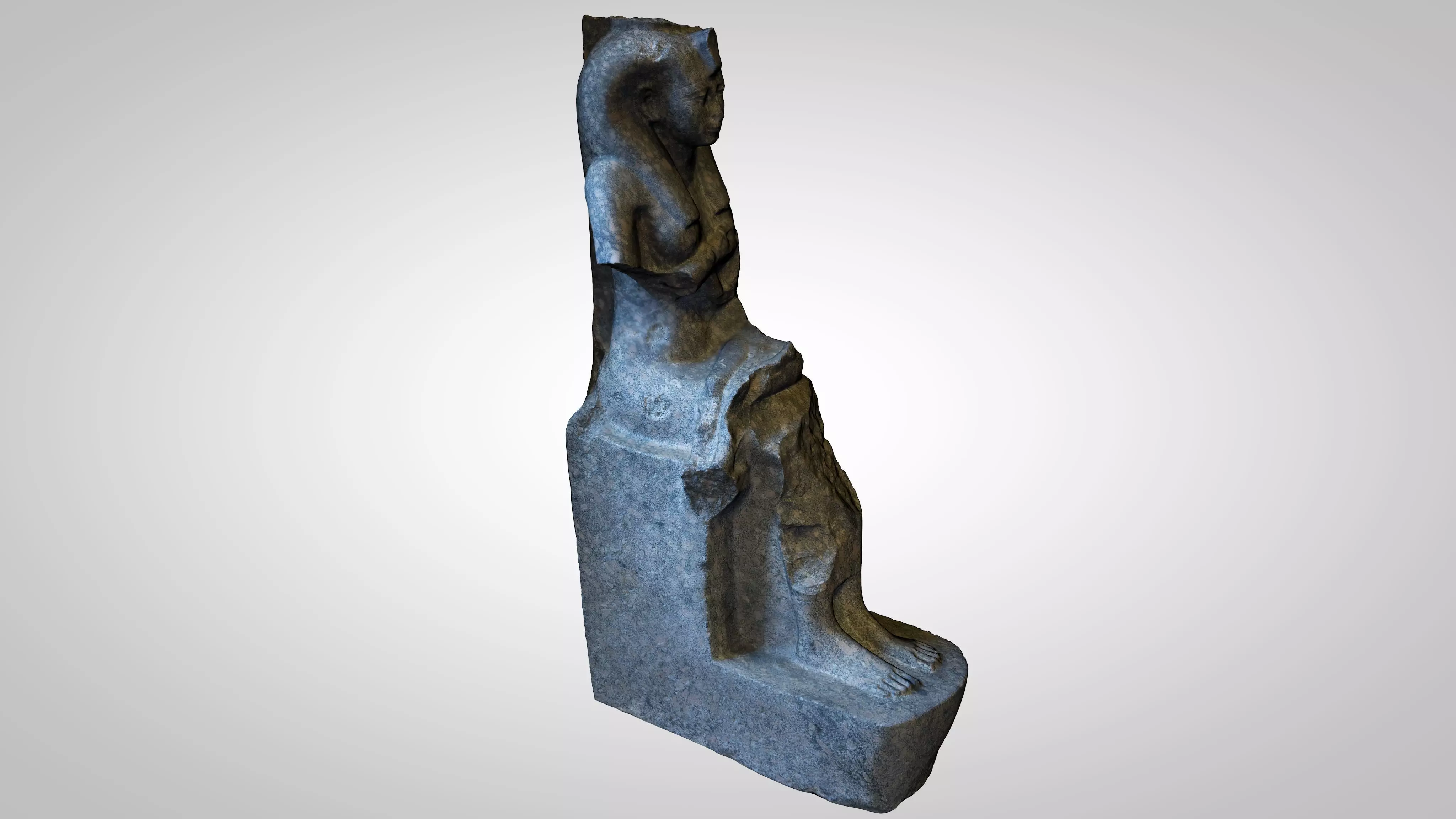
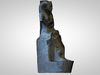
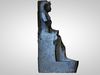
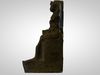
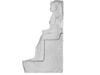
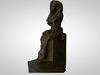
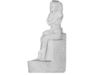
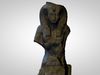
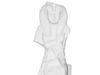
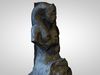
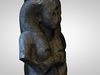
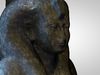
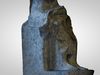
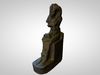
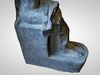
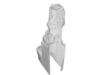
MATERIAL CHARACTERISTICS*Dimensions Height: 56.2 cm*Secondary material: goldTechnique: Round-bossing, plating (white of the eyes plated with gold)PLACE AND DATESDate of creation / manufactureLate Period (attribution according to style) (-664 - -332)Place of discoverySerapium = Serapium of Memphis (Saqqara-North->Saqqara->Memphite Necropolis)
Isis is a mythical queen and funerary goddess of ancient Egypt. She is most often depicted as a young woman wearing a throne or, like Hathor, a wig topped by a sun disk inserted between two cow horns.
The cunning Isis is one of the deities of the Ennead of Heliopolis. She is the sister and wife of King Osiris, a generous being who placed his reign under the sign of cosmic harmony. This happy time comes to an abrupt end when Osiris is murdered in a plot organised by his brother Set, a violent and jealous god. Isis finds the body of Osiris and hides it in the swamps of Chemnis. During a hunting trip, Set finds the corpse and, mad with anger, cuts it into several pieces. During a long quest, Isis, assisted by Nephthys, Thoth and Anubis, finds the disjointed limbs and reconstitutes the body of Osiris by mummifying it. After reviving Osiris, Isis makes him the eternal ruler of the Dourat, a heavenly world populated by immortal spirits. To ensure his protection, she places him under the attentive care of the dog god Anubis, her adopted son.
Isis, in the form of a bird of prey, unites with the mummy of her husband and conceives Horus. Raised in the marshes of Chemnis and fortified by Isis' mother's milk, Horus reaches adulthood. For many decades Horus and Isis fought against Set, supported by Ra, who was reluctant towards Horus. After many ups and downs, Horus succeeds in being recognised as the legitimate successor of his father, thus becoming the model of the ideal pharaoh.
The cult of Isis appeared at the end of the Old Kingdom, around the xxiv century BC. Initially confined to the funerary domain, Isis became, during the first millennium BC, a very popular goddess with universal power. The devotion of the Ptolemaic pharaohs endowed the goddess Isis with two grandiose places of worship; Isum in Lower Egypt and Phileas in Nubia. Between the end of the fourth century BC and the end of the fourth century AD, the cult of Isis spread throughout the Mediterranean basin and a large number of sanctuaries were built for her in Greece and Italy. In these new places, a syncretism took place in which the Egyptian rites dedicated to the goddess were adapted to Greco-Roman religious thought. The iconography and cult of Isis became Hellenised, and, through a comparison with Demeter's quest for Persephone (Eleusis Mysteries), the Isis Mysteries were created, organised in the form of an initiatory, progressive and secret ceremony.
Faced with the rise of Christianity, the cult of Isis declined and then disappeared at the turn of the fifth and fifth centuries of our era. However, the memory of Isis did not disappear because it was maintained by monastic and university scholasticism. The reading of the hieroglyphs having been lost, her image is however biased because it is only perceived through the filter of the Greek and Latin authors of late antiquity. Towards the end of the Middle Ages, Isis became an object of curiosity for secular scholars. This phenomenon became more pronounced during the Renaissance. Many humanists included Isis in their studies by elaborating historicising mythographies about her. The myth of Isis was merged with that of the nymph Io transformed into a cow by Hera, and the appearance of Isis was confused with that of Artemis multimammia of Ephesus. During the Enlightenment, certain Freemason philosophers, enamoured of Egyptomania, turned their attention to the Mysteries of Isis and attempted to reinvent them as part of the rituals of their initiation lodges. Artists and poets, for their part, have constantly speculated on the image of the veiled goddess and made Isis the symbol of the hidden laws of Nature.
Since the deciphering of hieroglyphics and the establishment of Egyptological science in the 19th century, the purely Egyptian aspects of the goddess have been rediscovered and popularised by scholars to the general public. However, the personality of Isis has not been entirely stripped of its esoteric aura, which has been developed since the 14th century by European alchemists and mystagogues. Isis thus remains the object of theological and hermetic reflections within confidential circles. Since the 1950s, especially in the United States, Isis has been particularly venerated by the Kemitist convents of Wicca, where a modern pagan cult is addressed to her as the great original, maternal and lunar goddess.