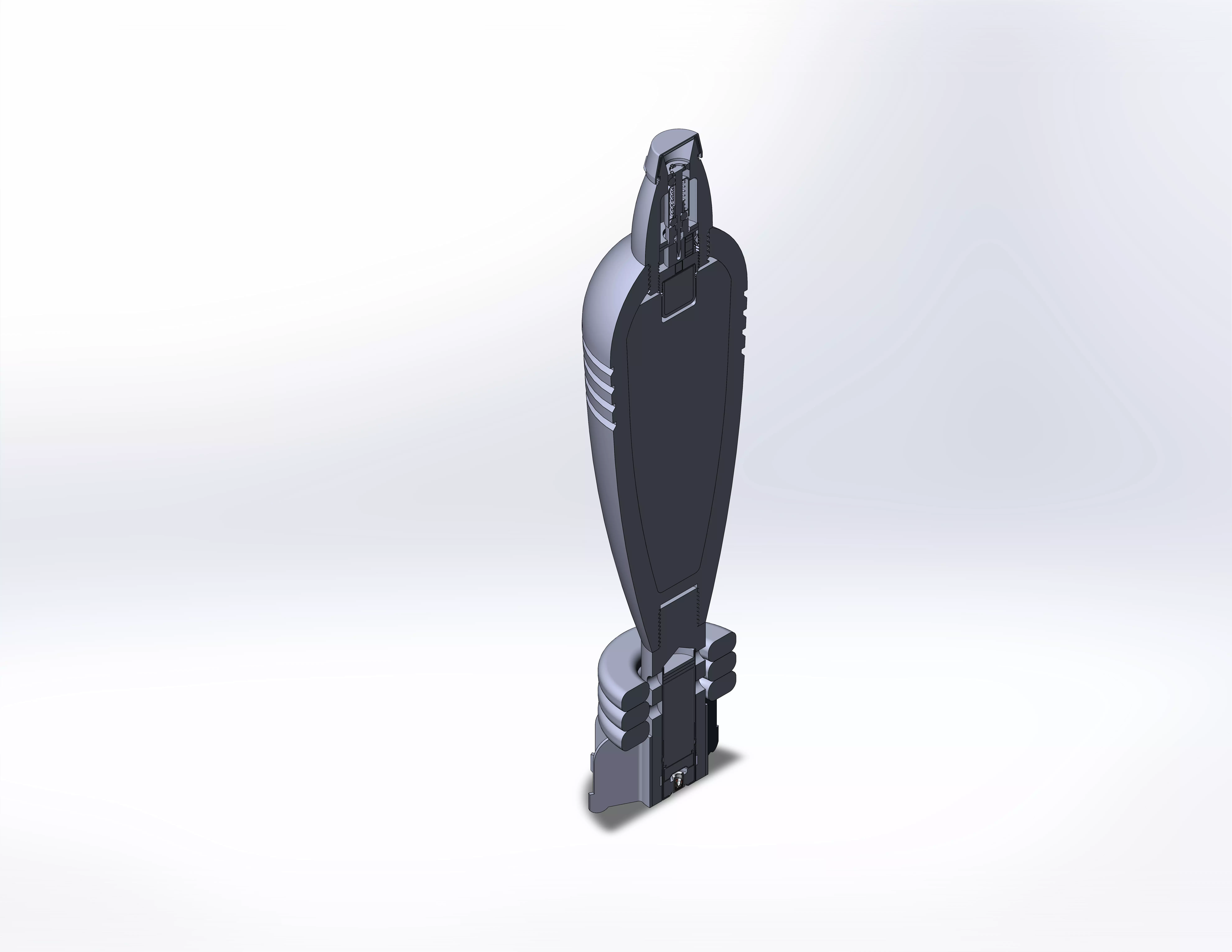
This is the Russian 82 mm high-explosive fragmentation mortar bomb, also manufactured in Bulgaria and Iraq.
The O-832-DU is a conventional teardrop-shaped mortar bomb with a ferro-steel body and a welded steel tail unit with 10 fins. The body has five gas-check rings around the bourrelet and is threaded at the nose for a fuze and at the rear for the tail unit.
A primary cartridge fits into the tail boom, and four secondary propellant increments in cloth-covered split rings fit around the boom. The nose is threaded for the fuze; no adaptor is used. The bursting charge is TD-42, a form of TNT.
The mortar bomb is fitted with an M-6 point-detonating fuze with long-range arming. The fuze’s safe drop height is 3 m, verified by drop testing in various orientations using an inert mock-up weighing up to 6.5 kg.
Thanks to its faster action and higher sensitivity, the M-6 fuze—compared to the M-4, M-5, and M-5S fuzes—provides more reliable functioning when firing onto stony ground.
The fuze body is made of plastic. A thin copper diaphragm is secured on the fuze head by means of a conical ring. To ensure sealing, the diaphragm’s outer conical surface and the ring’s inner conical surface are coated with red lead (lead tetroxide) diluted with oil varnish.
A safety cap is fitted over the fuze head to protect the diaphragm from damage. The cap is retained on the body by a safety pin with a pull tape. The tape bears the inscription: “Before loading, pull the pin and remove the cap.”
On the outside of the conical part of the body there are two wrench slots used when screwing the fuze into the bomb.
The stabilizer provides in-flight stability. It consists of a tube with fins welded to it. The primary charge is inserted into the stabilizer tube, and the additional charges are fitted externally. The stabilizer tube has holes for venting propellant gases from the primary charge and for igniting the additional increments.
The primary charge consists of a paper cartridge case with a metal base, a charge of nitroglycerin propellant, and an igniter primer. The case has an annular thickening to retain it in the stabilizer tube. The propellant charge is contained in the case and covered with wads. The entire primary charge is lacquer-coated.
The additional charge consists of nitroglycerin propellant packed in a cloth ring-shaped bag.
Before loading, the pull tape is used to withdraw the safety pin and remove the cap. Firing with the cap fitted is not permitted, as this may cause fuze malfunctions.
On firing, the additional increments are ignited by propellant gases from the primary charge, which rupture the cartridge case and vent through the holes in the stabilizer tube.
Under the inertial force generated on firing, the cap compresses the coil spring and moves downward. Due to a pin pressed into the bushing and engaged in the cap’s zigzag groove, the cap’s linear movement is somewhat retarded, since it is combined with a reciprocating rotary motion about the guide pin. However, the cap completes its travel to the extreme lower position before the bomb leaves the barrel.
At the same time, as the cap settles, the upper ball moves downward.
After the bomb clears the muzzle, the cap is driven upward by the spring until it seats against the mushroom. The cap’s upward travel is also somewhat retarded by the zigzag groove.
Using the chamfer on the striker, the two lower balls roll out into the body recess, thereby unlocking the striker so it can initiate the detonator upon impact with an obstacle.
Further upward movement of the cap occurs together with the mushroom and the striker until the mushroom bears against the diaphragm.
As it moves upward, the striker disengages from the slider, which, under spring force, shifts into the armed position in which the striker, the percussion primer, and the detonator are aligned on the same axis.
Fuze arming occurs after the bomb has traveled from the mortar muzzle at a distance of not less than 0.75 m and not more than 10 m.
On impact with an obstacle, the diaphragm deforms and the striker is driven sharply toward the rear of the fuze. The striker point pierces the percussion primer. The primer’s explosion destroys the shear web and initiates the detonator and booster, which in turn detonate the mortar bomb’s main charge.
The fuze is highly sensitive and functions instantaneously, operating virtually fail-safe when fired into snow, moss, marshland, water, and a wide range of soils, including rocky and stony ground.