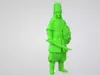
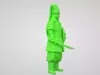
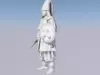
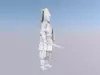
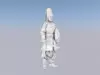
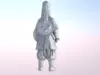
DESCRIPTION

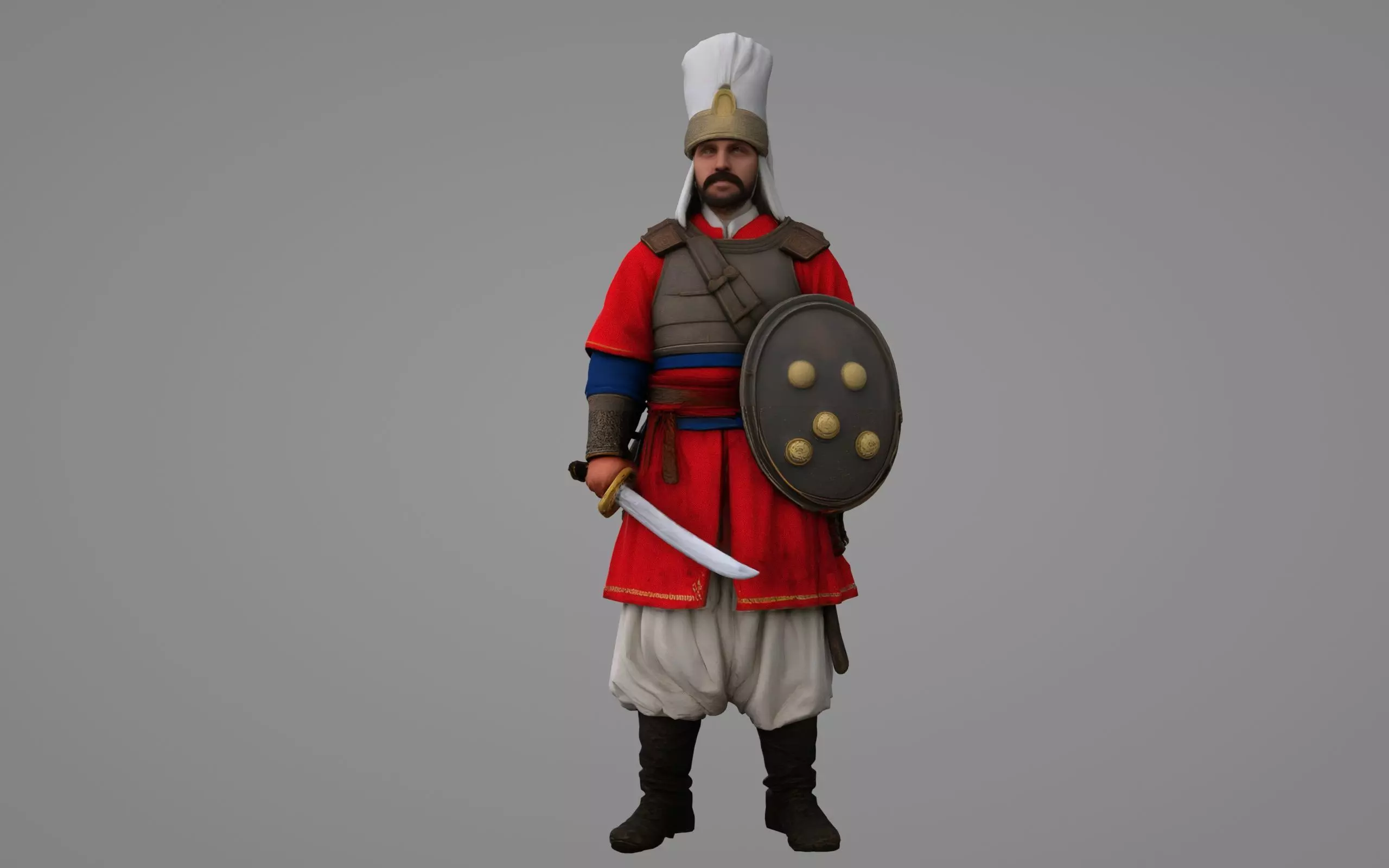
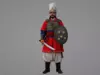
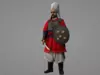
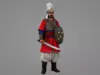
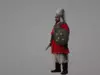
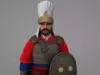
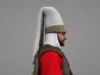
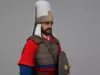
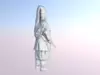
stl formatA janissary (UK: /ˈdʒænɪsəri/ JAN-iss-ər-ee, US: /-sɛri/ -⁠err-ee; Ottoman Turkish: یڭیچری, romanized: yeñiçeri, IPA: [jeˈɲit͡ʃeɾ̞i], lit. 'new soldier') was a member of the elite infantry units that formed the household troops. They were one of the first modern standing armies, and perhaps the first infantry force in the world to be equipped primarily with firearms, adopted during the reign of Murad II (r. 1421–1444, 1446–1451).[4][5][6][7] The corps was established under either Orhan or Murad I,[4] and dismantled by Mahmud II in 1826.

Janissaries began as an elite corps made up through the devşirme system of child levy enslavement,[8][9][10] by which Christian boys, chiefly from the Balkans, were taken, levied, subjected to forced circumcision and forced conversion to Islam,[8][9][10] and incorporated into the Ottoman army.[8][9][10] They became famed for internal cohesion cemented by strict discipline and order. Unlike typical slaves, they were paid regular salaries. Forbidden to marry before the age of 40 or engage in trade, their complete loyalty to the Ottoman sultan was expected.[11] By the 17th century, due to a dramatic increase in the size of the Ottoman standing army, the corps' initially strict recruitment policy was relaxed. Civilians bought their way into it in order to benefit from the improved socio-economic status it conferred upon them. Consequently, the corps gradually lost its military character, undergoing a process that has been described as civilianization.[12]

The Janissary Corps were a formidable military unit in the early centuries, but as Western Europe modernized its military organization and technology, the Janissaries became a reactionary force that resisted all change within the Ottoman army. Steadily the Ottoman military power became outdated, but when the Janissaries felt their privileges were being threatened, or outsiders wanted to modernize them, or they might be superseded by their cavalry rivals, they would rise in rebellion. By the time the Janissaries were suppressed, it was too late for Ottoman military power to catch up with the West.[13] The Janissary Corps was abolished by Mahmud II in 1826 in the Auspicious Incident, in which 6,000 or more Janissaries were executed.[14]

REVIEWS & COMMENTS

See what other buyers think about this model - real feedback on quality,
accuracy, and usability.
There are no reviews or comments yet. Please be the first one to write it.
NEW
Recently added to CGTrader - explore one of the latest models on the marketplace.

Turkish Ottoman soldier 3d model Low-poly 3D model

Royalty Free License
Hire
Like this model to show appreciation to the designer.
See how many times this model was viewed.
Share this model to support the designer and boost their visibility.
File formats
STL
Stereolithography<br />Version: 1<br />File Size: 2.37 MB
JPG
JPG | 2 files<br />Version: 3<br />File Size: 64.7 MB
PNG
PNG<br />File Size: 32.4 MB
C4D
Cinema 4D | 2 files<br />Version: 3 - Renderer: Default<br />Version: 19 - Renderer: Default<br />File Size: 81.6 MB
EXR
EXR<br />File Size: 78.4 MB
3DS
3D Studio<br />Version: 1<br />File Size: 1.31 MB
FBX
Autodesk FBX<br />Version: 1<br />File Size: 5.99 MB
DAE
Collada<br />Version: 1.<br />File Size: 4.39 MB
Verified by CGTrader
Verified models are of higher quality as they have
passed CGT Standard technical and visual checks,
making them more professional-grade 3D assets.
Learn more.
FBX
This FBX file has successfully passed the CGT Standard technical and visual checks. The verification results are detailed in the section below.
File & scene
Binary FBX
Binary FBX file is more compact and faster to load and process.
Learn more
No unsupported objects
Unsupported objects:
- Lights
- Cameras
Learn more
Geometry
No N-gons
N-gons are polygons with five or more sides which might cause issues in certain processes like rendering or animation. Learn more
No faceted geometry
Faceted geometry uses flat surfaces without smoothing, which can look unrealistic on curves.
Learn more
Manifold geometry
Manifold geometry ensures all surfaces are properly connected, avoiding issues like edges shared by more than two faces.
Learn more
Textures & material
PBR textures
PBR textures simulate how light interacts with materials, making the model look realistic under different lighting.
Required PBR textures:
- Base Color
- Roughness
- Metalness
- Normal
Learn more
No embed textures
Embedded textures are stored inside the model file, increasing its size and sometimes causing compatibility issues.
Learn more
Square textures
Texture aspect ratio is the width-to-height ratio of a texture. Expected texture aspect ratio: 1:1
Learn more
Power of 2 texture sizes
Textures with dimensions in power of two (e.g. 512x512px, 1024x1024px) are used to optimize performance and memory usage.
Learn more
Assigned materials
Materials are applied to the 3D model to allow visualize a model's surface properties and appearance.
Learn more
UVs & naming
No UV overlaps
UVs overlap when multiple points on the 3D model's surface are mapped to the same point on the UV island causing texture stretching.
Learn more
UV unwrapped model
A UV unwrapped model means its 3D surface is flattened into 2D space, allowing textures to be applied accurately.
Learn more
Allowed characters
Allowed ASCII characters: a-zA-Z0-9-_
Learn more
Provided by designer
Information and details shared directly by the model's designer.
3D Features
PBR
Uses Physically Based Rendering materials, which give the model realistic lighting and surface properties.
Textures
The model includes image files (textures) that add color, patterns, or detail to its surfaces.
Materials
The model has material settings that define how surfaces look (color, shine, transparency, etc.).
UV Mapping
The model's surfaces are mapped to a 2D image, allowing textures to display correctly.
Plugins Used
Some external plugins were used to create the model. These may be required for full functionality.
3D printing
Indicates whether the designer marked this model as suitable for 3D printing.
Model is not 3D printable
The designer indicates this model is intended for digital use only (rendering, animation, or AR/VR) and not for 3D printing.
Geometry
Polygon mesh
A model built from polygons (triangles or quads) connected in a mesh.
50525 polygons
The total number of polygons (flat shapes) that make up the 3D model.
/ 149567 vertices
The number of points (corners) that define the shape of the model's polygons.
Unwrapped UVs
Publish date
Model ID
Chat