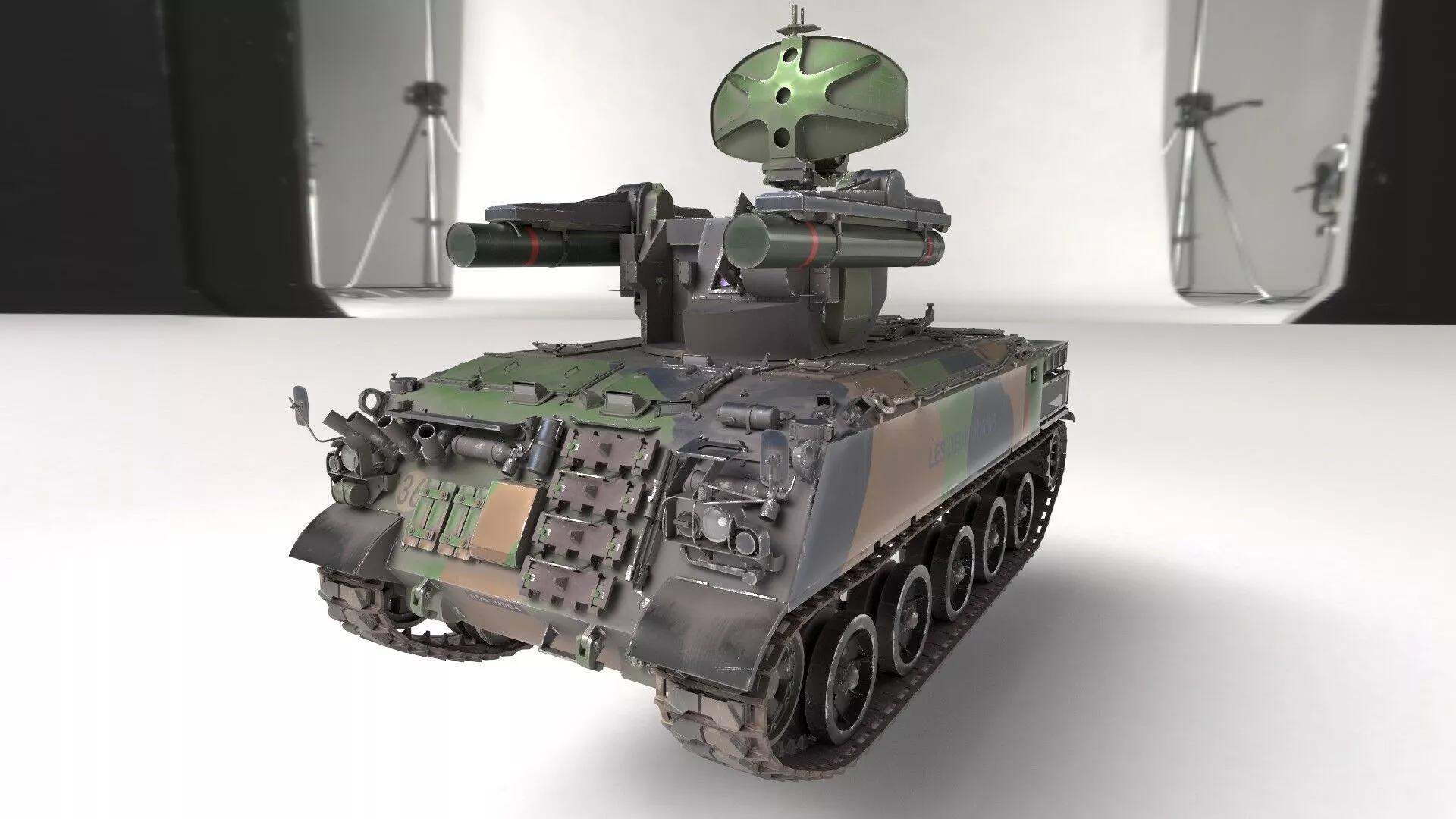
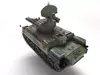
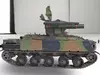
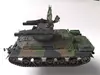
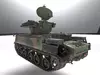
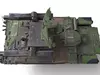
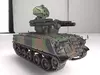
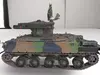
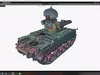
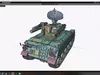
The development of SAMs (Surface to Air Missiles) launchers led to the creation of an all-terrain vehicle capable of covering divisions in operations. This imposed the SPAAML type or Self-Propelled Anti-Aircraft Missile Launcher. With its range, it gave another protective layer well above the range of sp. AA guns (SPAAGs). In France, the Roland was the dedicated platform to operate the Roland missile, co-developed with West Germany. Due to the weight of the launcher, reloads and operative systems, the AMX-30 chassis was chosen for this development, on specifications to GIAT. About the Roland SAM
This short-range surface-to-air missile was developed in the 1960s specifically for mobile platforms and to protect high-value targets like airfields. It was studied from 1936 by Nord Aviation of France and Bölkow of West Germany and led to the first test in June 1968. However, development continued on until 1977 when it was officially accepted into service. In 1978 the first all-weather Roland II version was introduced in Germany, 1981 in France.
The Roland deployed on the AMX-30 (Marder IFV in Germany) flew at Mach 1.3 to 1.6 at altitudes ranging from 20 to 5,500 meters. It was 67 kgs in weight and could carry a 6.5 kg (14.3 lb) pre-fragmented high-explosive payload with a 6 m lethality radius. The Roland 3, VT1 (1991) developed by Euromissile/Thomson CSF/Thales means it's still in service today, although due to high price tag the procurement never reached initial objectives. Outside France and Germany, it is also used by the US Army. Historically Roland was a famous Charlemagne's Paladin (Knight bodyguard).
Design of the AMX-30 Roland
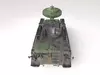
The main superstructure was completely rebuilt to integrate the launcher, with the driver, commander and operator nearby all in the front section with their separate hatches. Rather bulky with flat sides and barely sloped front, it is roomy enough to provide shelter to the operative systems and reloads (eight, four per reload bin, two ready, ten total).
Reaction time was for the 1st shot: 8 to 10 seconds and 2nd shot 2 to 6 seconds, with an average reloading time of 10 seconds and 80% first hit capability. For targeting, the central mount comprised a 16 km range surveillance radar, telescopic sight, infrared locator measuring the gaps between the trajectory and line of sight, fire control radar (Roland 2), computer and remote antenna. The drivetrain depends on the same multi-fuelled Hispano-Suiza HS-110 diesel engine generating 720hp on which the fast AMX-30 was based on. This gave the Roland the same all-terrain mobility and agility.