High-quality 3D assets at affordable prices — trusted by designers, engineers, and creators worldwide. Made with care to be versatile, accessible, and ready for your pipeline.
Included File Formats
This model is provided in 14 widely supported formats, ensuring maximum compatibility:
• - FBX (.fbx) – Standard format for most 3D software and pipelines
• - OBJ + MTL (.obj, .mtl) – Wavefront format, widely used and compatible
• - STL (.stl) – Exported mesh geometry; may be suitable for 3D printing with adjustments
• - STEP (.step, .stp) – CAD format using NURBS surfaces
• - IGES (.iges, .igs) – Common format for CAD/CAM and engineering workflows (NURBS)
• - SAT (.sat) – ACIS solid model format (NURBS)
• - DAE (.dae) – Collada format for 3D applications and animations
• - glTF (.glb) – Modern, lightweight format for web, AR, and real-time engines
• - 3DS (.3ds) – Legacy format with broad software support
• - 3ds Max (.max) – Provided for 3ds Max users
• - Blender (.blend) – Provided for Blender users
• - SketchUp (.skp) – Compatible with all SketchUp versions
• - AutoCAD (.dwg) – Suitable for technical and architectural workflows
• - Rhino (.3dm) – Provided for Rhino users
Model Info
• - All files are checked and tested for integrity and correct content
• - Geometry uses real-world scale; model resolution varies depending on the product (high or low poly)
• • - Scene setup and mesh structure may vary depending on model complexity
• - Rendered using Luxion KeyShot
• - Affordable price with professional detailing
Buy with confidence. Quality and compatibility guaranteed.
If you have any questions about the file formats, feel free to send us a message — we're happy to assist you!
Sincerely,
SURF3D
Trusted source for professional and affordable 3D models.
More Information About 3D Model :
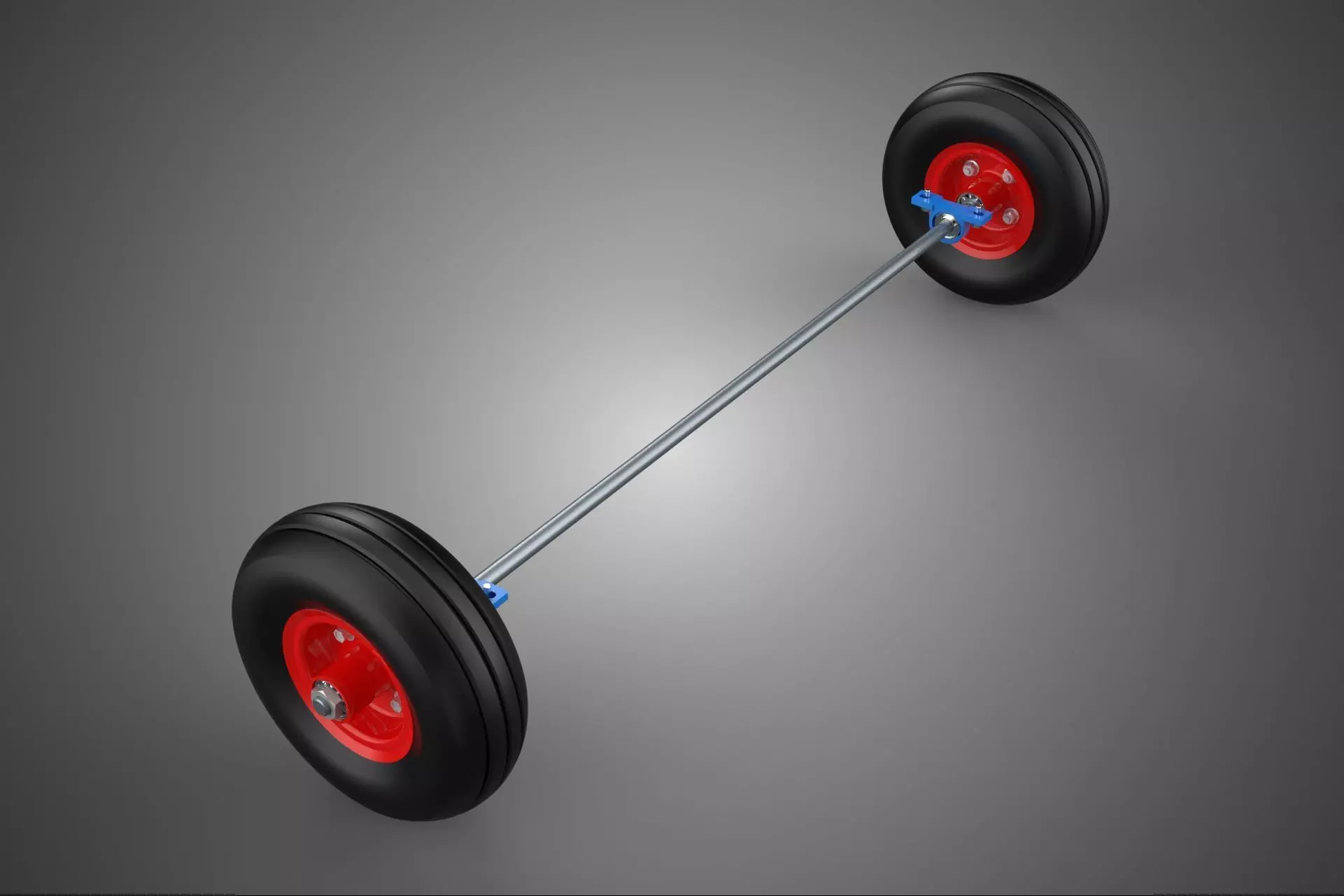
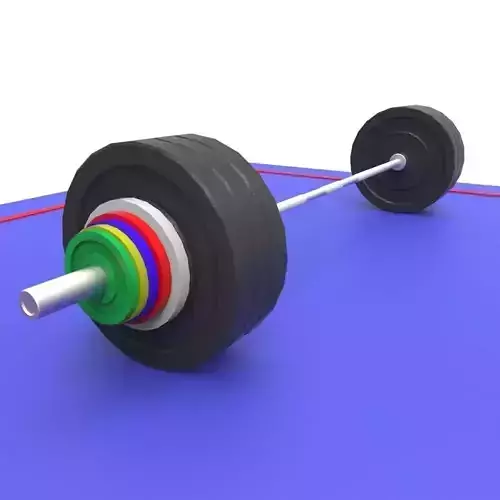
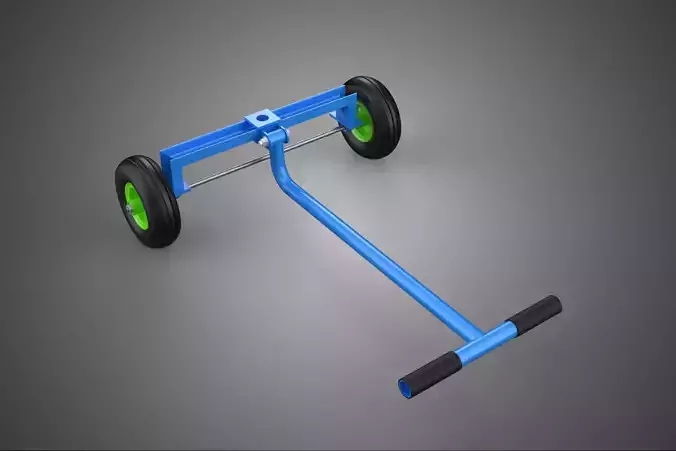
The components listed—Axle, Hub, Rod, Shaft, Wheel, Tire, Rim, Cart, Trolley, Barrow, and Bearing—collectively represent the fundamental mechanical architecture employed for non-motorized and low-speed mechanized rolling conveyance systems, designed to facilitate the transport of loads by converting sliding friction into significantly lower rolling friction. This system is foundational to virtually all terrestrial vehicles and material handling equipment.
Structural and Rotational Elements
Axle and Shaft: The Axle is a central structural component about which a wheel or system of wheels rotates. Axles are categorized based on their function: a dead axle supports weight but does not rotate or transmit power; a live axle transmits power and is typically rotated by an engine or motor. The term Shaft is broader, referring to any rotating machine element, usually of circular cross-section, used to transmit power or rotational motion; in wheeled systems, an axle often functions as a specific type of shaft.
Rod: In this context, a Rod typically refers to a structural member used for connection, stabilization, or articulation within the cart or trolley frame, distinguishing it from an axle or shaft primarily designed for rotation.
The Wheel Assembly
The Wheel is the primary circular component that contacts the ground, converting rotational motion into linear translation.
- Hub: The central part of the wheel assembly, often bowl- or cylinder-shaped, which provides the critical interface for mounting the wheel onto the axle or spindle. The hub houses the bearing system and secures the spokes or disc structure of the wheel.
- Rim: The outer edge of the wheel, typically a metal hoop, that supports the tire. The rim’s geometry is crucial for retaining the pneumatic or solid Tire under load and during motion.
- Tire: The ring-shaped component fitted around the rim, providing traction, cushioning, and acting as the final physical interface with the ground surface. Tires can be pneumatic (air-filled) for superior shock absorption or solid (e.g., hard rubber) for resilience in industrial environments.
### The Interface and Efficiency Component
Bearing: The Bearing is a critical machine element installed between the rotating hub and the stationary or rotating axle/spindle. Its primary function is to constrain relative movement, reduce rotational friction (kinetic friction), and efficiently support axial and radial loads. Common types used in these assemblies include ball bearings, roller bearings, and plain (sleeve) bearings, which drastically reduce the power required for movement compared to sliding mechanisms.
### Conveyance Applications
These components are integrated into load-bearing assemblies categorized by their design and intended use:
- Cart: Generally refers to a simple, two-wheeled vehicle designed for manual towing or pushing, utilizing balanced load distribution over the axle. Historically, the term also encompasses larger, animal-drawn vehicles.
- Trolley: Often used synonymously with a dolly or hand truck, a trolley is a platform or frame, typically with four wheels (or two fixed wheels and two swivel casters), designed for moving materials within confined spaces, such as warehouses or hospitals.
- Barrow: A single-wheeled or dual-wheeled vehicle (such as a wheelbarrow) designed for short-distance material conveyance. The defining characteristic is the use of handles and leverage, where the operator supports a significant portion of the load, minimizing the demand on the axle and bearing system.
The cohesive integration of the axle, bearing, hub, rim, and tire ensures efficient load transfer and minimized energy expenditure during locomotion across various surfaces.
KEYWORDS: Mechanics, Locomotion, Rolling Friction, Load Distribution, Material Handling, Conveyance System, Axle Assembly, Wheel Dynamics, Hub Assembly, Bearing Technology, Cart Design, Trolley Engineering, Wheelbarrow Structure, Spindle, Chassis, Radial Load, Axial Load, Rotational Motion, Pneumatic Tire, Solid Tire, Rim Profile, Power Transmission, Structural Integrity, Material Science, Lubrication, Friction Reduction, Vehicle Components, Transport Technology, Hand Truck, Industrial Dolly.