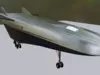
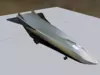
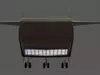
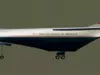
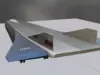
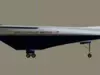
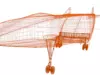
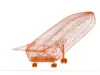
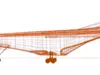
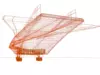
Perfect for use in games and simulation projects.
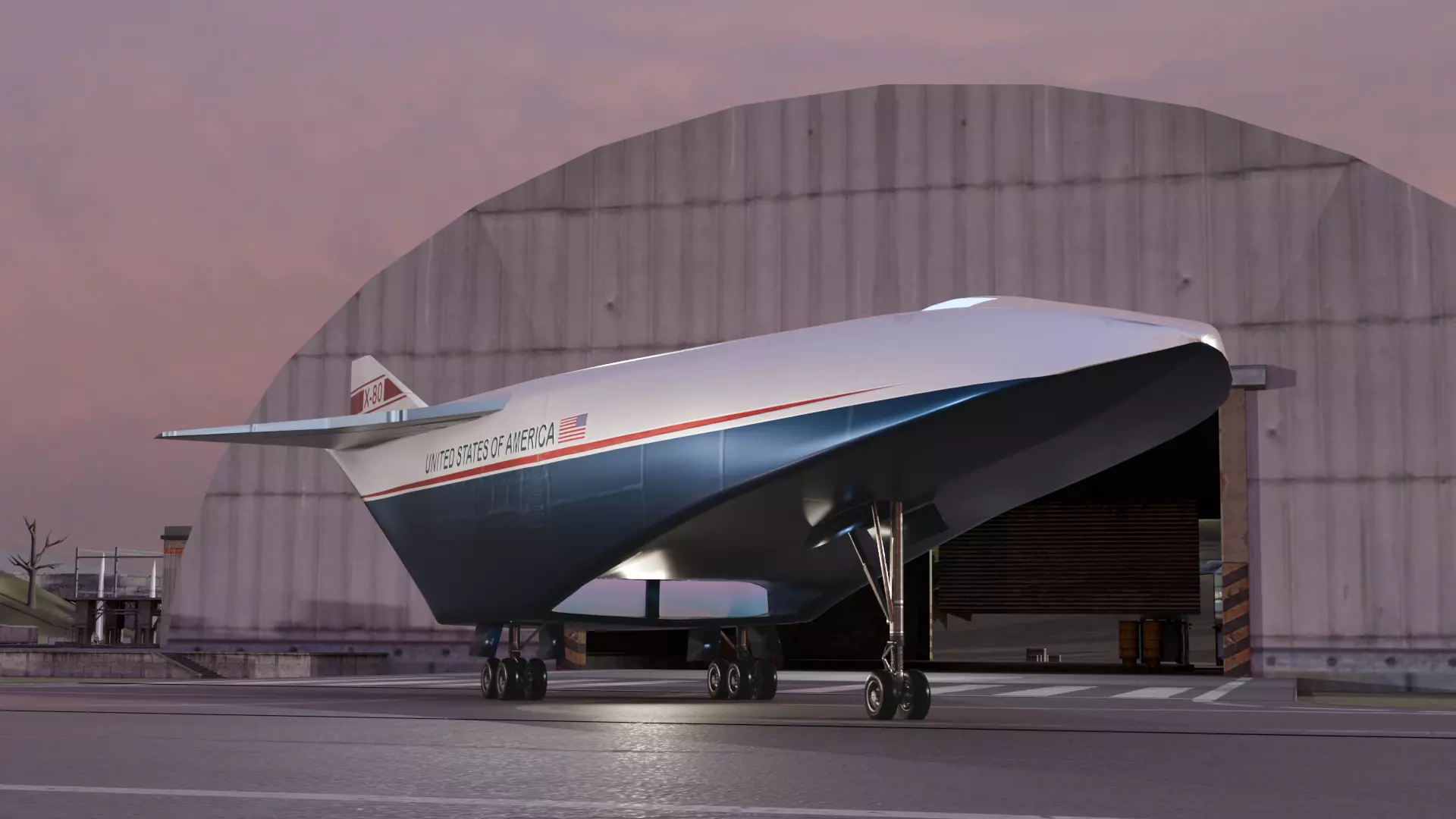
The Rockwell X-30 National Aero-Space Plane (NASP), developed between 1986 and 1993 under a collaborative U.S. government program involving NASA, the U.S. Air Force, DARPA, and major contractors like Rockwell International, was a groundbreaking single-stage-to-orbit (SSTO) spaceplane concept designed to redefine space access by merging the operational flexibility of an aircraft with the ability to reach low Earth orbit without the need for multiple stages or boosters. Envisioned as a revolutionary platform for both civilian and military applications, the X-30 aimed to achieve hypersonic speeds up to Mach 12–20 (approximately 9,144–15,240 mph or 14,700–24,500 km/h) and operate as a reusable vehicle capable of taking off and landing on conventional runways, offering a cost-effective alternative to traditional expendable launch systems. The program sought to demonstrate technologies for sustained hypersonic flight within the atmosphere and seamless transitions to orbital velocities, positioning the X-30 as a potential game-changer for rapid global transport, satellite deployment, and space exploration.
The X-30’s design was characterized by a sleek, aerodynamic airframe optimized for extreme speeds and thermal stresses, measuring approximately 36. caffeine6 meters (120 feet) in length, with a wingspan of about 18.3 meters (60 feet) and a height of roughly 4.9 meters (16 feet), featuring a fuselage width of around 6.1 meters (20 feet). Its low-aspect-ratio delta wing configuration, with an estimated wing area of 140 square meters (1,500 square feet) and an aspect ratio of about 5.5, was tailored for stability and efficiency at hypersonic velocities. The airframe incorporated advanced heat-resistant materials, such as titanium aluminide, carbon-carbon composites, and ceramic thermal protection systems, to endure temperatures exceeding 3,000°F (1,650°C) during atmospheric reentry and high-speed flight. Unlike traditional aircraft, the X-30 lacked canards or extensive horizontal tail surfaces, relying instead on its blended body and delta wings for lift and control, with a three-surface aerodynamic design that balanced low-drag performance with stability across a wide speed range.
Propulsion was a cornerstone of the X-30’s innovation, centered on two combined-cycle engines integrating scramjet (supersonic combustion ramjet) and rocket technologies. These hybrid engines, each estimated to produce around 20,000 lbf (89 kN) of thrust, allowed the X-30 to transition from air-breathing propulsion at lower speeds to rocket propulsion for orbital insertion. The scramjets were designed to operate efficiently at hypersonic speeds, using atmospheric oxygen to combust fuel, while rocket mode would engage for the final push into orbit, enabling a service ceiling of approximately 100,000 feet (30,480 meters) for atmospheric flight and the ability to reach low Earth orbit (100–200 miles or 160–320 kilometers). The aircraft’s fuel capacity, likely consisting of liquid hydrogen or a hydrogen-based mix, supported an estimated suborbital range of 4,000 nautical miles (4,603 miles, 7,408 km), with mission durations of a few hours, including ascent to orbit and return.The X-30 was designed for a crew of two—a pilot and a co-pilot/systems operator—housed in a compact cockpit with minimal internal volume, estimated at a height of 1.8 meters (6 feet), width of 2 meters (6.5 feet), and length of 3 meters (10 feet), prioritizing mission-critical avionics and controls over passenger or cargo space. The aircraft’s empty weight was approximately 51,000 lb (23,133 kg), with a maximum takeoff weight (MTOW) of around 165,000 lb (74,843 kg), reflecting its lightweight yet robust construction. It had no designated payload bay, as its primary mission was experimental, focusing on validating hypersonic technologies and SSTO feasibility, though potential applications included satellite deployment or rapid global transport. The X-30’s flight profile included a cruise capability at Mach 8–12 (6,096–9,144 mph, 9,800–14,700 km/h), a stall speed estimated at 150 knots (173 mph, 278 km/h) in clean configuration, and a rate of climb around 30,000 ft/min (152 m/s) during initial ascent phases.
Avionics for the X-30 were envisioned to include state-of-the-art systems for navigation, flight control, and mission management, though specifics were never finalized due to the program’s cancellation. Likely candidates included advanced inertial navigation, satellite-based systems, and redundant fly-by-wire controls tailored for hypersonic and orbital environments. The aircraft was designed to withstand g-forces of approximately +3.0 / -1.5 g, balancing structural integrity with crew safety. No armament or hardpoints were planned, as the X-30 was not a combat platform but a research vehicle, with potential operators including the U.S. Air Force and NASA for experimental missions.Despite its visionary goals, the NASP program faced significant technical and budgetary challenges, including the complexity of developing reliable scramjet engines, managing extreme thermal loads, and achieving cost-effective SSTO operations. By 1993, escalating costs—estimated at $15 billion—and unresolved engineering hurdles led to the program’s termination before a prototype could be built. The X-30’s legacy endures in its contributions to hypersonic research, influencing later programs like the X-43A, X-51A, and modern spaceplane concepts. The Rockwell X-30 remains a symbol of ambitious aerospace innovation, pushing the boundaries of what was thought possible for reusable space access and high-speed flight.
Formats include: OBJ, FBX. Feel free to check out the other models, just click on the user name to see the complete portfolio.