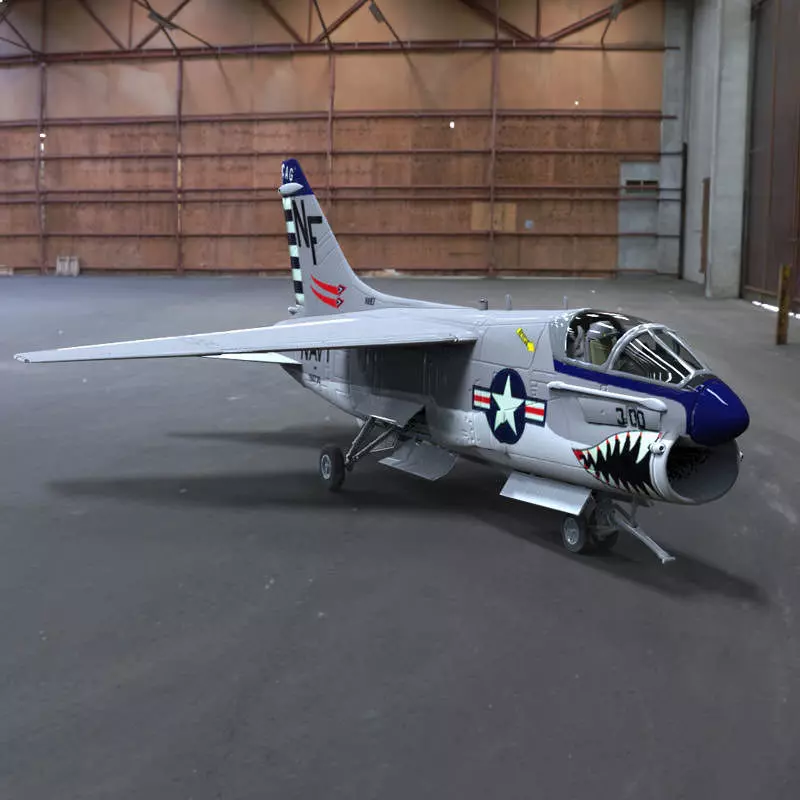
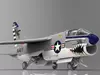
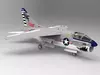
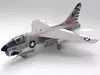
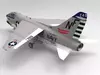
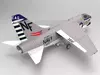
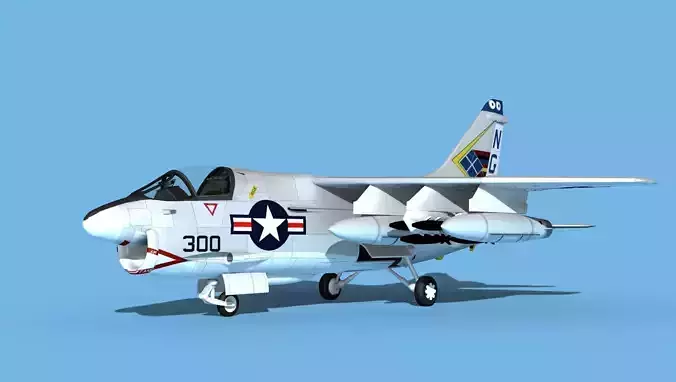
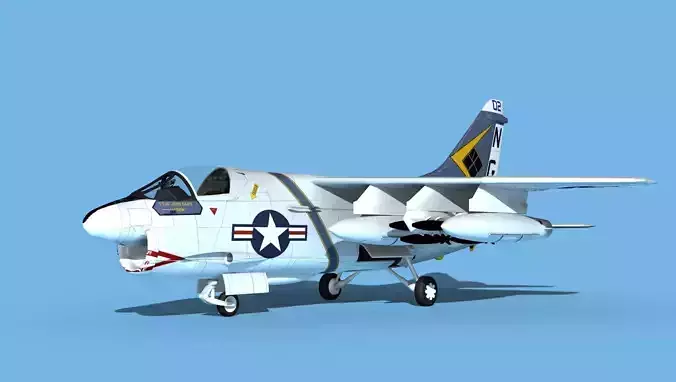
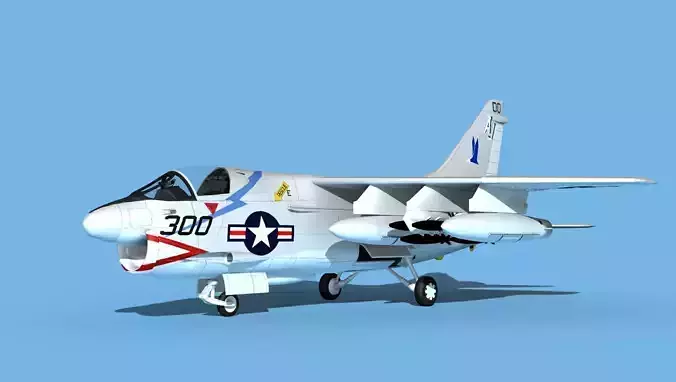
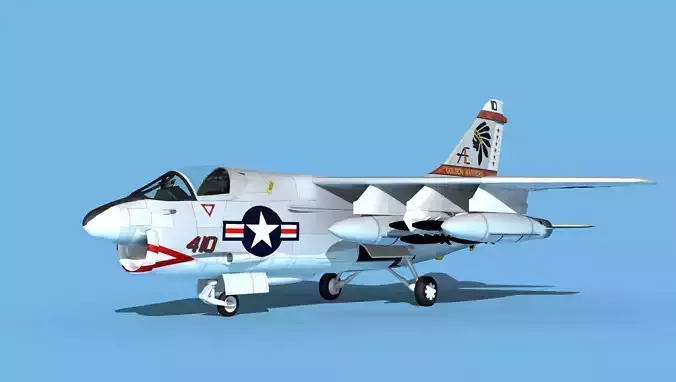
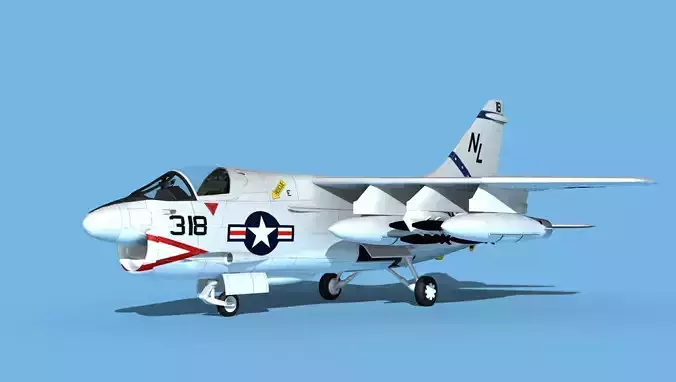
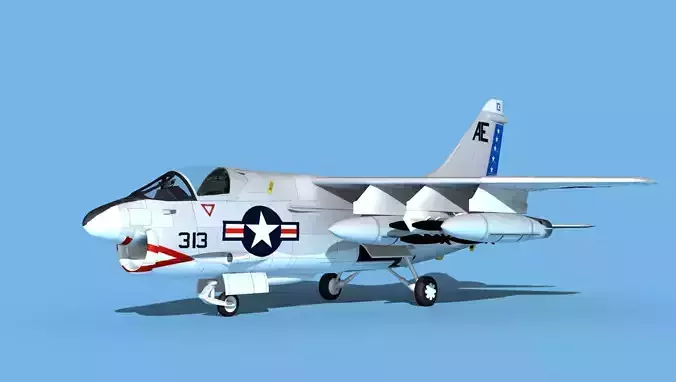
The Ling-Temco-Vought A-7 Corsair II is a carrier-based subsonic light attack aircraft design that was introduced to replace the A-4 Skyhawk in US Naval service and based on the successful supersonic F-8 Crusader aircraft produced by Chance Vought. The A-7 was one of the first combat aircraft to feature a head-up display (HUD), doppler-bounded inertial navigation system (INS), and a turbofan engine. It initially entered service with the United States Navy during the Vietnam conflict and was then adopted by the United States Air Force to replace their A-1 Skyraiders that were borrowed from the Navy as well as with the Air National Guard. It was exported to Greece (in the 1970s), Portugal, and Thailand (in the late 1980s).
The A-7 Corsair II was tagged with the nickname "SLUF" ("Short Little Ugly Feller" was the polite version) by pilots.
Pilots of the early A-7s lauded the aircraft for general ease of flying (with the exception of poor stability on cross-wind landings) and excellent forward visibility but noted a lack of engine thrust. This was addressed with A-7B and more thoroughly with A-7D/E. The turbofan engine provided a dramatic increase in fuel efficiency compared with earlier turbojets -- the A-7D was said to have specific fuel consumption one sixth that of an F-100 Super Sabre at equivalent thrust. An A-7D carrying 12x 500 lb (227 kg) bombs at 480 mph (775 km/h) at 33,000 ft (10,000 m) used only 3,350 lb (1,500 kg) of fuel per hour. The integrated weapons computer provided highly accurate bombing with CEP of 60 ft (20 m) regardless of pilot experience. The doppler navigation system required a mere 2.5 minutes on the ground for partial alignment, a big improvement over 13 minutes required in F-4 Phantom II. In addition, the A-7 required only 11.5 man hours of maintenance per mission resulting in quick turnaround and high number of combat-ready aircraft.
From 1967 thru 1973, ten of the twenty U.S. Navy aircraft carriers fighting off of the Vietnam coast lost A-7's, 15 of which were shot down by surface to air missiles (SAMs): USS Ticonderoga lost 3, USS Constellation lost 15, USS Ranger lost 11, USS Coral Sea lost 13, USS Midway lost 2, USS Oriskany lost 8, USS Saratoga lost 8, USS Kitty Hawk lost 13, USS Enterprise lost 3, and the USS America lost 16.
Product Features:
The product contains four resolutions of the model, the high resolution version being rigged for animation.
The model is highly detailed and textured.
This model is a 3DMax model, saved in version 8 as a MAX file, and requires 3DMax. It does not include any other formats to allow it to be opened in any other software. The model is rigged where appropriate, and mapped and textured.