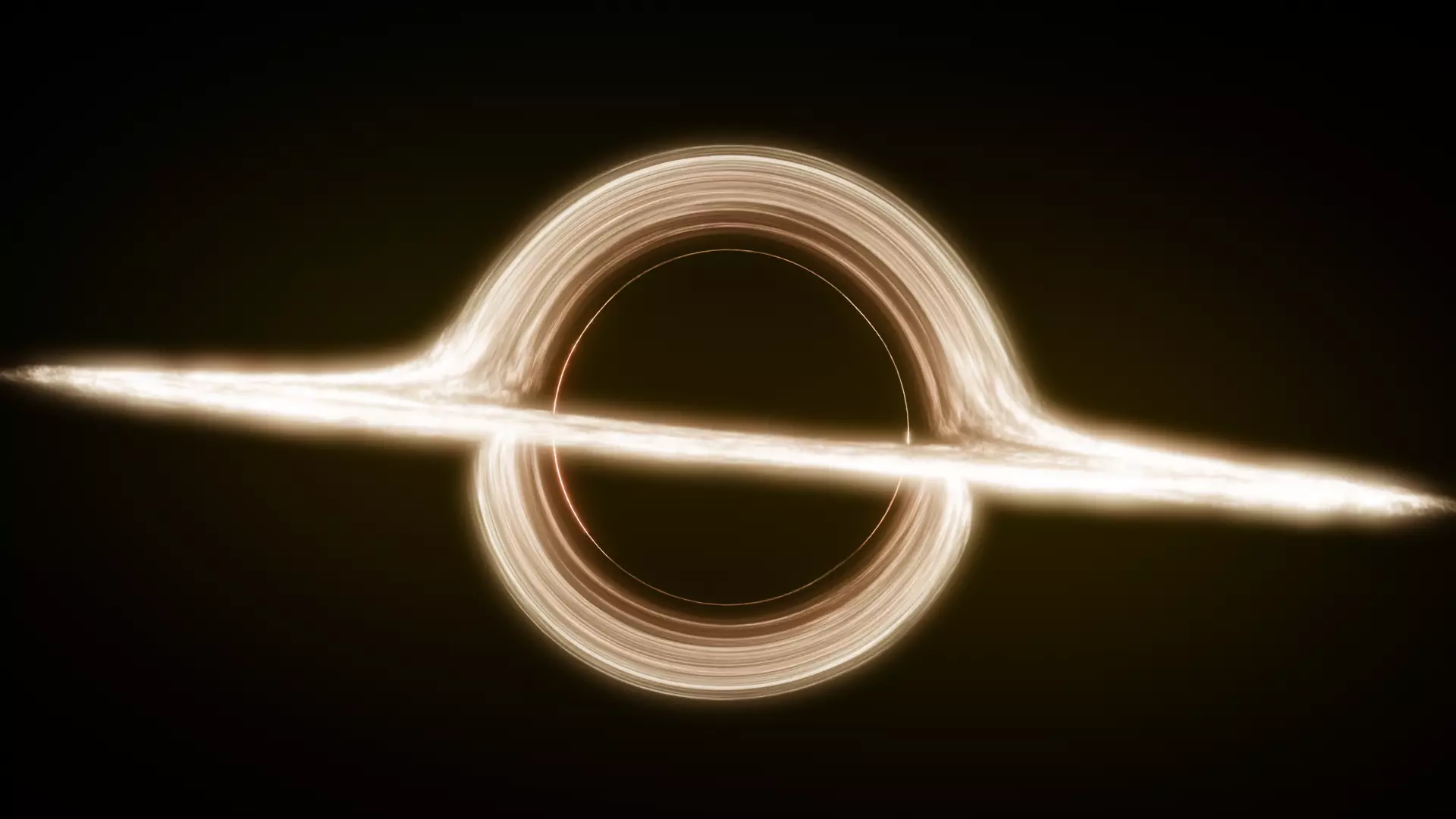
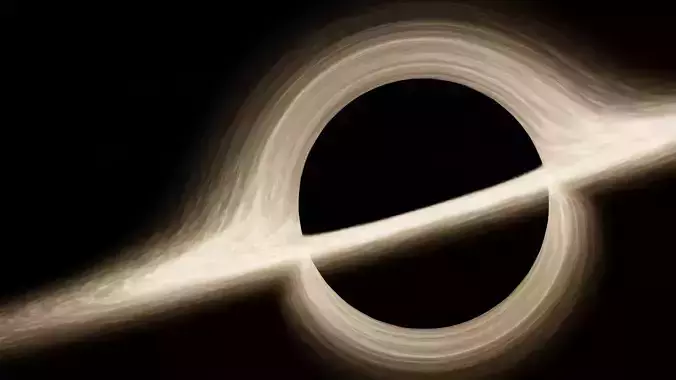
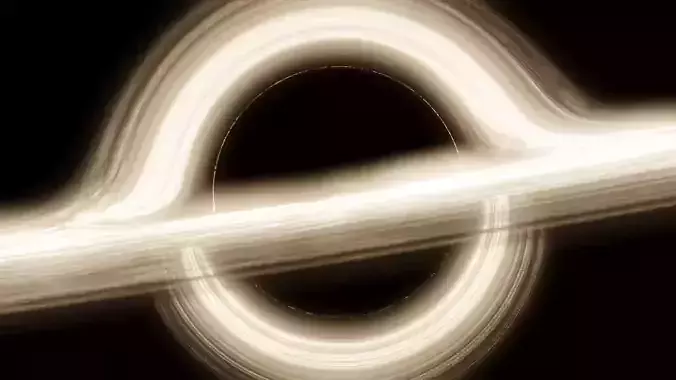
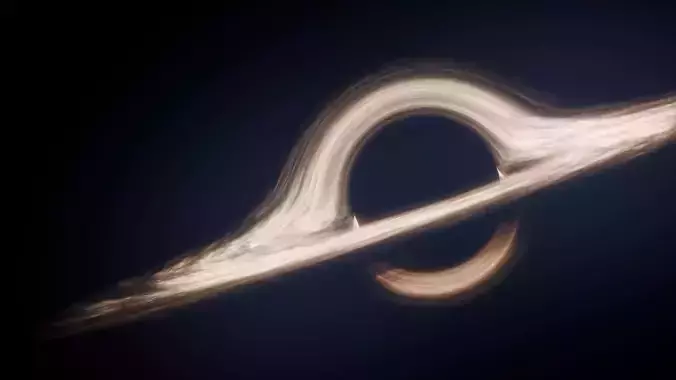
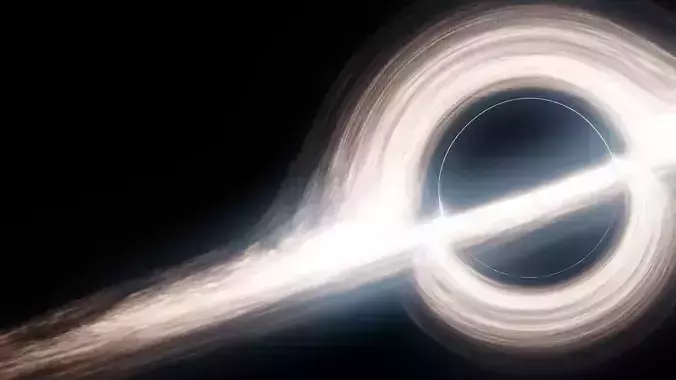
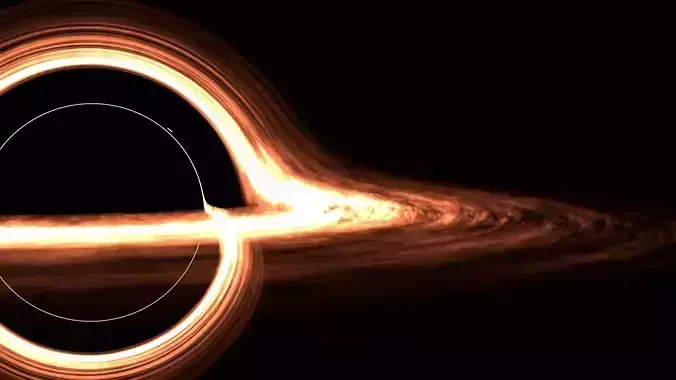
“Gargantua” is the name of the gigantic black hole featured in the science fiction film Interstellar (2014), directed by Christopher Nolan. In the story, Gargantua is located in a distant galaxy and plays a central role in the plot because several potentially habitable planets orbit around it.
A black hole is an object in space with gravity so strong that nothing — not even light — can escape once it passes a boundary called the “event horizon.” Because black holes themselves are invisible, they are usually shown surrounded by glowing matter and distorted light. In Interstellar, Gargantua is portrayed with remarkable scientific accuracy compared to many other science fiction movies.
The appearance of Gargantua was created with the help of physicist Kip Thorne, a Nobel Prize-winning expert in relativity and black holes. Instead of simply showing a dark sphere, the movie depicts how the black hole bends and warps light around itself through extreme gravity. The bright ring around Gargantua is called an accretion disk — superheated gas and dust spinning at enormous speed around the black hole.
One of the most important concepts connected to Gargantua is “time dilation.” According to Einstein’s theory of relativity, extremely strong gravity can slow down time. In the movie, this means that time passes much more slowly on planets near Gargantua than it does farther away. For example, on one nearby planet, a few hours for the astronauts equal many years for people elsewhere. This creates some of the film’s most emotional and dramatic moments.
Gargantua is also portrayed as a “supermassive rotating black hole,” meaning it is far larger than ordinary stellar black holes and spins rapidly. Its rotation allows some nearby planets to exist without immediately falling into it, although the environment remains extremely dangerous because of massive tides, radiation, and gravitational effects.
Visually, Gargantua became famous because it was one of the most scientifically realistic black holes ever shown in cinema. The visual effects were so advanced that researchers later used some of the rendering techniques in scientific studies and publications.
For viewers unfamiliar with astronomy, Gargantua can be understood as both a real scientific concept and a storytelling device. In Interstellar, it represents the mystery, beauty, danger, and scale of the universe, while also exploring human ideas about time, survival, love, and exploration.InterstellarGargantuablenderPolygons 154218Vertices 308172