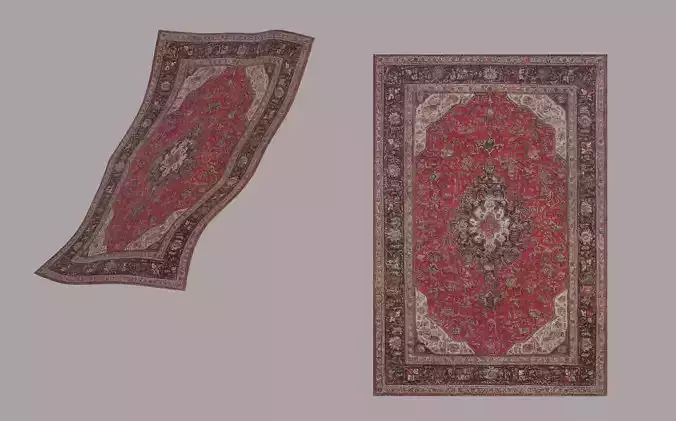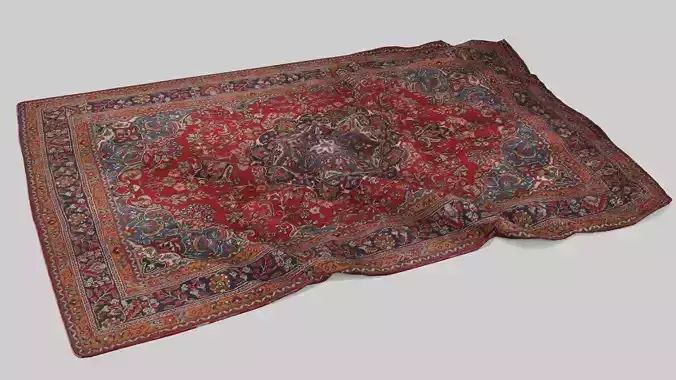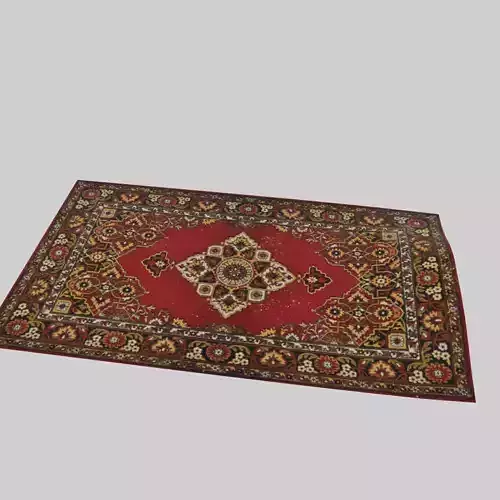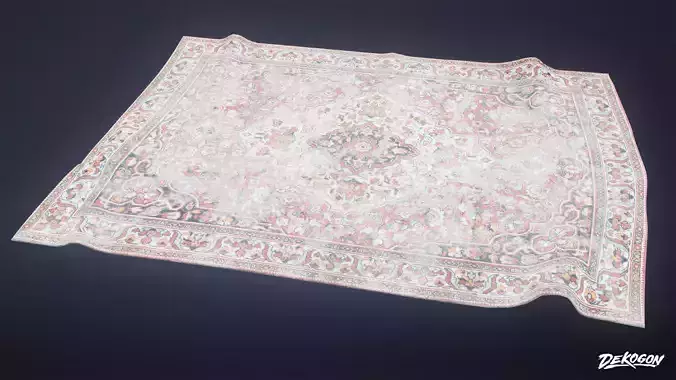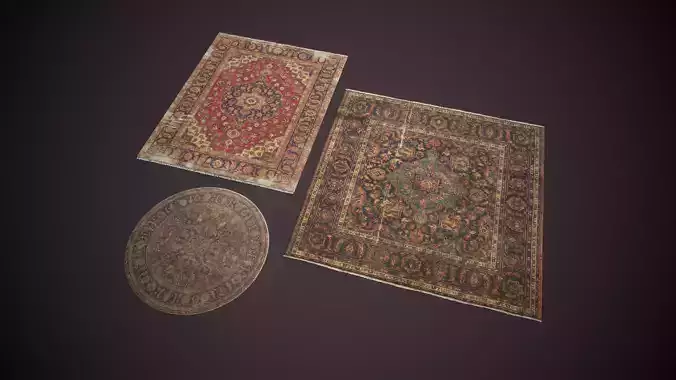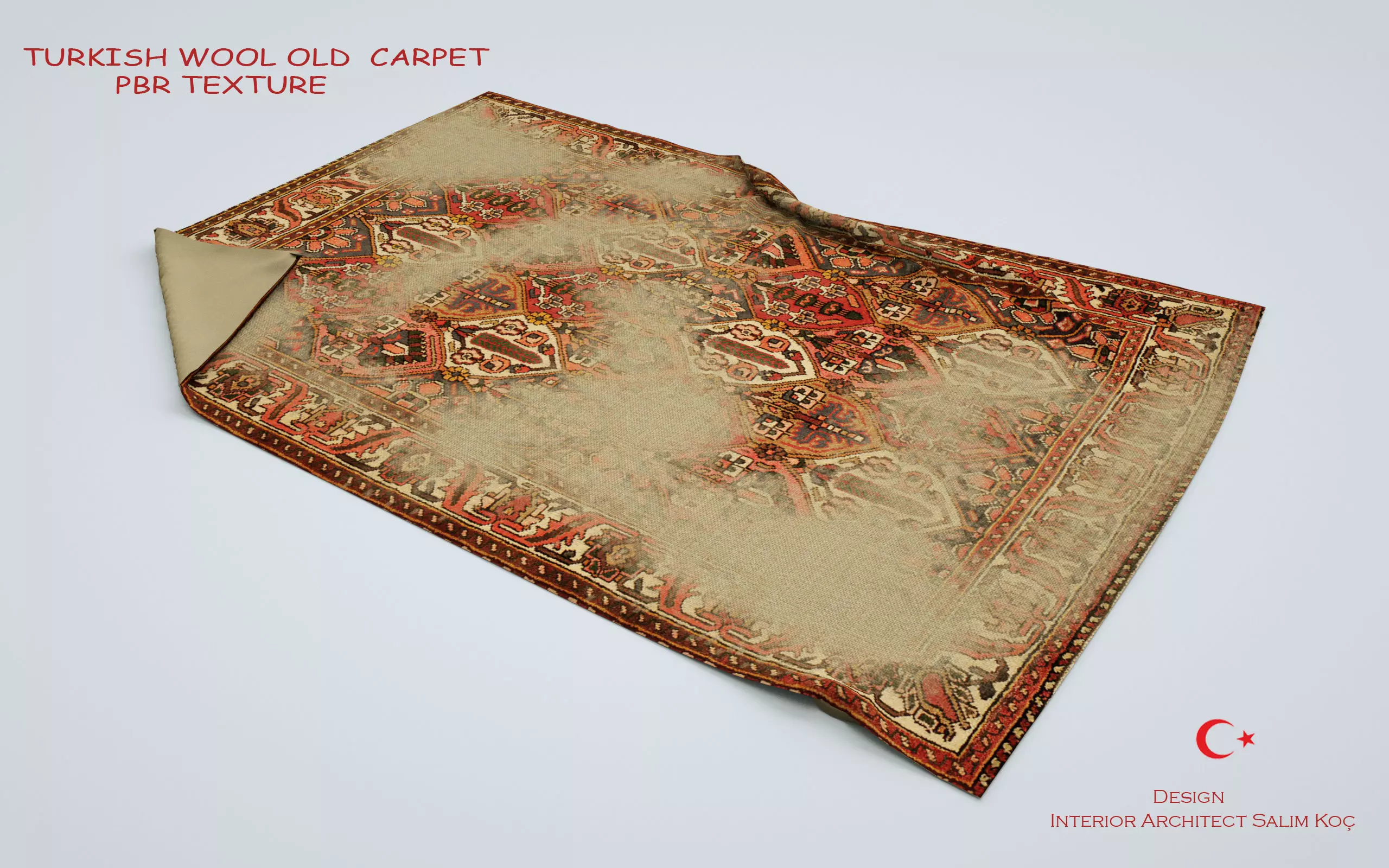
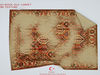
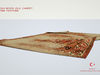
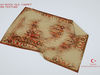
DESCRIPTION

OLD TURKISH CARPEThistory

This article is about pile-woven Anatolian rugs. For flat-woven rugs, see Kilim

Anatolian double-niche rug, Konya region, circa 1750–1800. LACMA M.2004.32

Bergama rug, west Anatolia, first half of 18th century.Anatolian rug is a term of convenience, commonly used today to denote rugs and carpets woven in Anatolia and its adjacent regions. Geographically, its area of production can be compared to the territories which were historically dominated by the Ottoman Empire. It denotes a knotted, pile-woven floor or wall covering which is produced for home use, local sale, and export. Together with the flat-woven kilim, Anatolian rugs represent an essential part of the regional culture, which is officially understood as the Culture of Turkey today,[1] and derives from the ethnic, religious and cultural pluralism of one of the most ancient centres of human civilisation.

Rug weaving represents a traditional craft dating back to prehistoric times. Rugs were woven much earlier than even the oldest surviving rugs like the Pazyryk rug would suggest. During its long history, the art and craft of the woven carpet has absorbed and integrated different cultural traditions. Traces of Byzantine design can be observed in Anatolian rugs; Turkic peoples migrating from Central Asia, as well as Armenian people, Caucasian and Kurdic tribes either living in, or migrating to Anatolia at different times in history contributed their traditional motifs and ornaments. The arrival of Islam and the development of the Islamic art has profoundly influenced the Anatolian rug design. Its ornaments and patterns thus reflect the political history and social diversity of the area. However, scientific research was unable, as yet, to attribute any particular design feature to any specific ethnic or regional tradition, or even to differentiate between nomadic and village design patterns.[2]

Within the group of oriental carpets, the Anatolian rug is distinguished by particular characteristics of its dyes and colours, motifs, textures and techniques. Examples range in size from small pillows (yastik) to large, room-sized carpets. The earliest surviving examples of Anatolian rugs known today date from the thirteenth century. Distinct types of rugs have been woven ever since in court manufactures and provincial workshops, village homes, tribal settlements, or in the nomad's tent. Rugs were simultaneously produced at all different levels of society, mainly using sheep wool, cotton and natural dyes. Anatolian rugs are most often tied with symmetrical knots, which were so widely used in the area that Western rug dealers in the early 20th century adopted the term Turkish or Ghiordes knot for the technique. From the 1870s onwards, the Ottoman court manufactures also produced silk-piled rugs, sometimes with inwoven threads of gold or silver, but the traditional material of the majority of Anatolian rugs was hand-spun, naturally-dyed wool.

In Europe, Anatolian rugs were frequently depicted in Renaissance paintings, often in a context of dignity, prestige and luxury. Political contacts and trade intensified between Western Europe and the Islamic world after the 13th century AD. When direct trade was established with the Ottoman Empire during the 14th century, all kinds of carpets were at first indiscriminately given the trade name of Turkish carpets, regardless of their actual place of manufacture.[3] Since the late nineteenth century, oriental rugs have been subject to art historic and scientific interest in the Western world.[3][4][5] The richness and cultural diversity of rug weaving were gradually better understood. More recently, also flat woven carpets (Kilim, Soumak, Cicim, Zili) have attracted the interest of collectors and scientists.

The art and craft of the Anatolian rug underwent serious changes by the introduction of synthetic dyes from the last third of the 19th century onwards. The mass production of cheap rugs designed for commercial success had brought the ancient tradition close to extinction. In the late twentieth century, projects like the DOBAG Carpet Initiative have successfully revived the tradition of Anatolian rug weaving using hand-spun, naturally-dyed wool and traditional designs

REVIEWS & COMMENTS

See what other buyers think about this model - real feedback on quality,
accuracy, and usability.
View all
0
0
3
Vampiral3D
Vampiral3DCommunity member
This user is part of the CGTrader community
Fantastic..
Reza-T
Reza-TCommunity member
This user is part of the CGTrader community
Terrific!
sohha
sohhaCommunity member
This user is part of the CGTrader community
it look like Pazyryk carpet. very pretty

OLD TURKISH CARPET 3D model

Royalty Free License
Hire
Like this model to show appreciation to the designer.
See how many times this model was viewed.
Share this model to support the designer and boost their visibility.
File formats
OBJ
OBJ | 3 files<br />Version: 19<br />File Size: 7.58 MB
3DS
3D Studio<br />File Size: 1.01 MB
DAE
Collada<br />Version: 1.5<br />File Size: 3.38 MB
C4D
Cinema 4D<br />Version: 19 - Renderer: Octane 19<br />File Size: 2.18 MB
FBX
Autodesk FBX<br />Version: 7.3<br />File Size: 1.33 MB
Verified by CGTrader
Verified models are of higher quality as they have
passed CGT Standard technical and visual checks,
making them more professional-grade 3D assets.
Learn more.
FBX
This FBX file has successfully passed the CGT Standard technical and visual checks. The verification results are detailed in the section below.
File & scene
Binary FBX
Binary FBX file is more compact and faster to load and process.
Learn more
No unsupported objects
Unsupported objects:
- Lights
- Cameras
Learn more
Geometry
No N-gons
N-gons are polygons with five or more sides which might cause issues in certain processes like rendering or animation. Learn more
No faceted geometry
Faceted geometry uses flat surfaces without smoothing, which can look unrealistic on curves.
Learn more
Manifold geometry
Manifold geometry ensures all surfaces are properly connected, avoiding issues like edges shared by more than two faces.
Learn more
Textures & material
PBR textures
PBR textures simulate how light interacts with materials, making the model look realistic under different lighting.
Required PBR textures:
- Base Color
- Roughness
- Metalness
- Normal
Learn more
No embed textures
Embedded textures are stored inside the model file, increasing its size and sometimes causing compatibility issues.
Learn more
Square textures
Texture aspect ratio is the width-to-height ratio of a texture. Expected texture aspect ratio: 1:1
Learn more
Power of 2 texture sizes
Textures with dimensions in power of two (e.g. 512x512px, 1024x1024px) are used to optimize performance and memory usage.
Learn more
Assigned materials
Materials are applied to the 3D model to allow visualize a model's surface properties and appearance.
Learn more
UVs & naming
No UV overlaps
UVs overlap when multiple points on the 3D model's surface are mapped to the same point on the UV island causing texture stretching.
Learn more
UV unwrapped model
A UV unwrapped model means its 3D surface is flattened into 2D space, allowing textures to be applied accurately.
Learn more
Allowed characters
Allowed ASCII characters: a-zA-Z0-9-_
Learn more
Provided by designer
Information and details shared directly by the model's designer.
3D Features
Materials
The model has material settings that define how surfaces look (color, shine, transparency, etc.).
Plugins Used
Some external plugins were used to create the model. These may be required for full functionality.
3D printing
Indicates whether the designer marked this model as suitable for 3D printing.
Model is not 3D printable
The designer indicates this model is intended for digital use only (rendering, animation, or AR/VR) and not for 3D printing.
Geometry
Polygon mesh
A model built from polygons (triangles or quads) connected in a mesh.
22303 polygons
The total number of polygons (flat shapes) that make up the 3D model.
/ 44265 vertices
The number of points (corners) that define the shape of the model's polygons.
Unwrapped UVs
Publish date
Model ID
Chat