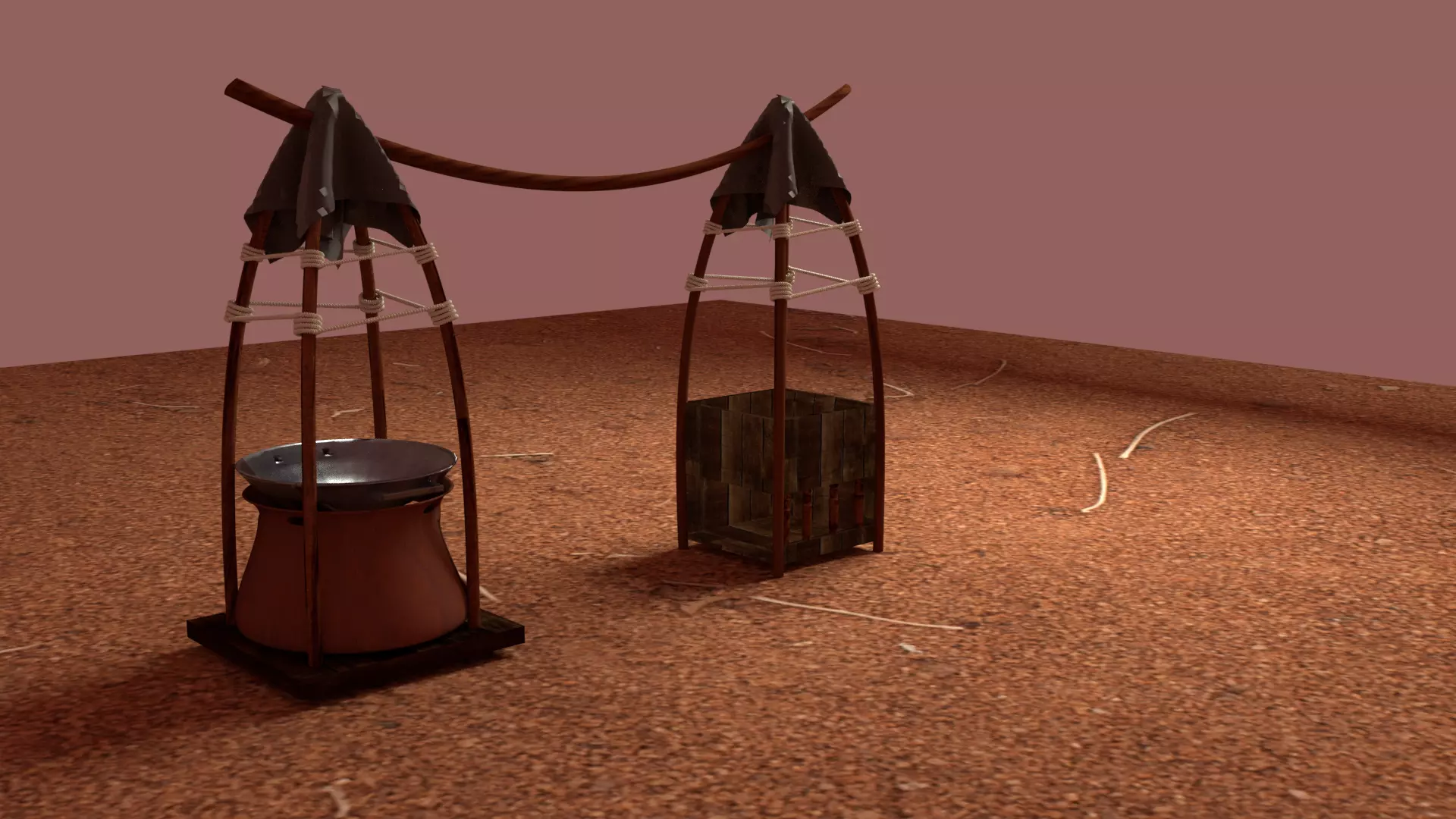
The earliest wheelbarrows with archaeological evidence in the form of a one-wheel cart come from second century Han Dynasty Emperor Hui's tomb murals and brick tomb reliefs.[8] The painted tomb mural of a man pushing a wheelbarrow was found in a tomb at Chengdu, Sichuan province, dated precisely to 118 AD.[9] The stone carved relief of a man pushing a wheelbarrow was found in the tomb of Shen Fujun in Sichuan province, dated circa 150 AD.[10] And then there is the story of the pious Dong Yuan pushing his father around in a single-wheel lu che barrow, depicted in a mural of the Wu Liang tomb-shrine of Shandong (dated to 147 AD).[11] However, there are even earlier accounts than this that date back to the 1st century BC and 1st century AD. The 5th century Book of Later Han stated that the wife of the once poor and youthful imperial censor Bao Xuan helped him push a lu che back to his village during their feeble wedding ceremony, around 30 BC.[9] Later, during the Red Eyebrows Rebellion (c. 20 AD) against Xin dynasty's Wang Mang (45 BC–23 AD), the official Zhao Xi saved his wife from danger by disguising himself and pushing her along in his lu che barrow, past a group of brigand rebels who questioned him, and allowed him to pass after he convinced them that his wife was terribly ill.[9] The first recorded description of a wheelbarrow appears in Liu Xiang's work Lives of Famous Immortals. Liu describes the invention of the wheelbarrow by the legendary Chinese mythological figure Ko Yu, who builds a Wooden ox.[12]
Nevertheless, the Chinese historical text of the Sanguozhi (Records of the Three Kingdoms), compiled by the ancient historian Chen Shou (233–297 AD), credits the invention of the wheelbarrow to Prime Minister Zhuge Liang (181–234 AD) of Shu Han from 197–234.[13] It was written that in 231 AD, Zhuge Liang developed the vehicle of the wooden ox and used it as a transport for military supplies in a campaign against Cao Wei.[14] Further annotations of the text by Pei Songzhi (430 AD) described the design in detail as a large single central wheel and axle around which a wooden frame was constructed in representation of an ox.[14] Writing later in the 11th century, the Song Dynasty (960–1279) scholar Gao Cheng wrote that the small wheelbarrow of his day, with shafts pointing forward (so that it was pulled), was the direct descendant of Zhuge Liang's wooden ox.[15] Furthermore, he pointed out that the third century 'gliding horse' wheelbarrow featured the simple difference of the shaft pointing backwards (so that it was pushed instead).[15]