High-quality 3D assets at affordable prices — trusted by designers, engineers, and creators worldwide. Made with care to be versatile, accessible, and ready for your pipeline.
Included File Formats
This model is provided in 14 widely supported formats, ensuring maximum compatibility:
• - FBX (.fbx) – Standard format for most 3D software and pipelines
• - OBJ + MTL (.obj, .mtl) – Wavefront format, widely used and compatible
• - STL (.stl) – Exported mesh geometry; may be suitable for 3D printing with adjustments
• - STEP (.step, .stp) – CAD format using NURBS surfaces
• - IGES (.iges, .igs) – Common format for CAD/CAM and engineering workflows (NURBS)
• - SAT (.sat) – ACIS solid model format (NURBS)
• - DAE (.dae) – Collada format for 3D applications and animations
• - glTF (.glb) – Modern, lightweight format for web, AR, and real-time engines
• - 3DS (.3ds) – Legacy format with broad software support
• - 3ds Max (.max) – Provided for 3ds Max users
• - Blender (.blend) – Provided for Blender users
• - SketchUp (.skp) – Compatible with all SketchUp versions
• - AutoCAD (.dwg) – Suitable for technical and architectural workflows
• - Rhino (.3dm) – Provided for Rhino users
Model Info
• - All files are checked and tested for integrity and correct content
• - Geometry uses real-world scale; model resolution varies depending on the product (high or low poly)
• • - Scene setup and mesh structure may vary depending on model complexity
• - Rendered using Luxion KeyShot
• - Affordable price with professional detailing
Buy with confidence. Quality and compatibility guaranteed.
If you have any questions about the file formats, feel free to send us a message — we're happy to assist you!
Sincerely,
SURF3D
Trusted source for professional and affordable 3D models.
More Information About 3D Model :
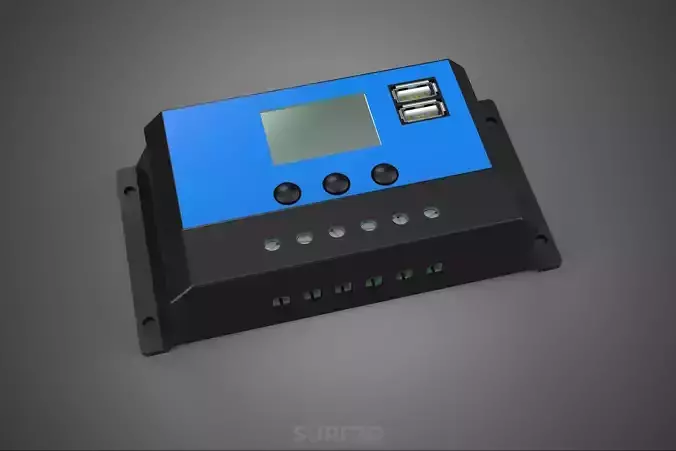
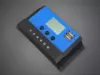
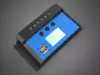
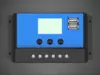
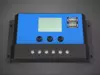
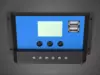
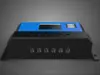
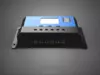
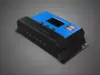
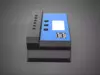
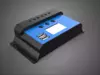
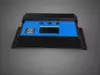
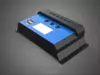
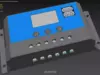
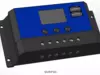
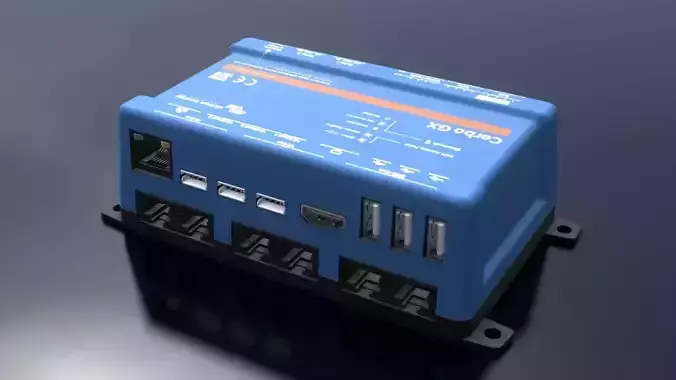
A Solar Charge Controller, specifically a Pulse Width Modulation (PWM) Photovoltaic (PV) Regulator, is a critical component in off-grid and hybrid solar power systems. This particular variant integrates a user-friendly display for system monitoring and a Universal Serial Bus (USB) port for auxiliary device charging. Its primary function is to manage the power flow from solar panels to a battery bank, ensuring efficient and safe charging while preventing overcharge, deep discharge, and other potential system damage.
The core purpose of a solar charge controller is to optimize battery charging from a PV array and protect the battery from conditions that could reduce its lifespan or cause failure. It acts as an intermediary, regulating the voltage and current delivered by the solar panels, which can fluctuate significantly due to varying sunlight intensity and temperature, to match the charging requirements of the connected battery bank.
Key Components and Features:
- PV Regulation and Pulse Width Modulation (PWM): The PV Regulator aspect signifies its role in managing solar input. The device utilizes Pulse Width Modulation (PWM) technology for battery charging. PWM works by rapidly switching the solar panel's connection to the battery on and off. By varying the width of these pulses (the duty cycle), the controller can effectively regulate the average voltage and current delivered to the battery. This method is designed to trickle charge the battery when it is near full, preventing overcharging and desulfation, thereby extending battery life. While simpler and generally less expensive than Maximum Power Point Tracking (MPPT) controllers, PWM controllers are less efficient in situations where the solar panel voltage significantly exceeds the battery voltage, as they effectively pull down the panel voltage to match the battery.
- Battery Charging Management: The controller incorporates multi-stage charging algorithms, typically including bulk, absorption, and float stages, to optimize battery health. It provides critical protection features such as:
- Overcharge Protection: Automatically disconnects the PV array when the battery reaches its full charge voltage.
- Deep Discharge Protection (Low Voltage Disconnect - LVD): Disconnects connected DC loads if the battery voltage drops below a safe threshold, preventing irreversible battery damage.
- Reverse Polarity Protection: Safeguards against incorrect wiring of the solar panels or battery.
- Short Circuit Protection: Guards against damage from accidental short circuits on the solar input or load output.
- Overload Protection: Prevents damage from excessive current draw by connected loads.
- Temperature Compensation: Many advanced PWM controllers include a temperature sensor (or the capability to connect one) to adjust charging voltages based on ambient temperature, further optimizing battery charging.
- Load Management: Beyond battery charging, many controllers also manage connected DC loads. They can provide a regulated DC output for various appliances, often including programmable timers or dusk-to-dawn functionalities.
- Universal Serial Bus (USB) Port: The integrated USB port allows for direct charging of small electronic devices such as smartphones, tablets, and other USB-powered gadgets. This feature enhances the system's utility, especially in remote or off-grid environments where conventional power outlets may be unavailable. The USB output typically provides a standard 5V DC at a specified current (e.g., 1A, 2A).
- Integrated Display: A crucial user interface element, the display (commonly an LCD or LED screen) provides real-time operational data and status indicators. Typical information displayed includes:
- Battery voltage and state of charge (SOC).
- Solar panel voltage and charging current.
- Load current and status.
- Accumulated charge/discharge ampere-hours (Ah).
- Error codes or fault indications.
- System parameters and settings (e.g., battery type, load timer).
The display facilitates system monitoring, troubleshooting, and configuration by the user.
Applications:
Such controllers are widely employed in a variety of small to medium-scale solar power applications, including:
- Off-grid cabins and sheds.
- Recreational vehicles (RVs) and camper vans.
- Marine applications (boats).
- Remote lighting systems (e.g., streetlights, garden lights).
- Backup power systems for critical small loads.
- Educational projects and DIY solar setups.
While not offering the higher efficiency of MPPT controllers, especially in cold weather or when panel voltage significantly exceeds battery voltage, PWM regulators with integrated USB and display provide a cost-effective, robust, and user-friendly solution for managing solar power in numerous applications, balancing performance with affordability and convenience.
KEYWORDS: Solar Charge Controller, PWM PV Regulator, Photovoltaic System, Battery Charging, Solar Panel Regulator, Off-grid Power, DC-DC Converter, USB Power Output, Digital Display, System Monitoring, Overcharge Protection, Low Voltage Disconnect, Reverse Polarity Safety, Short Circuit Protection, Solar Load Controller, Renewable Energy System, Battery Bank Management, Voltage Regulation, Current Limiting, Standalone Solar, RV Solar, Marine Solar, Remote Power, Solar Kit Component, Multi-stage Charging, Power Management Unit, Energy Controller, 12V Solar Controller, 24V Solar Controller, Power Regulator