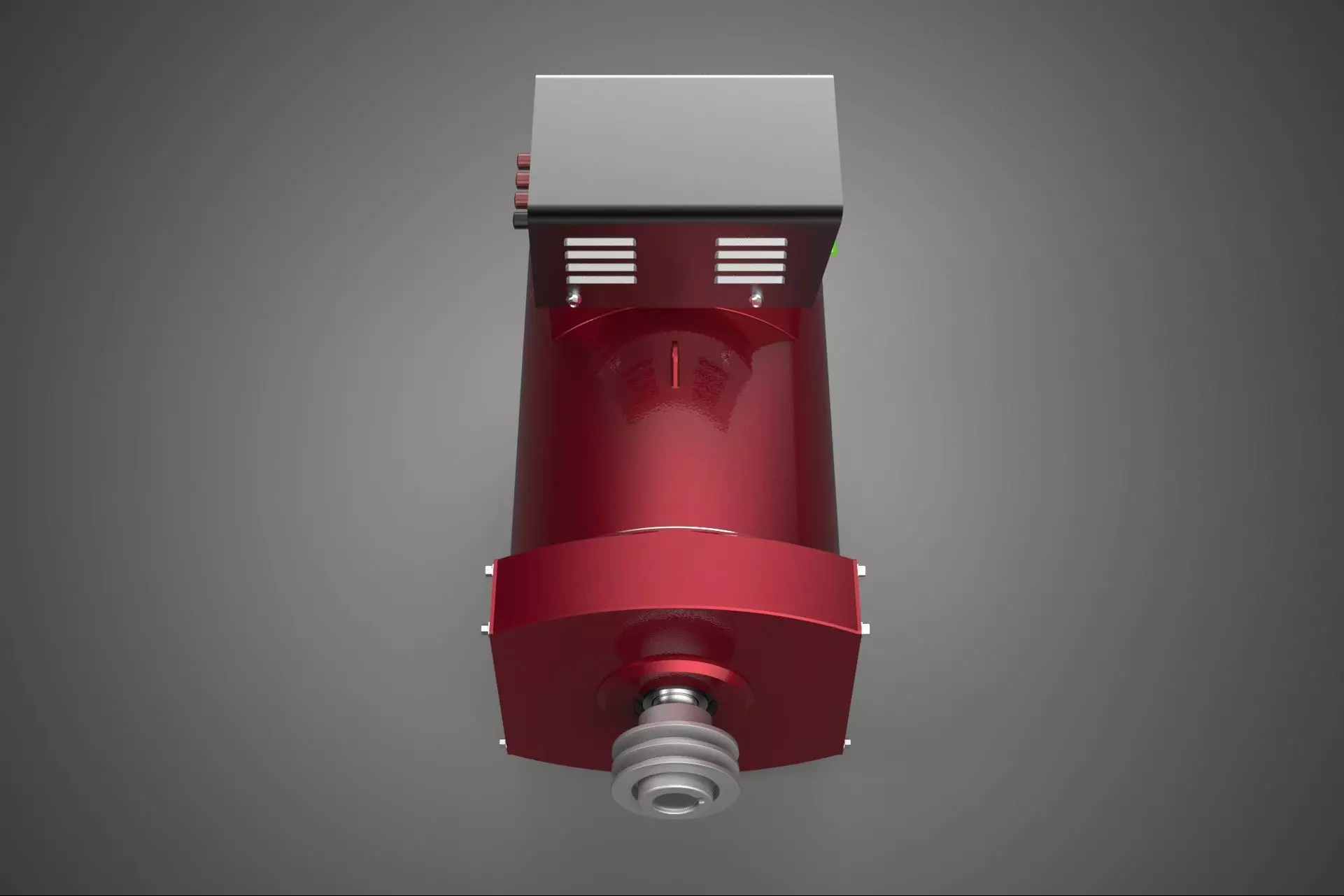
High-quality 3D assets at affordable prices — trusted by designers, engineers, and creators worldwide. Made with care to be versatile, accessible, and ready for your pipeline.
Included File Formats
This model is provided in 14 widely supported formats, ensuring maximum compatibility:
• - FBX (.fbx) – Standard format for most 3D software and pipelines
• - OBJ + MTL (.obj, .mtl) – Wavefront format, widely used and compatible
• - STL (.stl) – Exported mesh geometry; may be suitable for 3D printing with adjustments
• - STEP (.step, .stp) – CAD format using NURBS surfaces
• - IGES (.iges, .igs) – Common format for CAD/CAM and engineering workflows (NURBS)
• - SAT (.sat) – ACIS solid model format (NURBS)
• - DAE (.dae) – Collada format for 3D applications and animations
• - glTF (.glb) – Modern, lightweight format for web, AR, and real-time engines
• - 3DS (.3ds) – Legacy format with broad software support
• - 3ds Max (.max) – Provided for 3ds Max users
• - Blender (.blend) – Provided for Blender users
• - SketchUp (.skp) – Compatible with all SketchUp versions
• - AutoCAD (.dwg) – Suitable for technical and architectural workflows
• - Rhino (.3dm) – Provided for Rhino users
Model Info
• - All files are checked and tested for integrity and correct content
• - Geometry uses real-world scale; model resolution varies depending on the product (high or low poly)
• • - Scene setup and mesh structure may vary depending on model complexity
• - Rendered using Luxion KeyShot
• - Affordable price with professional detailing
Buy with confidence. Quality and compatibility guaranteed.
If you have any questions about the file formats, feel free to send us a message — we're happy to assist you!
Sincerely,
SURF3D
Trusted source for professional and affordable 3D models.
More Information About 3D Model :
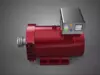
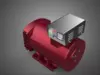
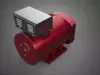
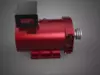
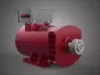
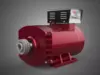
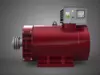
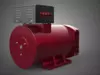
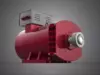
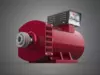
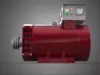
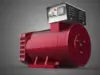
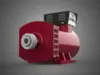
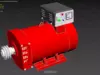
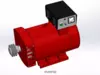
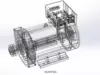
The terminology encompassing Electrical Power Generator Motor Alternator Dynamo Genset Pulley refers to the family of rotating electrical machines and their associated mechanical transmission systems, which collectively enable the bidirectional conversion and transmission of electrical and mechanical energy. These devices are fundamental to modern power generation, distribution, and utilization.
I. Rotating Electrical Machines: Generator and Motor Function
A Rotating Electrical Machine is an electromechanical device operating on the principles of electromagnetism.
1. Generator Function (Electrical Power Generation):
A machine that converts mechanical energy (rotational motion) into electrical energy, primarily utilizing Faraday’s Law of Induction. The core components include a magnetic field (field winding or permanent magnets) and an armature winding, where voltage is induced due to relative motion.
- Dynamo: Historically and technically, a Dynamo refers specifically to a Direct Current (DC) generator. It utilizes a commutator—a mechanical rectifier composed of segmented contacts—to maintain current flow in a single direction in the external circuit, despite the alternating voltage generated internally. Dynamos are common in older automotive systems and certain industrial applications requiring high-voltage DC power.
- Alternator: An Alternator is an Alternating Current (AC) generator. In most modern alternators, the magnetic field rotates (rotor) while the armature winding is stationary (stator). This configuration simplifies the transfer of high current output as the generated power does not need to pass through brushes and slip rings. Alternators are the ubiquitous standard for utility-scale power generation (synchronous generators) and are also widely used in vehicles and small power plants.
2. Motor Function (Mechanical Power Utilization):
A Motor is an electromechanical machine that performs the inverse function, converting electrical energy into mechanical energy (rotational torque). This operation relies on the Lorentz force principle, where current-carrying conductors experience a force when situated within a magnetic field. Motors and generators often share similar structural architectures (e.g., synchronous motors are structurally identical to synchronous alternators) and can sometimes operate in either mode (motor-generators).
### II. Integrated Systems and Transmission Components
Genset (Generator Set):
A Genset is an integrated system designed for autonomous power production. It consists of the electrical generator (alternator or dynamo) mechanically coupled to a Prime Mover, such as a diesel engine, gasoline engine, natural gas engine, or gas/steam turbine. Gensets are engineered as complete packages, including cooling systems, fuel systems, voltage regulation, and control panels. They are crucial for standby power (emergency backup), primary power in remote locations, and distributed generation (DG).
Pulley:
The Pulley is a mechanical component, typically a wheel fixed to the shaft of the rotating electrical machine, designed to transmit power via a belt or rope (belt drive). In the context of generators and motors:
- Power Transmission: A pulley facilitates the efficient transfer of rotational mechanical energy from a prime mover to the generator shaft, often allowing for speed ratio changes.
- Auxiliary Drive: In many genset or vehicular applications (e.g., car alternators), the pulley drives ancillary equipment, such as cooling fans, water pumps, or external exciter systems, ensuring simultaneous operation with the main machine.
- Torque Management: The pulley and belt system absorb minor shock loads and vibrations, protecting the sensitive electrical components from mechanical stress inherent in the prime mover operation.
### III. Operational Context
Collectively, these components facilitate the global infrastructure of electrical power. Generators convert raw energy (chemical, nuclear, hydrokinetic, wind) into usable electricity. Motors convert that electricity back into kinetic energy for industrial processes, transportation, and daily use. The Genset provides the necessary portability and reliability for isolated or backup power, and the Pulley ensures the reliable mechanical interface required for efficient energy transmission between the constituent components.
KEYWORDS: Alternating Current, Direct Current, Electromagnetic Induction, Prime Mover, Mechanical Energy, Electrical Energy, Commutator, Stator, Rotor, Slip Ring, Synchronous Generator, Induction Motor, Standby Power, Distributed Generation, Power Conversion, Belt Drive, Torque Transmission, Excitation System, Faraday's Law, Lorentz Force, Armature Winding, Field Winding, Electromechanical Conversion, Utility Scale, Auxiliary Equipment, Renewable Energy, Cogeneration, Frequency Regulation, Voltage Regulation, Hybrid System.