


DESCRIPTION

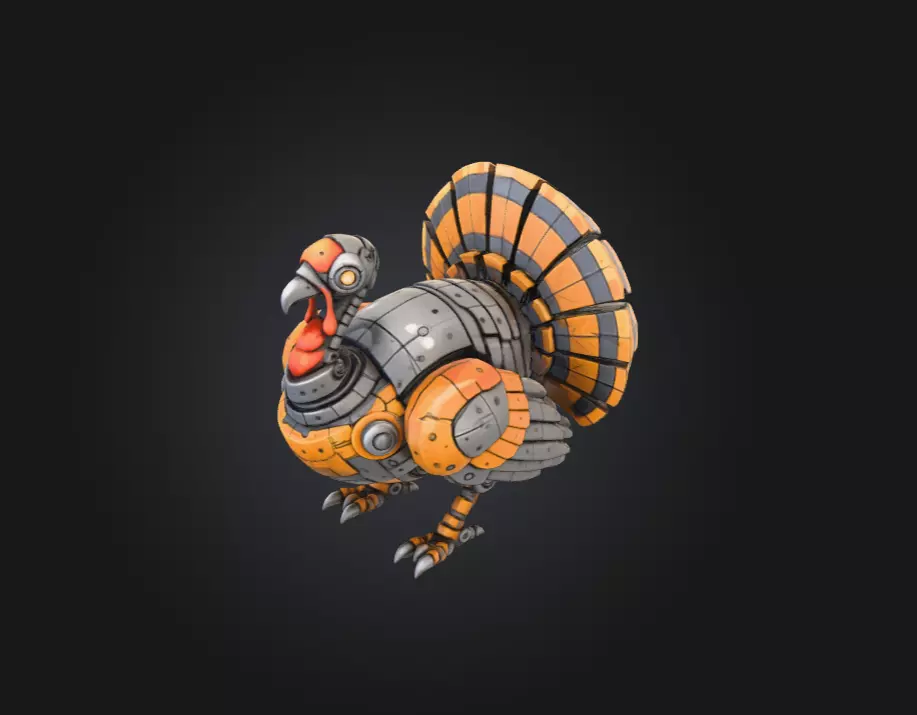
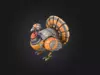
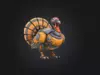
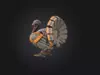
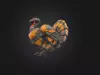
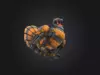
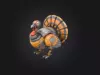
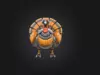
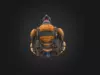
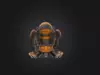
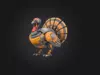
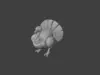
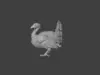
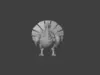
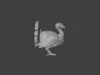
The Cyber Turkey is a whimsical yet formidable fusion of poultry biology and high-tech engineering, transforming a traditionally harmless farm bird into a fully mechanized marvel. Its body is constructed from interlocking steel plates, polished alloys, and reinforced composite segments, giving it a durable exoskeletal frame capable of withstanding harsh environments and combat scenarios. Bright orange and metallic gray accents highlight its modular design, suggesting factory-precision assembly and advanced robotics technology. Despite its humorous concept, the Cyber Turkey exudes a sense of mechanical strength, with servo-driven joints, hydraulic leg actuators, and retractable talons designed for terrain adaptability and defensive capabilities.

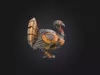
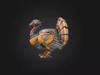
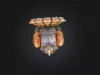
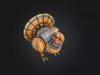
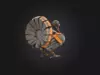
Its tail fan, a signature feature of real turkeys, has been reimagined as a segmented mechanical stabilizer—possibly functioning as a heat dissipation system or aerodynamic control surface. The head retains the recognizable silhouette of a turkey but incorporates optical sensors and targeting lenses, replacing organic eyes with glowing cybernetic optics that scan the environment with precision. The presence of wiring seams and bolted armor plating hints at field modifications or military retrofitting, implying that this creature may serve as surveillance hardware, autonomous security, or even a combat drone disguised with a humorous aesthetic.

In fictional worlds, the Cyber Turkey fits seamlessly into sci-fi, post-apocalyptic, and futuristic settings where technology and biology blur. It can act as a quirky companion robot, a hostile mechanical enemy, or a thematic environmental character in games and animation. Its playful appearance masks the potential for unpredictable behavior—whether operating as a farm guardian, a malfunctioning lab creation, or a rogue AI experiment wandering industrial wastelands. This unique design adds humor, personality, and narrative depth to any project, making it both visually memorable and functionally versatile.

REVIEWS & COMMENTS

See what other buyers think about this model - real feedback on quality,
accuracy, and usability.
There are no reviews or comments yet. Please be the first one to write it.

Cyber Turkey Low-poly 3D model

Royalty Free License
Hire
Like this model to show appreciation to the designer.
See how many times this model was viewed.
Share this model to support the designer and boost their visibility.
File formats
STL
Stereolithography<br />File Size: 40.5 MB
OBJ
OBJ<br />File Size: 27.1 MB
3MF
3D Manufacturing File<br />File Size: 10.7 MB
GLTF
glTF<br />File Size: 33.8 MB
BLEND
Blender<br />Renderer: Default<br />File Size: 79.7 MB
USDZ
USDZ<br />File Size: 29.1 MB
PNG
PNG | 3 files<br />File Size: 75.4 MB
FBX
Autodesk FBX | 2 files<br />File Size: 81.3 MB
TEXTURES
Textures | 2 files<br />File Size: 48.3 MB
Verified by CGTrader
Verified models are of higher quality as they have
passed CGT Standard technical and visual checks,
making them more professional-grade 3D assets.
Learn more.
FBX
This FBX file has successfully passed the CGT Standard technical and visual checks. The verification results are detailed in the section below.
File & scene
Binary FBX
Binary FBX file is more compact and faster to load and process.
Learn more
No unsupported objects
Unsupported objects:
- Lights
- Cameras
Learn more
Geometry
No N-gons
N-gons are polygons with five or more sides which might cause issues in certain processes like rendering or animation. Learn more
No faceted geometry
Faceted geometry uses flat surfaces without smoothing, which can look unrealistic on curves.
Learn more
Manifold geometry
Manifold geometry ensures all surfaces are properly connected, avoiding issues like edges shared by more than two faces.
Learn more
Textures & material
PBR textures
PBR textures simulate how light interacts with materials, making the model look realistic under different lighting.
Required PBR textures:
- Base Color
- Roughness
- Metalness
- Normal
Learn more
No embed textures
Embedded textures are stored inside the model file, increasing its size and sometimes causing compatibility issues.
Learn more
Square textures
Texture aspect ratio is the width-to-height ratio of a texture. Expected texture aspect ratio: 1:1
Learn more
Power of 2 texture sizes
Textures with dimensions in power of two (e.g. 512x512px, 1024x1024px) are used to optimize performance and memory usage.
Learn more
Assigned materials
Materials are applied to the 3D model to allow visualize a model's surface properties and appearance.
Learn more
UVs & naming
No UV overlaps
UVs overlap when multiple points on the 3D model's surface are mapped to the same point on the UV island causing texture stretching.
Learn more
UV unwrapped model
A UV unwrapped model means its 3D surface is flattened into 2D space, allowing textures to be applied accurately.
Learn more
Allowed characters
Allowed ASCII characters: a-zA-Z0-9-_
Learn more
Provided by designer
Information and details shared directly by the model's designer.
3D Features
PBR
Uses Physically Based Rendering materials, which give the model realistic lighting and surface properties.
Textures
The model includes image files (textures) that add color, patterns, or detail to its surfaces.
Materials
The model has material settings that define how surfaces look (color, shine, transparency, etc.).
UV Mapping
The model's surfaces are mapped to a 2D image, allowing textures to display correctly.
Plugins Used
Some external plugins were used to create the model. These may be required for full functionality.
3D printing
Indicates whether the designer marked this model as suitable for 3D printing.
Model is not 3D printable
The designer indicates this model is intended for digital use only (rendering, animation, or AR/VR) and not for 3D printing.
Unwrapped UVs
Publish date
Model ID
Chat