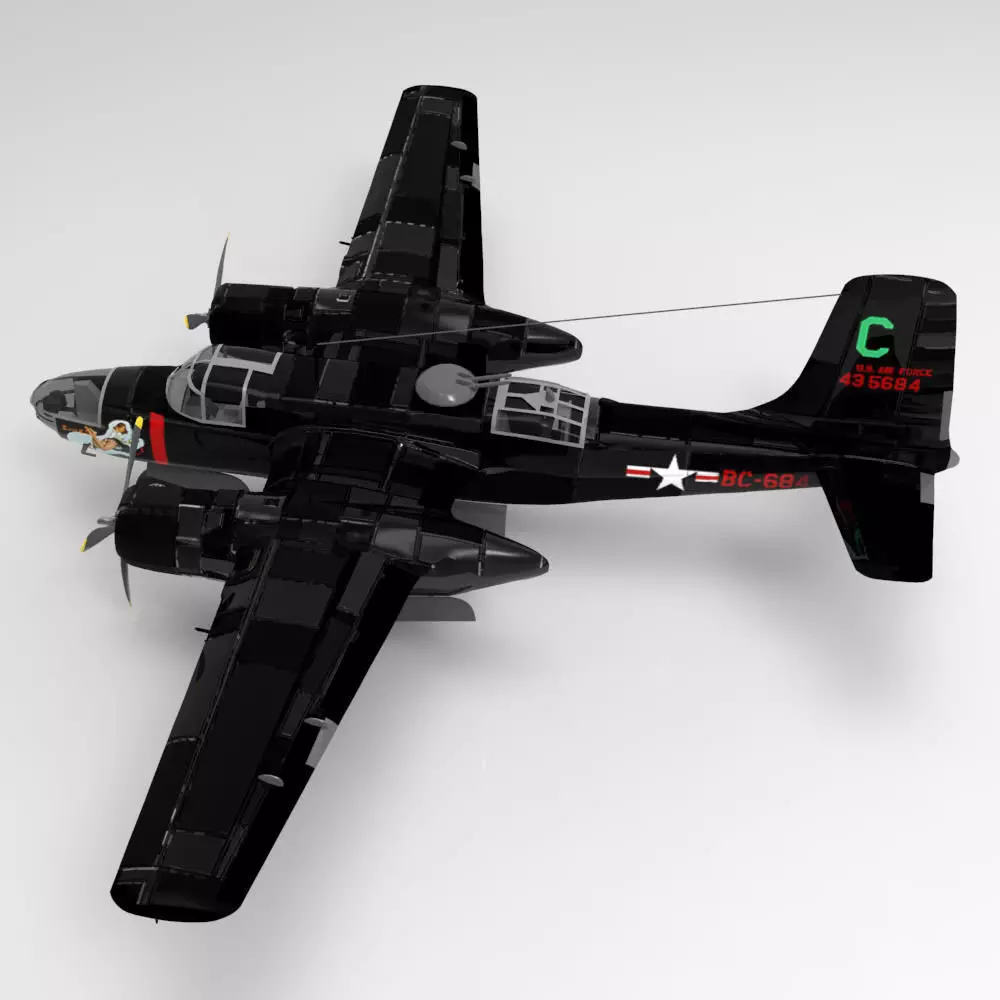
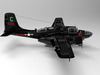
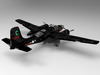
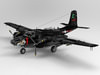
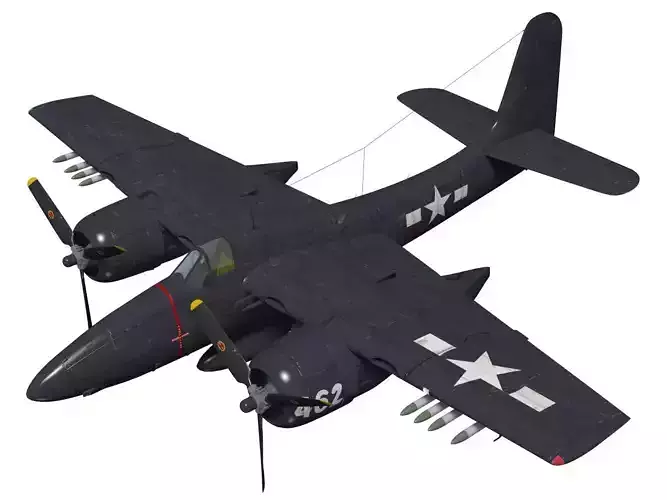
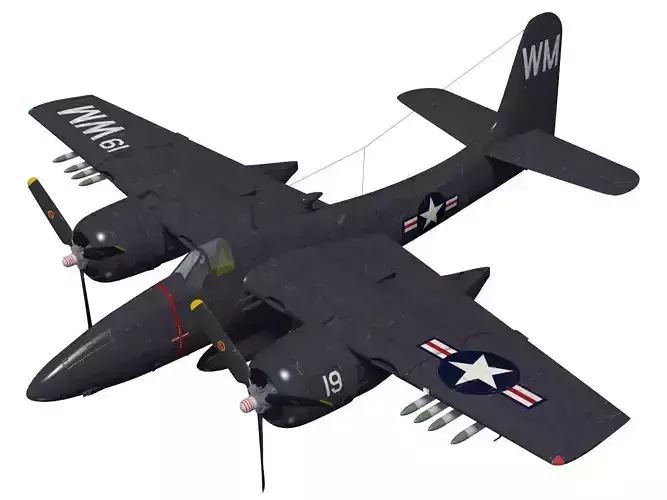
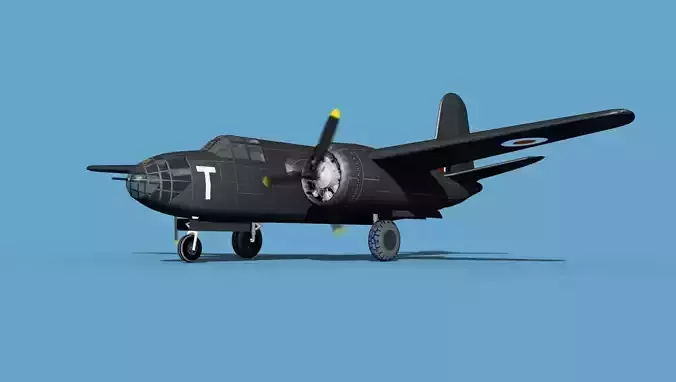
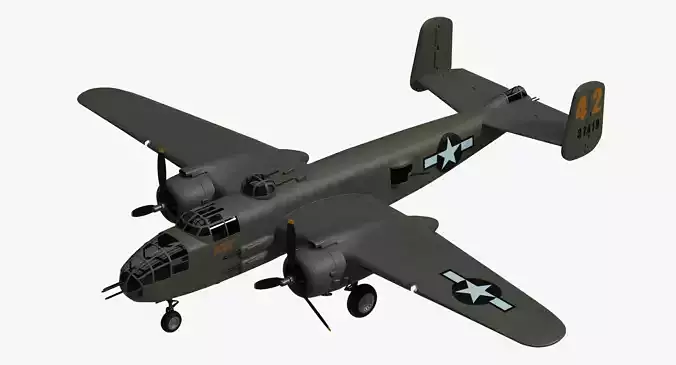
First flown in 1942, the American Douglas A-26 Invader (from 1948, the B-26, although the designation A-26 was also in use again from 1965) was a twin-engined light attack bomber aircraft built by the Douglas Aircraft Co. during World War II and seeing service during the Cold War's major conflicts. A limited number of highly modified aircraft served in combat until 1969. The last B-26 was retired from service in 1972 by the National Guard Bureau and donated to the National Air and Space Museum.
The A-26 was originally built in two different configurations: the A-26B had a solid nose, which normally housed six or eight .50 caliber machine guns, while the A-26C’s glass nose contained a Norden bombsight and was used for medium altitude precision bombing. Some aircraft were armed with additional guns in their wings, giving some configurations as many as fourteen .50 caliber machine guns fixed forward.
Invaders first saw action with the Fifth Air Force in the Southwest Pacific theater on 23 June 1944, when they bombed Japanese-held islands near Manokwari. They began arriving in Europe in September 1944 for assignment to the Ninth Air Force, and entered combat two months later on 19 November.
Invaders carried out the first USAF bombing mission of the Korean War on 29 June 1950 when they bombed an airfield outside of Pyongyang. Invaders were credited with the destruction of 38,500 vehicles, 406 locomotives, 3,700 railway trucks, and seven enemy aircraft on the ground. On 14 September 1951, Captain John S. Walmsley Jr attacked a supply train. When his guns jammed he illuminated the target with his searchlight to enable his wingmen to destroy the target. Walmsley was shot down and posthumously awarded the Medal of Honor. Invaders carried out the last USAF bombing mission of the war 24 minutes before the cease fire was signed on 27 June 1953.
During the early phase of the Vietnam War, the US Air Force used standard B-26s, but with Vietnamese markings. These aircraft were withdrawn from service in 1964 after two accidents related to wing spar fatigue. The On Mark Engineering Company of Van Nuys, California was selected by the Air Force to extensively upgrade the Invader for a counterinsurgency role. On Mark converted 40 Invaders to the new B-26K Counter Invader standard, which included upgraded engines, re-manufactured wings and wing tip fuel tanks for use by the 1st Air Commando Group. In May 1966, the B-26K was re-designated A-26A for political reasons and deployed in Thailand to help disrupt supplies moving along the Ho Chi Minh trail.
In April 1961, B-26s provided from US military stocks were flown by Cuban exiles during the failed Bay of Pigs invasion. CIA mercenary pilots that may have been the same Cuban exiles flew them against Simba rebels in the former Belgian Congo who were supported by Cubans, the Communist Chinese and the Soviets. The Portuguese Air Force acquired Invaders for use in Angola. Biafra used two provisionally armed B-26s in combat during Nigerian Civil War in 1967.
Product Features (Studio Max):
The product contains four resolutions of the model, the high resolution version being rigged for animation.
The model is highly detailed and textured.
This model is a 3DMax model, saved in version 8 as a MAX file, and requires 3DMax. It does not include any other formats to allow it to be opened in any other software. The model is rigged where appropriate, and mapped and textured.