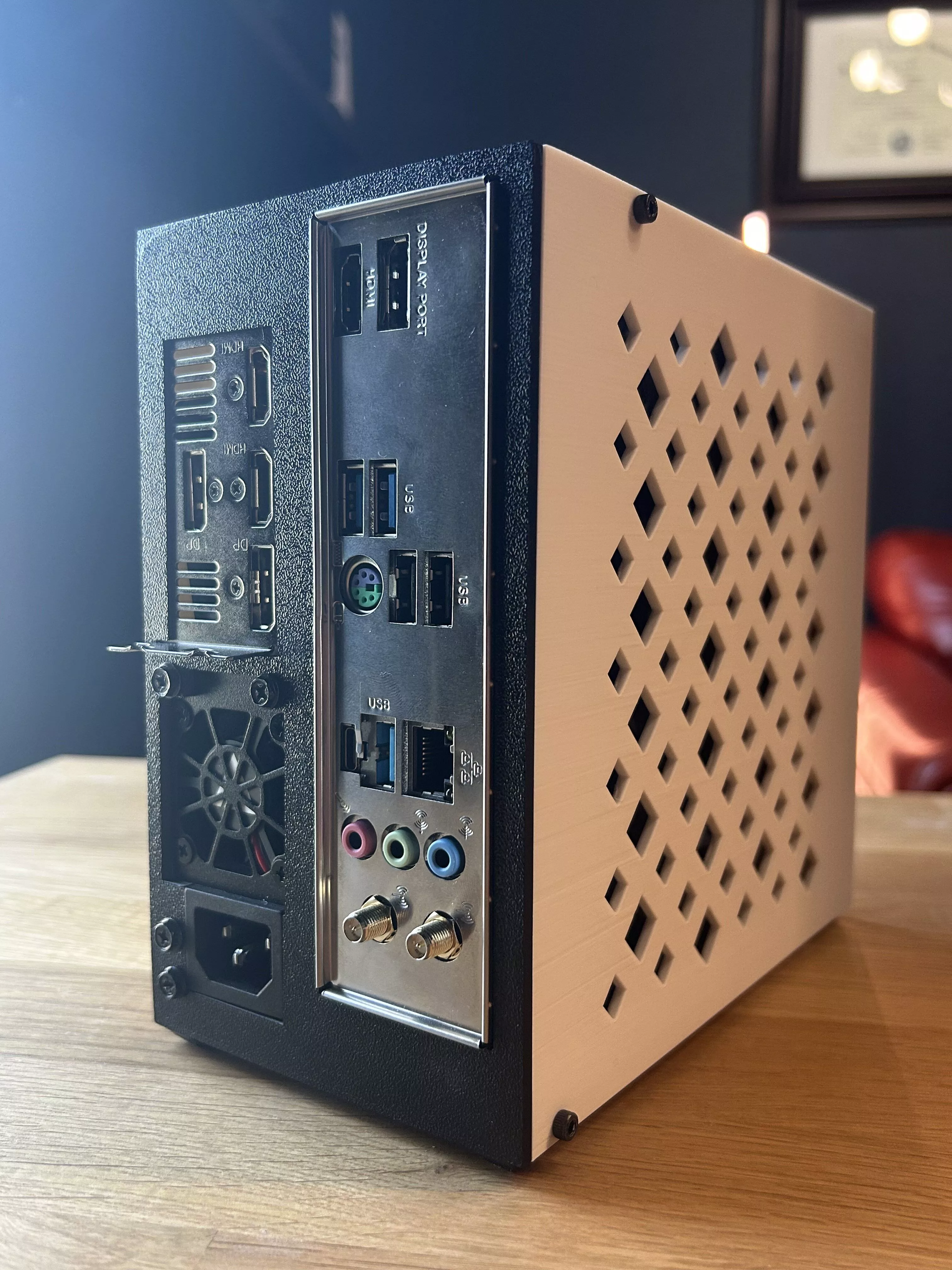
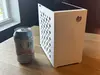
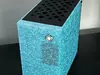
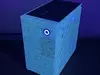
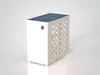
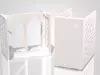
V1 was 4.7L and needed seven printed parts plus a pile of specialty hardware. It worked, but building it felt like its own side project. Every revision after that had the same goal: take something out without breaking anything.
V6 is where it landed. 3.73 liters. Two parts. Four screws. Start the print before bed. It's ready in the morning.
What you get
Two STL files, a skeleton and a shell. Print both, screw them together with 4x M3x6mm hex socket head cap screws, and you've got a working case. No heat-set inserts, no metal threaded inserts, no hunting down specialty hardware from three different sites.
Hardware compatibility
Volume: 3.73L
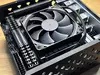
Max CPU cooler height: 37mm
Max RAM height: 37mm
PSU: any standard Flex ATX (170 x 82 x 41.2mm or smaller)
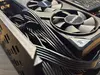
Max GPU: 182 x 69 x 36-40mm (tested with a Gigabyte 5060 LP)
GPU note: you'll need a 200mm PCIe riser cable
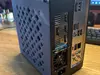
Vents on all sides except the front plate. Air comes in from the sides, exhausts through the top and back via the Flex ATX fan.
Print requirements
Any FDM printer with a 256x256mm bed or larger. Tested on a Bambu P1S.
Print time runs about 12 hours at standard quality, or around 22 hours if you want finer layers and more walls.
For the skeleton, use ABS, ASA, or PETG. The exhaust hits 61.8°C under stress, so you need something with a glass transition above 60°C. PLA will warp over time.
For the shell, PLA works fine. Shell panels max out at 45°C. Print it in whatever filament looks good to you.
Thermals
Stress tested with a thermometer. Hottest exhaust point (top/back) hit 61.8°C. Shell panels peaked at 45°C. Both well within safe limits for the materials listed above.