High-quality 3D assets at affordable prices — trusted by designers, engineers, and creators worldwide. Made with care to be versatile, accessible, and ready for your pipeline.
Included File Formats
This model is provided in 14 widely supported formats, ensuring maximum compatibility:
• - FBX (.fbx) – Standard format for most 3D software and pipelines
• - OBJ + MTL (.obj, .mtl) – Wavefront format, widely used and compatible
• - STL (.stl) – Exported mesh geometry; may be suitable for 3D printing with adjustments
• - STEP (.step, .stp) – CAD format using NURBS surfaces
• - IGES (.iges, .igs) – Common format for CAD/CAM and engineering workflows (NURBS)
• - SAT (.sat) – ACIS solid model format (NURBS)
• - DAE (.dae) – Collada format for 3D applications and animations
• - glTF (.glb) – Modern, lightweight format for web, AR, and real-time engines
• - 3DS (.3ds) – Legacy format with broad software support
• - 3ds Max (.max) – Provided for 3ds Max users
• - Blender (.blend) – Provided for Blender users
• - SketchUp (.skp) – Compatible with all SketchUp versions
• - AutoCAD (.dwg) – Suitable for technical and architectural workflows
• - Rhino (.3dm) – Provided for Rhino users
Model Info
• - All files are checked and tested for integrity and correct content
• - Geometry uses real-world scale; model resolution varies depending on the product (high or low poly)
• • - Scene setup and mesh structure may vary depending on model complexity
• - Rendered using Luxion KeyShot
• - Affordable price with professional detailing
Buy with confidence. Quality and compatibility guaranteed.
If you have any questions about the file formats, feel free to send us a message — we're happy to assist you!
Sincerely,
SURF3D
Trusted source for professional and affordable 3D models.
More Information About 3D Model :
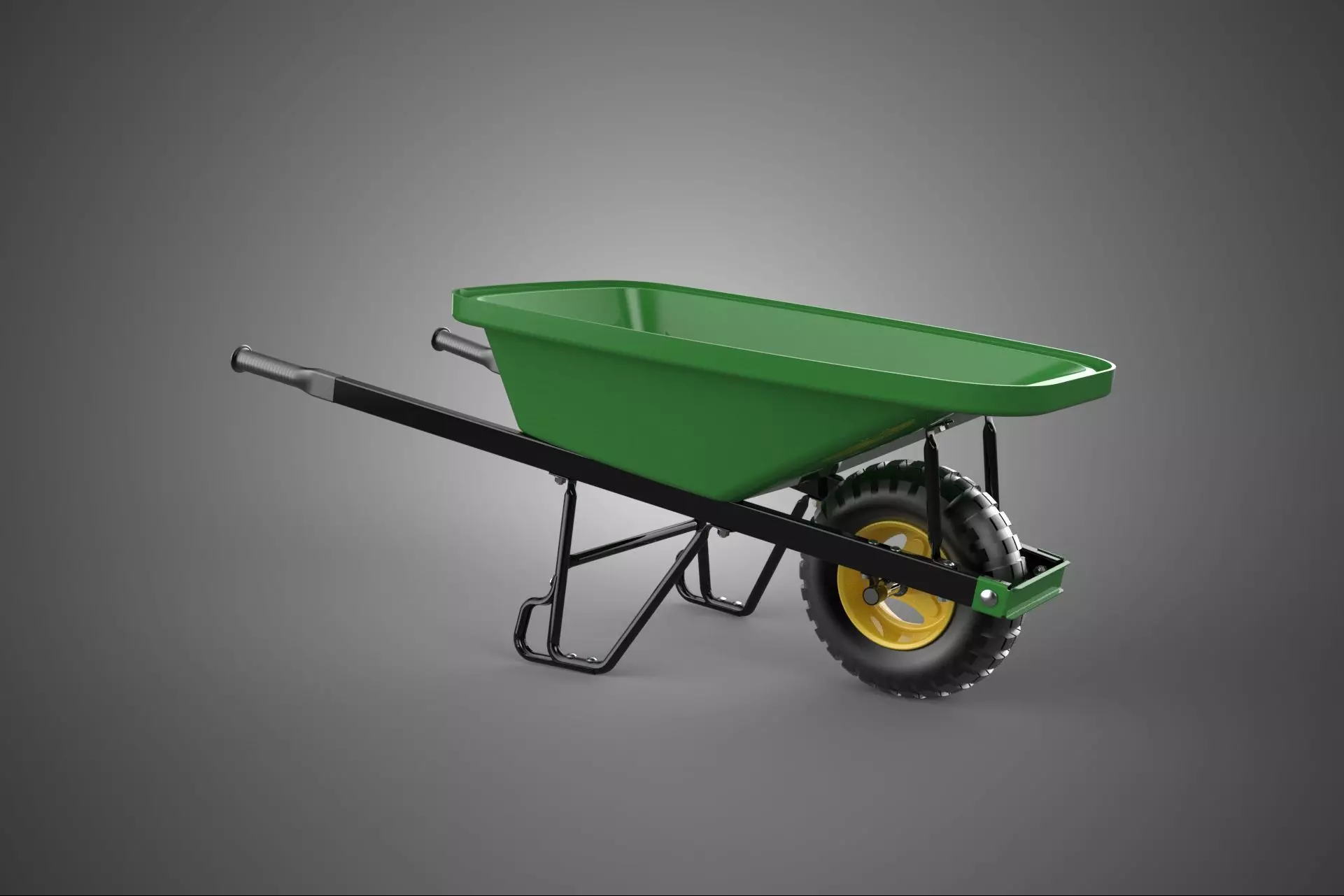
The single-wheel barrow, commonly known as a heavy-duty wheelbarrow, is an essential piece of materials handling equipment classified mechanically as a Class II lever system. Designed primarily for manual propulsion and leverage-assisted transport of bulk materials and heavy loads, this apparatus is characterized by a frame supported by a singular, centrally located wheel, allowing the operator to lift and balance significant weight while benefiting from reduced rolling resistance over varied terrain.
Nomenclature and Definition
The comprehensive title SINGLE WHEEL BARROW HEAVY WHEELBARROW CART TROLLEY WAGON TRAY encompasses several terms often used interchangeably or inaccurately to describe the device. The most precise and universally accepted term is wheelbarrow or barrow.
- Single Wheel: Defines the kinematic configuration, contrasting it with the less maneuverable two-wheel garden cart or utility wagon. The single-wheel design is crucial for navigation on narrow paths, uneven ground, and slopes typical of construction or landscaping environments.
- Heavy-Duty Classification: This designation implies superior structural integrity and load-bearing capacity compared to standard domestic models. Heavy wheelbarrows are engineered to manage payloads typically ranging from 100 kg to 200 kg (220 lbs to 440 lbs) and volumetric capacities often exceeding 100 liters (4 cubic feet).
- Cart, Trolley, Wagon: While these terms generally refer to multi-wheeled transport devices, they are sometimes used colloquially to describe the wheelbarrow's function as a mobile conveyance.
- Tray: Refers specifically to the hopper or cargo receptacle, typically a deep trough designed for holding aggregates, soil, masonry debris, concrete mix, or tools.
### Design and Anatomy of the Heavy Wheelbarrow
Heavy-duty wheelbarrows feature robust construction materials chosen for durability, resistance to abrasion, and fatigue strength.
#### 1. The Frame and Understructure
The supporting structure is typically fabricated from thick-gauge tubular steel (often powder-coated or galvanized for corrosion resistance). Key features differentiating heavy models include:
- Reinforced Handles: Longer handles provide increased leverage (mechanical advantage), reducing the operator’s required lifting force. Handle ends are fitted with ergonomic, non-slip grips.
- Welded Legs and Bracing: The frame utilizes heavy-duty cross-braces and leg supports, often incorporating skid plates or heavy-gauge steel shoes to protect the frame base when resting or being dumped. The legs must withstand repeated impact when the load is placed on the ground.
- Axle Mounts: The axle assembly utilizes reinforced plates or channels to ensure the integrity of the connection point, preventing deformation under maximum rated load.
#### 2. The Tray (Hopper)
The tray, or tub, must resist impact damage and corrosive materials.
- Material: Heavy-duty trays are commonly made from deep-drawn, high-gauge steel (typically 14-gauge or thicker) with rolled edges for structural stiffness, or from high-density, impact-resistant polyurethane or polyethylene (HDPE/HDPE). Steel trays are preferred for hot materials (like hot asphalt) or heavy, abrasive loads (rock), while poly trays offer chemical resistance and reduced weight.
- Capacity: Rated both volumetrically (in cubic feet or liters) and by weight capacity (in kilograms or pounds). Heavy models prioritize weight capacity.
#### 3. The Wheel Assembly
The wheel is the single point of contact with the ground and is critical to maneuverability and load dissipation.
- Wheel Type: Heavy wheelbarrows typically utilize wide-profile tires (often 4.80/4.00-8 size) to spread the load and minimize sinkage on soft ground.
- Pneumatic Tires: Offer cushioning and excellent shock absorption, preferred for rough or uneven sites. They require maintenance (inflation).
- Solid or Flat-Free Tires: Made of micro-cellular polyurethane foam. These are puncture-proof and maintenance-free, ideal for sites prone to sharp debris (e.g., construction waste).
- Bearings: Industrial-grade ball bearings or roller bearings replace simple bushings found on lighter models, ensuring smooth rolling under high pressure.
### Applications and Mechanical Principle
The heavy wheelbarrow is indispensable in environments requiring efficient, manual, short-distance transport of dense materials. Primary applications include:
- Construction: Moving wet concrete, mortar, sand, gravel, and demolition debris.
- Landscaping and Horticulture: Hauling dense soil, stone, bark mulch, and large plants.
- Agricultural and Equine: Transporting feed, heavy manure, and bedding.
- Industrial: Moving heavy parts, specialized tools, and bulk waste within manufacturing facilities.
Mechanically, the wheelbarrow functions as a Class II Lever, where the fulcrum (the wheel axle) is located at one end, the resistance (the load/tray center of gravity) is in the middle, and the effort (the operator's lift force on the handles) is applied at the opposite end. This configuration ensures that the effort required is substantially less than the weight of the load, enabling a single operator to manage heavy payloads.
KEYWORDS: Wheelbarrow, Heavy-Duty, Single-Wheel, Materials Handling, Construction Equipment, Class II Lever, Manual Transport, Aggregates, Pneumatic Tire, Flat-Free Tire, Steel Frame, Tubular Steel, Hopper, Tray, Polypropylene, Galvanized, Ergonomics, Load Capacity, Industrial Cart, Landscaping Tool, Site Management, Reinforced Axle, Bearings, Volumetric Capacity, Mobility, Single Operator, Short-Haul, Leverage, Abrasion Resistance, Dump Mechanism.