High-quality 3D assets at affordable prices — trusted by designers, engineers, and creators worldwide. Made with care to be versatile, accessible, and ready for your pipeline.
Included File Formats
This model is provided in 14 widely supported formats, ensuring maximum compatibility:
• - FBX (.fbx) – Standard format for most 3D software and pipelines
• - OBJ + MTL (.obj, .mtl) – Wavefront format, widely used and compatible
• - STL (.stl) – Exported mesh geometry; may be suitable for 3D printing with adjustments
• - STEP (.step, .stp) – CAD format using NURBS surfaces
• - IGES (.iges, .igs) – Common format for CAD/CAM and engineering workflows (NURBS)
• - SAT (.sat) – ACIS solid model format (NURBS)
• - DAE (.dae) – Collada format for 3D applications and animations
• - glTF (.glb) – Modern, lightweight format for web, AR, and real-time engines
• - 3DS (.3ds) – Legacy format with broad software support
• - 3ds Max (.max) – Provided for 3ds Max users
• - Blender (.blend) – Provided for Blender users
• - SketchUp (.skp) – Compatible with all SketchUp versions
• - AutoCAD (.dwg) – Suitable for technical and architectural workflows
• - Rhino (.3dm) – Provided for Rhino users
Model Info
• - All files are checked and tested for integrity and correct content
• - Geometry uses real-world scale; model resolution varies depending on the product (high or low poly)
• • - Scene setup and mesh structure may vary depending on model complexity
• - Rendered using Luxion KeyShot
• - Affordable price with professional detailing
Buy with confidence. Quality and compatibility guaranteed.
If you have any questions about the file formats, feel free to send us a message — we're happy to assist you!
Sincerely,
SURF3D
Trusted source for professional and affordable 3D models.
More Information About 3D Model :
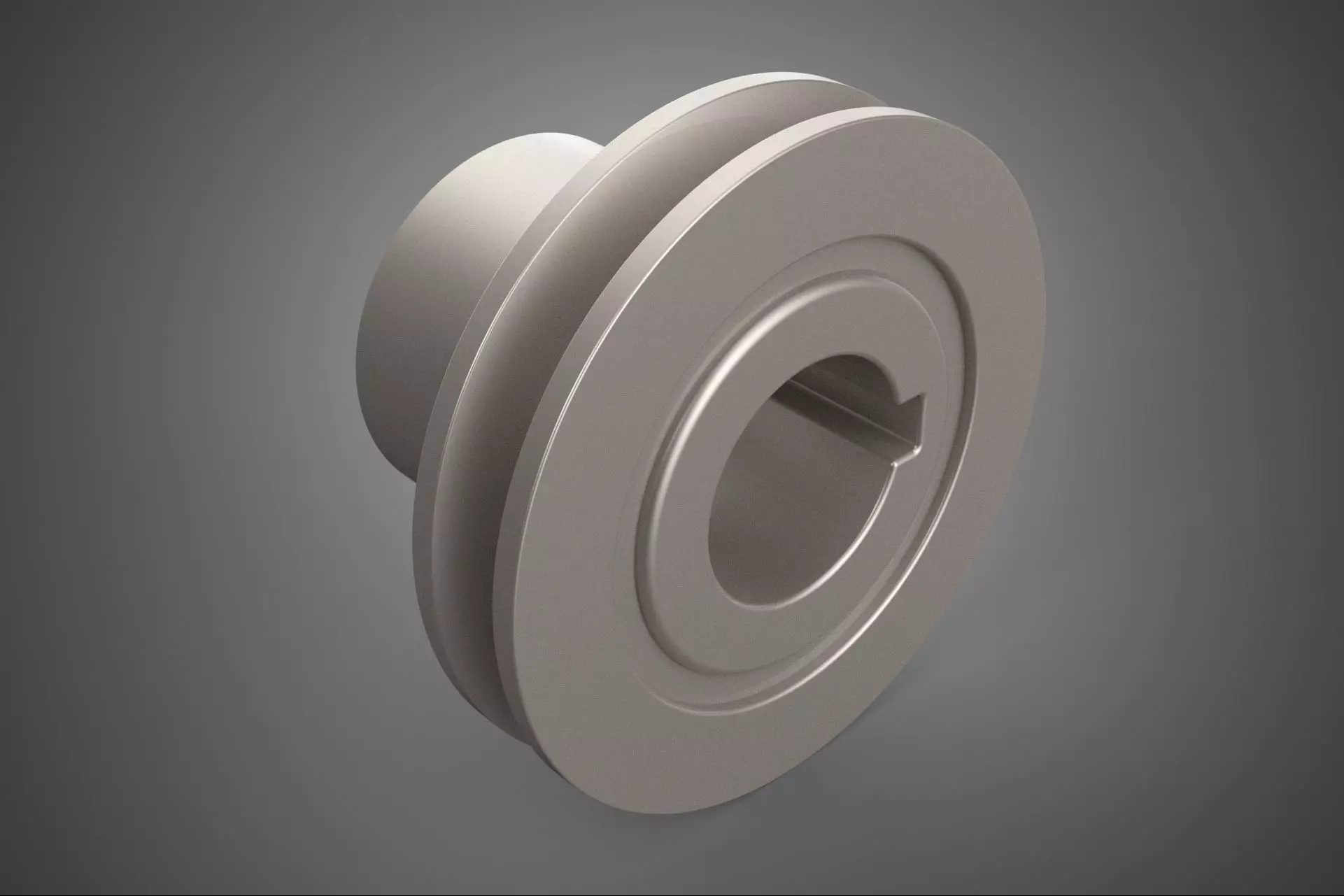
The standard single-groove track pulley, frequently referred to as a sheave wheel, is a fundamental mechanical component integral to power transmission systems utilizing flexible linkages, predominantly belts or cables. This device serves primarily to transmit rotary motion, manage tensile loads, or alter the direction of force in mechanical assemblies.
Nomenclature and Definition
The nomenclature Pulley Sheave Wheel denotes the interchangeable names for the component—a wheel mounted on an axle or shaft designed to support movement and change the direction of a tensioned cable or belt. The defining characteristic is the Single Groove Track, which specifies the geometry: a singular, precisely machined channel located on the rim’s circumference designed to cradle and guide one continuous belt or rope. The term Standard signifies that the component conforms to established industry specifications (such as ISO, DIN, or ANSI standards) relating to critical dimensions like pitch diameter, bore tolerance, keyway sizing, and groove profile, ensuring interchangeability and compatibility across various industrial applications.
The descriptor Belt Gear, while technically less precise than Belt Drive Component, contextualizes its function within a gearing mechanism that uses the ratio of pulley diameters to determine speed and torque ratios between driving and driven shafts.
Structural Characteristics and Geometry
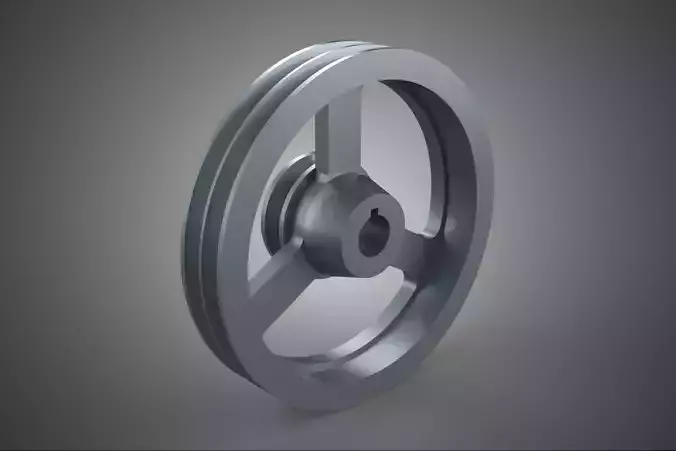
A standard single-groove pulley typically consists of a rim, a hub (or boss), and connecting webbing or spokes. The critical structural element is the groove profile, which must be perfectly matched to the cross-section of the belt utilized.
- V-Groove Profile: The most prevalent design for single-track pulleys in industrial power transmission. The V-shape profile wedges the V-belt against the sidewalls of the groove as tension increases, generating high friction necessary for effective torque transfer and minimizing slippage. Standard dimensions adhere to specific V-belt classes (e.g., 3L, 4L, 5L, or classical A, B, C series).
- Flat or Round Profiles: Less common for singular power transmission but used frequently for cable guidance (sheave wheels) or light-duty lifting operations where ropes or round belts are employed.
- Hub and Bore: The central section contains a bore machined to accept the shaft. This bore is often fitted with a keyway, set screws, or specialized locking mechanisms (e.g., taper-lock bushings) to ensure rotational synchronization and prevent relative movement between the pulley and the shaft.
### Functional Principle and Mechanics
The single-groove pulley functions as the active or passive rotating member in a belt drive system. When torque is applied to the driving pulley, the friction (in V-belt systems) or the positive engagement (in synchronous timing belt systems) transfers kinetic energy to the belt, which, in turn, drives the attached secondary (driven) pulley.
In contrast to multi-groove pulleys, the single-groove configuration is used when the required power capacity can be met by a single belt, prioritizing simplicity and component space efficiency. The efficiency of power transfer is heavily dependent on the proper alignment of the driving and driven pulleys, as misalignment rapidly degrades belt life and mechanical efficiency.
### Materials and Manufacturing
Material selection for standard single-groove pulleys is dictated by speed requirements, environmental factors, and the torque rating.
- Cast Iron (ASTM A48 Class 30): Common for heavy-duty industrial applications requiring high stability, damping characteristics, and durability at moderate speeds.
- Steel (Carbon or Alloy): Used when maximum strength and precision are required, often fabricated through forging or precise machining from bar stock.
- Aluminum Alloys: Preferred for high-speed operation or applications where reduced rotational inertia is critical.
- Engineered Plastics/Composites: Employed in light-duty applications or environments requiring resistance to corrosion or chemical exposure.
Manufacturing processes typically involve casting (for iron and large diameters) or machining (for steel and aluminum). Precision dynamic balancing is often performed, especially for pulleys intended for high-speed operation, to minimize vibration and bearing wear.
### Applications
Standard single-groove pulleys are pervasive components in numerous mechanical and engineering disciplines, including:
- Heating, Ventilation, and Air Conditioning (HVAC) systems.
- Industrial compressors and vacuum pumps.
- Agricultural machinery and small engine drives.
- Conveyor systems and material handling equipment.
- Simple lifting tackle and block and fall assemblies (as sheave wheels).
KEYWORDS: Pulley, Sheave Wheel, Single Groove, V-Belt Drive, Power Transmission, Mechanical Component, Belt Gear, Standardized, Rotary Motion, Cast Iron, Aluminum, Machined, Drive System, Friction Drive, Industrial Machinery, Kinematics, Torque Transfer, Alignment, Component Geometry, Machine Element, Flexible Linkage, Pitch Diameter, Bore, Keyway, Track, Single Track, Single Channel, Constant Speed, Standard Dimensions, Mechanical Advantage.